


Silicon Valley wants to read your mind – here's why you should be worried
Elon Musk's Neuralink is developing a brain implant to connect people’s minds directly to a computer.


Representational image. Image credit: Flow/Shutterstock[/caption]These mind-reading systems could affect our privacy, security, identity, equality and personal safety. Do we really want all that left to companies with philosophies such as that of Facebook’s former mantra, “move fast and break things”?Though they sound futuristic, the technologies needed to make brainwave-reading devices are not that dissimilar to the standard MRI (magnetic resonance imaging) and EEG (electroencephalography) neuroscience tools used in hospitals all over the world. You can already buy a kit to control a drone with your mind, so using one to type out words is, in some ways, not that much of a leap. The advance will likely be due to the use of machine learning to sift through huge quantities of data collected from our brains and find the patterns in neuron activity that link thoughts to specific words.Also Read: Elon Musk's Neuralink wants to insert sensors in human brains to treat brain diseaseA brain implant is likely to take a lot longer to develop, and it’s important to separate out the actual achievements of Neuralink from media hype and promotion. But Neuralink has made simultaneous improvements in materials for electrodes and robot-assisted surgery to implant them, packaging the technology neatly so it can be read via USB.
Discrimination and manipulation
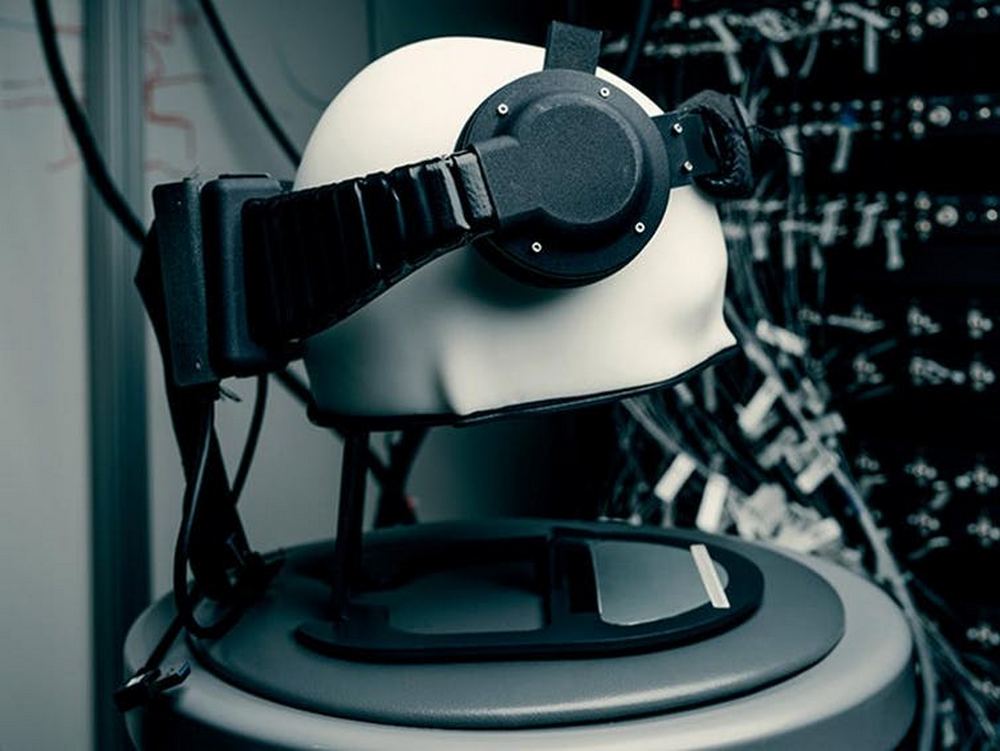 Facebook’s prototype brainwave-reading device. Image credit: Facebook[/caption]If mind-reading devices become the normal way to interact with computers, we may end up with little choice but to use them in order to keep up with more productive colleagues. (Imagine someone today applying for an office job but refusing to use email.) And if Neuralink-style implants become the norm, this could also lead to greater inequality determined by what level of kit you could afford to have installed.Elon Musk has stated that the enormous loan required to afford Neuralink surgery would be offset by potential earnings for the “enhanced”. The idea of people feeling pressured to take on huge debts to have surgery just to keep their job comes straight from a sci-fi dystopia.On top of all this is the more direct physical threat of having systems physically intruding on our brains. While some people may want to modify their brain with a computer interface (there are already plenty of experimental biohackers), to roll this out on a large scale would require massive and thorough testing.Given Silicon Valley’s reputation (and penchant) for breaking things rather than stopping to think them through, these systems will need close regulation and ethical review even before testing begins. Otherwise it risks creating mutilated human guinea pigs.For all this, there could be huge advantages to continuing research in this area, particularly for those suffering from paralysis or sensory impairment. But Silicon Valley should not be able to dictate the way these technologies are developed and deployed. If they do, it may radically reshape the way we identify as human.
 Garfield Benjamin, Postdoctoral Researcher, School of Media Arts and Technology, Solent UniversityThis article is republished from The Conversation under a Creative Commons license. Read the original article.
Why AI notetakers are raising serious privacy and security concerns
China's low-cost AI models are changing the global AI race. Here's why Silicon Valley is worried
China's Kimi K3 challenges US AI leaders with frontier-level performance at lower cost
How did Instagram run ads promoting child abuse in India?
Why has India halted WhatsApp’s username feature before launch?