


Scientists discover method to convert dried leaves into electronics
Scientists used a multi-step, yet simple, process to convert phoenix tree leaves into a form that could be incorporated into electrodes as active materials.

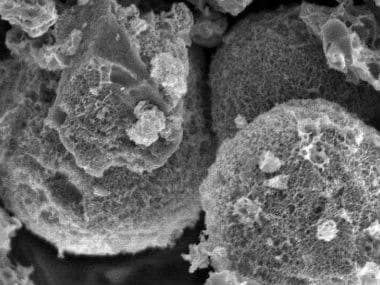
Scanning Electron Microscopy (SEM) image of porous carbon microspheres. Qilu University[/caption]Researchers from Qilu University of Technology in China used a multi-step, yet simple, process to convert phoenix tree leaves into a form that could be incorporated into electrodes as active materials.The dried leaves were first ground into a powder, then heated to 220 degrees Celsius for 12 hours. This produced a powder composed of tiny carbon microspheres.These microspheres were then treated with a solution of potassium hydroxide and heated by increasing the temperature in a series of jumps from 450 to 800degrees Celsius.The chemical treatment corrodes the surface of the carbon microspheres, making them extremely porous. The final product, a black carbon powder, has a very high surface area due to the presence of many tiny pores that have been chemically etched on the surface of the microspheres.These microspheres were then treated with a solution of potassium hydroxide and heated by increasing the temperature in a series of jumps from 450 to 800degrees Celsius.The chemical treatment corrodes the surface of the carbon microspheres, making them extremely porous.The final product, a black carbon powder, has a very high surface area due to the presence of many tiny pores that have been chemically etched on the surface of the microspheres.A capacitor is a widely used electrical component that stores energy by holding a charge on two conductors, separated from each other by an insulator.Supercapacitors can typically store 10-100 times as much energy as an ordinary capacitor, and can accept and deliver charges much faster than a typical rechargeable battery.For these reasons, supercapacitive materials hold great promise for a wide variety of energy storage needs, particularly in computer technology and hybrid or electric vehicles.The supercapacitive properties of the porous carbon microspheres made from phoenix tree leaves are higher than those reported for carbon powders derived from other bio- waste materials, researchers said.The fine scale porous structure seems to be key to this property, since it facilitates contact between electrolyte ions and the surface of the carbon spheres, as well as enhancing ion transfer and diffusion on the carbon surface.

Why AI notetakers are raising serious privacy and security concerns
China's low-cost AI models are changing the global AI race. Here's why Silicon Valley is worried
China's Kimi K3 challenges US AI leaders with frontier-level performance at lower cost
How did Instagram run ads promoting child abuse in India?
Why has India halted WhatsApp’s username feature before launch?