
Advertisement


Sections
Scientists develop Mortimer, a drumming robot designed to study long term human-robot relationships
One group was sent a Facebook friend request from Mortimer allowing the robot to tag them in pictures taken during the session.

Scientists have developed a drumming robot, called Mortimer, who can compose music responsively to human pianists in real-time, and also post pictures of the sessions on Facebook.[caption id="attachment_4270037" align="alignleft" width="380"]![Mortimer. Queen Mary University, London.]() Mortimer. YouTube.[/caption]The research, published in IEEE Transactions on Cognitive and Developmental Systems, looked at how humans interact with robots over time and in particular how social media can enhance that relationship."We'd previously uncovered new and exciting findings that suggested open-ended creative activities could be a strong bedrock to build long-term human-robot relationships," said lead author Louis McCallum from the Queen Mary University of London."This particular research sought to examine whether the relationships that were initially developed face-to-face, but under lab conditions, could be extended to the more open, but virtual, realm of social media," McCallum said.Relationships between humans and robots require both long-term engagement and a feeling of believability towards the robot.The researchers contend that music can provide this engagement and developed the robotic drummer, Mortimer, who is able to compose music responsively to human pianists.To help trigger a sense of believability, the researchers extended Mortimer's capabilities to allow him to take pictures during sessions and post them with a supporting comment to Facebook while also tagging the keyboard player.During the study, two groups of participants were chosen.One group was sent a Facebook friend request from Mortimer allowing the robot to tag them in pictures taken during the session.The other group was not sent a request and had no contact with the robot outside of the sessions.Participants took part in six weekly sessions in a controlled studio environment and were instructed to stay for a minimum of 20 minutes but could optionally stay for up to 45.They were greeted by Mortimer, who communicates via speech synthesis software, and used a tablet to interact with him.From the Facebook data, the researchers found that there were considerably more 'likes' for posts made by a user as opposed to one of Mortimer's posts that the user was tagged in.The researchers found that the time spent with the robot increased over the study but session length for the group who were Facebook friends with Mortimer reduced over time.This may be because the participants had additional contact with Mortimer outside the sessions, the researchers said.
Mortimer. YouTube.[/caption]The research, published in IEEE Transactions on Cognitive and Developmental Systems, looked at how humans interact with robots over time and in particular how social media can enhance that relationship."We'd previously uncovered new and exciting findings that suggested open-ended creative activities could be a strong bedrock to build long-term human-robot relationships," said lead author Louis McCallum from the Queen Mary University of London."This particular research sought to examine whether the relationships that were initially developed face-to-face, but under lab conditions, could be extended to the more open, but virtual, realm of social media," McCallum said.Relationships between humans and robots require both long-term engagement and a feeling of believability towards the robot.The researchers contend that music can provide this engagement and developed the robotic drummer, Mortimer, who is able to compose music responsively to human pianists.To help trigger a sense of believability, the researchers extended Mortimer's capabilities to allow him to take pictures during sessions and post them with a supporting comment to Facebook while also tagging the keyboard player.During the study, two groups of participants were chosen.One group was sent a Facebook friend request from Mortimer allowing the robot to tag them in pictures taken during the session.The other group was not sent a request and had no contact with the robot outside of the sessions.Participants took part in six weekly sessions in a controlled studio environment and were instructed to stay for a minimum of 20 minutes but could optionally stay for up to 45.They were greeted by Mortimer, who communicates via speech synthesis software, and used a tablet to interact with him.From the Facebook data, the researchers found that there were considerably more 'likes' for posts made by a user as opposed to one of Mortimer's posts that the user was tagged in.The researchers found that the time spent with the robot increased over the study but session length for the group who were Facebook friends with Mortimer reduced over time.This may be because the participants had additional contact with Mortimer outside the sessions, the researchers said.
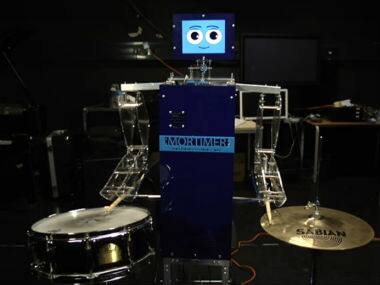 Mortimer. YouTube.[/caption]The research, published in IEEE Transactions on Cognitive and Developmental Systems, looked at how humans interact with robots over time and in particular how social media can enhance that relationship."We'd previously uncovered new and exciting findings that suggested open-ended creative activities could be a strong bedrock to build long-term human-robot relationships," said lead author Louis McCallum from the Queen Mary University of London."This particular research sought to examine whether the relationships that were initially developed face-to-face, but under lab conditions, could be extended to the more open, but virtual, realm of social media," McCallum said.Relationships between humans and robots require both long-term engagement and a feeling of believability towards the robot.The researchers contend that music can provide this engagement and developed the robotic drummer, Mortimer, who is able to compose music responsively to human pianists.To help trigger a sense of believability, the researchers extended Mortimer's capabilities to allow him to take pictures during sessions and post them with a supporting comment to Facebook while also tagging the keyboard player.During the study, two groups of participants were chosen.One group was sent a Facebook friend request from Mortimer allowing the robot to tag them in pictures taken during the session.
First Published:Dec 21, 2017, 22:01:55 IST
Advertisement
Advertisement

Why AI notetakers are raising serious privacy and security concerns
AI notetakers promise effortless meeting summaries, but experts warn they could expose confidential conversations, corporate secrets and personal voiceprints. As businesses increasingly adopt AI-powered meeting assistants, questions over data storage, privacy, consent and legal risks are becoming impossible to ignore
5 min read
China's low-cost AI models are changing the global AI race. Here's why Silicon Valley is worried
As Chinese firms continue to improve performance while keeping prices low, the AI race is no longer just about building the smartest model—it is increasingly becoming a battle over who can deliver the best value
2 min read
China's Kimi K3 challenges US AI leaders with frontier-level performance at lower cost
Chinese artificial intelligence startup Moonshot AI has unveiled its latest open-weight AI model, Kimi K3, with early results suggesting it could compete with some of the world's most advanced AI systems developed by leading US companies
2 min read
How did Instagram run ads promoting child abuse in India?
India has issued a notice to Meta after an investigation alleged that Instagram displayed paid advertisements promoting child sexual abuse material. MeitY ordered Meta to remove such Instagram ads and explain within seven days how they were approved
8 min read
Why has India halted WhatsApp’s username feature before launch?
India has halted WhatsApp’s planned username feature, citing concerns about cybercrime, impersonation, and law enforcement challenges. As Meta races to address security concerns, here’s why MeitY has paused the rollout, what the feature does, and how it could influence privacy and online safety in India
3 min read
Advertisement
Advertisement