


San Francisco Police can now kill high-risk suspects using robots
The San Francisco Police Department will now strap bomb disposal robots with explosives and try to kill high-risk suspects by detonating these robots near them.

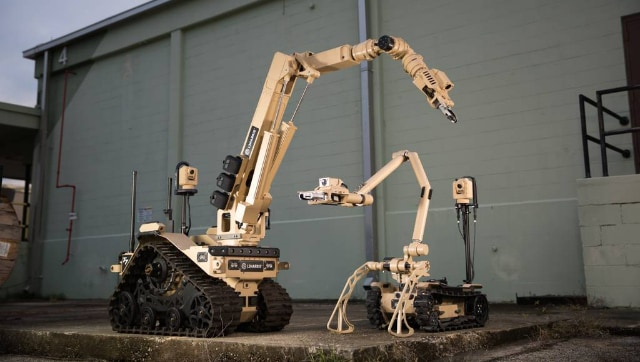
The San Francisco Police Department will now strap bomb disposal robots with explosives and try to kill high-risk suspects by detonating these robots near them. Image Credit: AFP[/caption]As per local reports, the killer robot will be controlled by a handler using a remote, and that it would not have any autonomous features. Moreover, the robot will be loaded with explosives, instead of firearms, which will be used to kill or incapacitate suspects.Police forces in America have often been accused of being militaristic. Many towns and cities across the US are actually more heavily armed than many armed forces representing some countries - several police departments have their own battle tanks and other combat vehicles that have no place among civilians.This pandora’s box of using robots as an explosive delivery device was originally opened by the Dallas Police Department. In 2016, after failed negotiations with a holed-up active shooter, the DPD wired up a disposal robot with explosives, drove it up to the suspect, and detonated it, killing the shooter.As for the San Francisco City Police Department’s claim of not arming the robots with firearms is concerned, it isn’t entirely true. A local report from the city said that The SFPD has 17 robots in total, 12 of which are currently functioning. Most of the robots that are used for clearing bombs, have the ability to shoot shotgun shells at the bombs - so basically, these robots that will be used to kill high-risk suspects, already has lethal guns.Moreover, the robots that are used by most police departments for bomb disposal, which will be repurposed to blow up suspects, come from the same robot makers who supply the US army. In fact, they essentially are the same robot. Only the load-outs are different. Moreover, the robots used by the US army, do have some autonomous features.

Why AI notetakers are raising serious privacy and security concerns
China's low-cost AI models are changing the global AI race. Here's why Silicon Valley is worried
China's Kimi K3 challenges US AI leaders with frontier-level performance at lower cost
How did Instagram run ads promoting child abuse in India?
Why has India halted WhatsApp’s username feature before launch?