


Samsung Galaxy Gear smartwatch? No thanks, I'll stick to my Pebble
Although I am intrigued by the Toq, I'd stick to my Pebble for now.

By Abhimanyu Tewari
In the mid-nineties there was a craze for Chinese talking watches among school kids. These were cheap plastic concoctions with two round buttons on the base. Press one and a shrill melodious woman's voice would shout out the time complete with am and pm.Just like the talking watches of old, the new wave of smartwatches also succeed on novelty. There is something fresh and new that these devices offer as they reinvent the plain, simple and unimpressive watch.
I have been a Pebble user for the last six months now, and am greatly fond of my Pebble device. Although it looks clunky and plasticky, what the watch lacks in aesthetics it makes up for in sturdiness. In the last five months the watch has been dropped, scraped, stepped on and has even survived one very vicious attack from my puppy.
 More from News Analysis
In terms of specifications the Pebble has in its arsenal a 1.26 inch 144 X 168 pixel black and white-ultra low-power memory LCD. The display is sharp and crisp, its easy to read even in sunlight and the lack of a colour display brings with it a degree of soberness that I'm happy the people at Pebble borrowed from the original watch. It helps portray the product as subtle and understated.
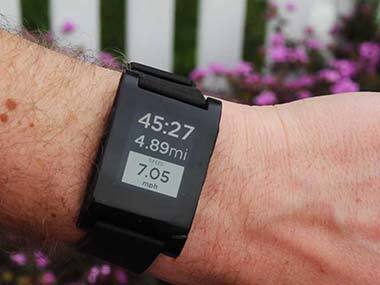
Image from Pebble website.[/caption]
The best thing about the watch however, is the promise of unending possibilities. With apps and updates flowing in, it is refreshing to be able to reinvent your watch from time to time, from appearance to functionality. It generates new excitement about an otherwise quintessential but mundane device.
In terms of functionality, the Pebble scores big again. It allows the user to acknowledge or reject a call from the watch itself, without having to dig your phone out of your pocket. It also allows you to stay connected even if your phone is charging in the next room.
With the launch of the Galaxy Gear and the Sony SmartWatch 2 and the Qualcomm Toq however, the question now is do I ditch the Pebble for a younger more vibrant (or so they state) competitor. Well to decide that lets do a quick round up of the competition.
Of the four watches being compared, only the Pebble has a monochrome display while the other three all sport -coloured displays. The Galaxy Gear has a 1.63 inch super AMOLED color touch screen, the Sony smartwatch 2 comes with a 1.6 inch touch screen, and the Toq has an e-ink style colour Mirasol display. Of all these, the Toq display seems closest to the e-ink display the pebble uses, but details on the device are sketchy.
There is no doubt that both the Samsung device as well as the Sony device will support high resolution display, but I think the Pebble's monochrome display is much classier. Also the higher display will mean bad battery life and I already have my hands full trying to keep my cell battery from dying at the end of the day, so I don't really want to have to start worrying about my watch battery as well.
On the battery front my Pebble gives me around 7-8 days of battery backup if I'm careful enough to switch to airplane mode at night. The Samsung device is supposed to have a battery life of 18- 20 hours but then having used a Note II before purchasing my Nexus 4, I don't really much have faith in Samsung's battery life claims.
The Sony and the Qualcomm numbers are not confirmed yet but both companies are touting that its watch will have 2-3 days of battery backup. This for me is a big deal breaker. As a heavy user of my mobile phone, I know the quiet desperation that grips me once my cell battery begins to fade towards evening. As a consequence I now have portable chargers in my car and office. It's the curse of the modern age that the more connected I get the more deadly the idea of my battery failing is. The Pebble with its simplistic approach allows me a degree of security in this regard.
In conclusion, though I must admit I am intrigued by the Toq smartwatch. For now, I'd stick to my Pebble.

Why AI notetakers are raising serious privacy and security concerns
China's low-cost AI models are changing the global AI race. Here's why Silicon Valley is worried
China's Kimi K3 challenges US AI leaders with frontier-level performance at lower cost
How did Instagram run ads promoting child abuse in India?
Why has India halted WhatsApp’s username feature before launch?