


Russia's Soyuz capsule with three astronauts on board docks with space station
An international trio blasted off today on top of a Russian Soyuz rocket for the International Space Station with a busy schedule full of space walks and a docking with a pioneering US cargo craft.

Moscow: A Soyuz capsule carrying an American, Russian and Italian successfully docked Wednesday with the International Space Station, where the new crew will spend six months conducting a variety of experiments.
The docking took place at 8:10 am (0210 GMT, 10:10 pm EDT) less than six hours after the Russian spacecraft lifted off from the Baikonur Cosmodrome, which Russia leases in Kazakhstan.
Live footage provided by NASA TV showed it soaring into the clear night sky. About four minutes later, the announcer said the Soyuz was traveling at 4,700 miles per hour (about 7,500 kilometers per hour).
The cramped capsule carrying NASA's Karen Nyberg, Russian cosmonaut Fyodor Yurchikhin and Italy's Luca Parmitano orbited the Earth four times before docking with the space station.
 More from News Analysis
[caption id="attachment_824097" align="alignleft" width="380"]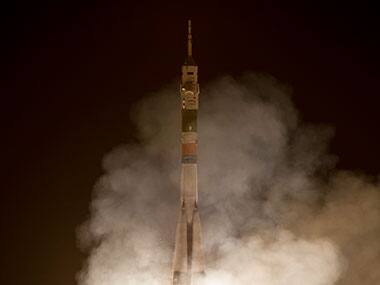 A Soyuz rocket carrying Expedition 36/37 Soyuz Commander Fyodor Yurchikhin, Flight Engineers: Luca Parmitano, and Karen Nyberg , launches from the Baikonur Cosmodrome in Kazakhstan to the International Space Station. AP[/caption]
Once the hatches open, they will join NASA's Chris Cassidy and Russians Pavel Vinogradov and Alexander Misurkin who have been aboard the space station since late March.
Yurchikhin, 54, is a veteran of three previous spaceflights, while the 36-year-old Parmitano, a former test pilot, is making his first trip into space. Nyberg, 43, spent two weeks in space in 2008 as part of a U.S. space shuttle crew.
Four spacewalks are planned during the expedition, including what NASA said would be the first by an Italian.
The International Space Station is the biggest orbiting outpost ever built and can sometimes be seen from Earth with the naked eye. It consists of more than a dozen modules built by the United States, Russia, Canada, Japan and the European Space Agency.
Associated Press

Why AI notetakers are raising serious privacy and security concerns
China's low-cost AI models are changing the global AI race. Here's why Silicon Valley is worried
China's Kimi K3 challenges US AI leaders with frontier-level performance at lower cost
How did Instagram run ads promoting child abuse in India?
Why has India halted WhatsApp’s username feature before launch?