


Researchers from Michigan create a computer that's smaller than a grain of rice
The world's smallest computer measure just 0.3 mm to a side, completely dwarfed by a grain of rice.

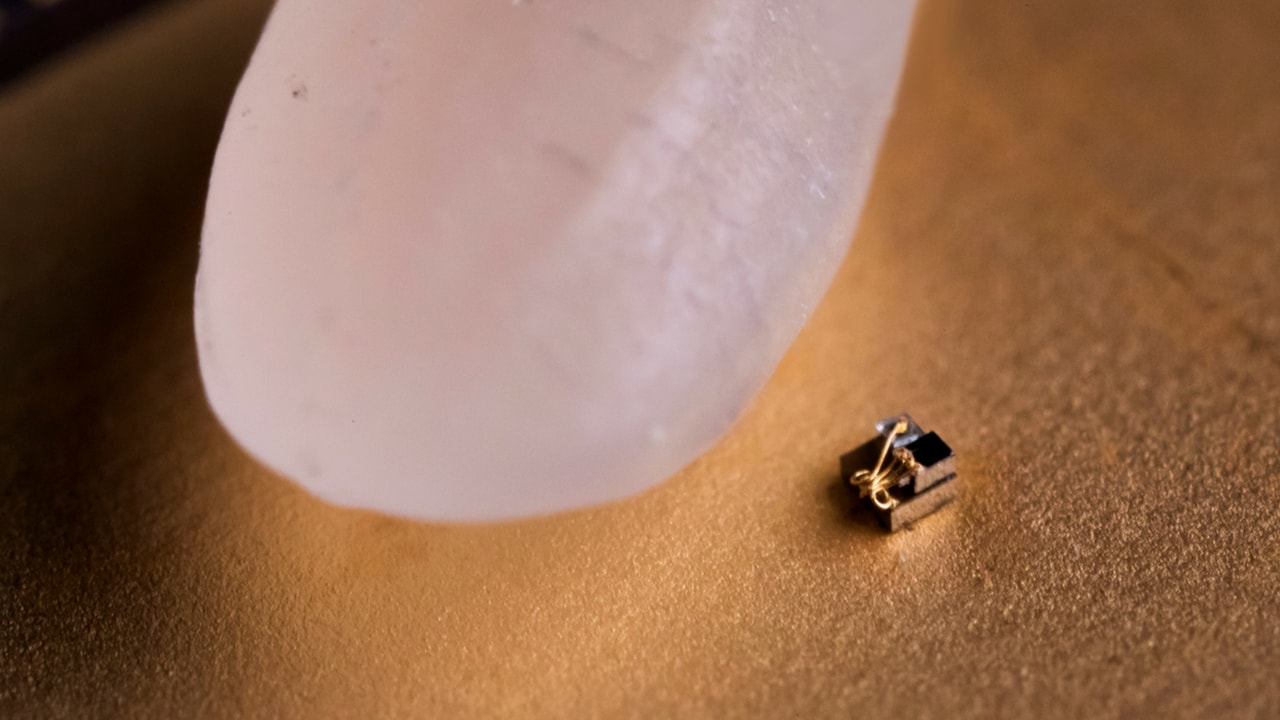
The computer measures just 0.3 mm dwarfed by a grain of rice. Image: University of Michigan News[/caption]In addition to the RAM and photovoltaics, the new micro-computing device – Michigan Micro Mote – has processors and wireless transmitters and receivers.As the Motes are too small to have conventional radio antennae, they receive and transmit data with visible light. A base station provides light for power and programming, and it receives the data.Designed as a precision temperature sensor, the new device converts temperatures into time intervals, defined with electronic pulses. The intervals are measured on-chip against a steady time interval sent by the base station and then converted into a temperature.As a result, the computer can report temperatures in minuscule regions, such as a cluster of cells, with an error of about 0.1 degree Celsius.The system is very flexible and could be reimagined for a variety of purposes.The device can help in oncology research. "Since the temperature sensor is small and biocompatible, we can implant it into a mouse where cancer cells are growing," said Gary Luker, a UM professor of radiology and biomedical engineering."We are using this temperature sensor to investigate variations in temperature within a tumour versus normal tissue and if we can use changes in temperature to determine success or failure of therapy."The study was presented on Thursday at the 2018 Symposia on VLSI Technology and Circuits.

Why AI notetakers are raising serious privacy and security concerns
China's low-cost AI models are changing the global AI race. Here's why Silicon Valley is worried
China's Kimi K3 challenges US AI leaders with frontier-level performance at lower cost
How did Instagram run ads promoting child abuse in India?
Why has India halted WhatsApp’s username feature before launch?