
Advertisement


Sections
Researchers create robotic ankle support to help stroke patients walk more easily
Researchers develop a soft robotic ankle-support system weighing 0.9 kg, roughly twice as heavy as a soccer ball, to be worn on one side of the body.

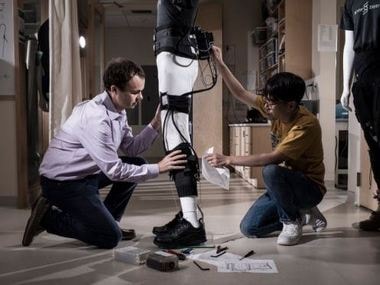 Image Courtesy: Harvard.edu[/caption]"In about 80 per cent of patients post-stroke, it is typical that one limb loses its ability to function normally - a clinical phenomenon called hemiparesis," Xinhua cited the study published in the US journal Science Translational Medicine."And even patients who recover walking mobility during rehabilitation retain abnormalities in their gait that hinder them from participating in many activities, pose risks of falls and since they impose a more sedentary lifestyle, can lead to secondary health problems," it said.To help stroke patients regain their walking abilities, various robotics groups from industry and academia are developing powered wearable devices known as exoskeletons, but most of which are rigid, bulky products that are impractical for people to wear during everyday activities."This study provides a glimpse of a new future where much of patient care will be carried out at home with the help of human-friendly robots, which look nothing like the robots we see in television and movies," Wyss Institute Founding Director Donald Ingber, who was not involved in the study, said.
In search of a better alternative, researchers at Harvard University's Wyss Institute for Biologically Inspired Engineering and Boston University's College of Health & Rehabilitation Sciences developed a soft robotic ankle-support system weighing 0.9 kg, roughly twice as heavy as a soccer ball, to be worn on one side of the body.[caption id="attachment_3860707" align="alignnone" width="825"]
 Harvard.edu[/caption]Their system consists of a close-fitting waist belt and leg straps connected to a calf sleeve where small robotic actuators exerted force on a shoe insole to provide forward propulsion and correct problems with ankle dorsiflexion, commonly referred to as "drop foot," which affects roughly 20 percent of stroke survivors.The team was now looking to further personalise its system to specific gait abnormalities, investigate assistance at other joints such as the hip and knee and assess longer-term therapeutic effects of their technology.
First Published:Jul 27, 2017, 09:47:02 IST
Advertisement
Advertisement

Why AI notetakers are raising serious privacy and security concerns
AI notetakers promise effortless meeting summaries, but experts warn they could expose confidential conversations, corporate secrets and personal voiceprints. As businesses increasingly adopt AI-powered meeting assistants, questions over data storage, privacy, consent and legal risks are becoming impossible to ignore
5 min read
China's low-cost AI models are changing the global AI race. Here's why Silicon Valley is worried
As Chinese firms continue to improve performance while keeping prices low, the AI race is no longer just about building the smartest model—it is increasingly becoming a battle over who can deliver the best value
2 min read
China's Kimi K3 challenges US AI leaders with frontier-level performance at lower cost
Chinese artificial intelligence startup Moonshot AI has unveiled its latest open-weight AI model, Kimi K3, with early results suggesting it could compete with some of the world's most advanced AI systems developed by leading US companies
2 min read
How did Instagram run ads promoting child abuse in India?
India has issued a notice to Meta after an investigation alleged that Instagram displayed paid advertisements promoting child sexual abuse material. MeitY ordered Meta to remove such Instagram ads and explain within seven days how they were approved
8 min read
Why has India halted WhatsApp’s username feature before launch?
India has halted WhatsApp’s planned username feature, citing concerns about cybercrime, impersonation, and law enforcement challenges. As Meta races to address security concerns, here’s why MeitY has paused the rollout, what the feature does, and how it could influence privacy and online safety in India
3 min read
Advertisement
Advertisement