


Radioactive nanoparticles to kill cancer cells
The scientists covered the lutetium nanoparticles with gold shells and attached targeting agents.

Washington: Scientists have successfully created radioactive nanoparticles that hunt down lymphoma tumour cells wherever they may be in the body.
Researchers at the University of Missouri have created nanoparticles made of a radioactive form of the element lutetium.[caption id="attachment_805109" align="alignleft" width="380"]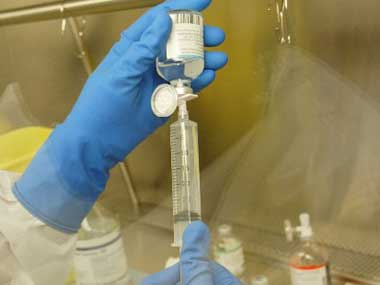
Fighting cancer. AFP[/caption]
Michael Lewis, an associate professor of oncology in the MU College of Veterinary Medicine, said being able to target secondary tumours is vital to successfully treating patients with progressive cancers.
"Depending on the type of cancer, primary tumours usually are not the cause of death for cancer patients," Lewis said.
"If a cancer metastasises, or spreads creating hard-to-find tumours, it often becomes fatal. Having a way to identify and shrink these secondary tumours is of utmost importance when fighting to save people with these diseases," Lewis said.
 More from News Analysis
The scientists covered the lutetium nanoparticles with gold shells and attached targeting agents.
In previous research, Lewis has already proven the effectiveness of similar targeting agents in mice and dogs suffering from tumours.
In that research, the targeting agents were attached to single radioactive atoms that were introduced into the bodies of animals with cancer.
The targeting agents were able to seek out the tumours existing within the animals, which were then revealed through radio-imaging of those animals.
In the current study, researchers showed that the targeting agents can deliver the new radioactive lutetium nanoparticles to lymphoma tumour cells without attaching to and damaging healthy cells in the process.
J David Robertson, director of research at the MU Research Reactor and professor of chemistry in the College of Arts and Science, said this is an important step toward developing therapies for lymphoma and other advanced-stage cancers.
"The ability to deliver multiple radioactive atoms to individual cancer cells should greatly increase our ability to selectively kill these cells," Robertson said.
PTI

Why AI notetakers are raising serious privacy and security concerns
China's low-cost AI models are changing the global AI race. Here's why Silicon Valley is worried
China's Kimi K3 challenges US AI leaders with frontier-level performance at lower cost
How did Instagram run ads promoting child abuse in India?
Why has India halted WhatsApp’s username feature before launch?