
Advertisement


Sections
Qualcomm Snapdragon 855 highlights: Portrait mode in video, huge AI and performance gains
As far as performance is concerned, expect massive gains over the previous Snapdragon 845.

Great design is one thing, but without an intelligent core, a smartphone is little more than a metal and glass paperweight. That intelligent core is the chipset, and one of the best chipset makers in the world is Qualcomm. And today, Qualcomm took the wraps off their latest and greatest smartphone chipset, the Snapdragon 855 Mobile Platform.While the chip was announced on 4 December, what little was revealed was little more than an unsatisfactory teaser. Today, we finally have the full details. Here goes:Performance gains: MassiveAs far as performance is concerned, expect massive gains over the previous Snapdragon 845. As Qualcomm themselves note, this is the biggest generational leap in performance in Qualcomm’s history.[caption id="attachment_5680721" align="alignnone" width="1024"]![An overview of the Qualcomm Snapdragon 855 mobile platform]() An overview of the Qualcomm Snapdragon 855 mobile platform[/caption]According to Qualcomm, the chip will be 45 percent faster in the CPU department, feature a 20 percent faster GPU, a new DSP (digital signal processor) for 3x faster AI performance and huge improvements to the camera department.Part of this performance gain comes from tweaks to the chip architecture and the shift to a more efficient 7 nm manufacturing process of course, but we’re also seeing a fundamental shift to the design of the CPU.For a long time now, Qualcomm and most other manufactures have opted for a big.LITTLE architecture. This architecture basically involves “big” high performance cores and “LITTLE” high efficiency cores. The new design now features an extremely fast ‘Prime core’, 3x performance cores and 4x efficiency cores. This new design, and the inclusion of a Prime core in particular, are intended to speed up tasks such as opening apps and other single-threaded applications.[caption id="attachment_5681061" align="alignnone" width="1280"]
An overview of the Qualcomm Snapdragon 855 mobile platform[/caption]According to Qualcomm, the chip will be 45 percent faster in the CPU department, feature a 20 percent faster GPU, a new DSP (digital signal processor) for 3x faster AI performance and huge improvements to the camera department.Part of this performance gain comes from tweaks to the chip architecture and the shift to a more efficient 7 nm manufacturing process of course, but we’re also seeing a fundamental shift to the design of the CPU.For a long time now, Qualcomm and most other manufactures have opted for a big.LITTLE architecture. This architecture basically involves “big” high performance cores and “LITTLE” high efficiency cores. The new design now features an extremely fast ‘Prime core’, 3x performance cores and 4x efficiency cores. This new design, and the inclusion of a Prime core in particular, are intended to speed up tasks such as opening apps and other single-threaded applications.[caption id="attachment_5681061" align="alignnone" width="1280"]![Snapdragon 855 details.]() Snapdragon 855 details.[/caption]The main focus, however, is on ensuring that the chip is able to deliver sustained performance to the user. Most chipsets, especially on mobile devices, tend to deliver a very high level of performance for several seconds only. This is bad for tasks such as gaming, where performance is required for a longer duration. AI: 4th generation hardwareOne thing that Qualcomm keeps insisting on highlighting is that its AI hardware is now in its 4th generation, and with good reason. While competitors tend to highlight the inclusion of features like “AI cores”, it’s worth noting that Qualcomm’s chips have indeed supported AI tasks for a long time, it’s just that they haven’t specifically assigned or described a part of their chip as an AI core. As pointed out by Qualcomm’s engineers, the Snapdragon platform assigns processing tasks to whichever core is free and/or best suited to the task at hand (including the CPU and GPU).If anything can be called an AI core, it has to be the Hexagon DSP, which now features a dedicated tensor processing unit that vastly accelerates AI tasks. According to Qualcomm, the current chip is 3x faster than the 845 at AI tasks, and 2x faster than the nearest competition in Android land. The new chip also integrates a computer vision image signal processor (CV-ISP), a first for a mobile platform. This core essentially enables features like real-time bokeh in videos, real-time and on-device text translation and more.[caption id="attachment_5681071" align="alignnone" width="1280"]
Snapdragon 855 details.[/caption]The main focus, however, is on ensuring that the chip is able to deliver sustained performance to the user. Most chipsets, especially on mobile devices, tend to deliver a very high level of performance for several seconds only. This is bad for tasks such as gaming, where performance is required for a longer duration. AI: 4th generation hardwareOne thing that Qualcomm keeps insisting on highlighting is that its AI hardware is now in its 4th generation, and with good reason. While competitors tend to highlight the inclusion of features like “AI cores”, it’s worth noting that Qualcomm’s chips have indeed supported AI tasks for a long time, it’s just that they haven’t specifically assigned or described a part of their chip as an AI core. As pointed out by Qualcomm’s engineers, the Snapdragon platform assigns processing tasks to whichever core is free and/or best suited to the task at hand (including the CPU and GPU).If anything can be called an AI core, it has to be the Hexagon DSP, which now features a dedicated tensor processing unit that vastly accelerates AI tasks. According to Qualcomm, the current chip is 3x faster than the 845 at AI tasks, and 2x faster than the nearest competition in Android land. The new chip also integrates a computer vision image signal processor (CV-ISP), a first for a mobile platform. This core essentially enables features like real-time bokeh in videos, real-time and on-device text translation and more.[caption id="attachment_5681071" align="alignnone" width="1280"]![Snapdragon 855 brings 5G.]() Snapdragon 855 brings 5G.[/caption]Together with the CV-ISP and overall improvements to performance, the 855 essentially ensures that the bulk of essential AI processing tasks happen on device and not on the cloud, making for a much faster, more immersive and convenient experience. Qualcomm has also worked with Google and other companies to fine-tune and optimise AI performance.Cameras: Portrait mode comes to videoIt’s in the camera department that users are likely to notice the biggest improvements. The faster GPU, Spectra ISP (image signal processor) and powerful Hexagon DSP work with the camera to introduce some incredible new features, including the computational photography features that Google introduced with its Pixel line of smartphones. Features equivalent to night sight and Google’s HDR+ are now supported by default (Google uses a dedicated chip for this), but additional features like real-time bokeh in 4K HDR video are also included. Better yet, the background in videos can be replaced in real-timeLike Apple’s chips, the 855 now finally adds support for HEVC and HEIF video and image formats. Without delving too deep, think of HEIF and HEVC as next generation image and video formats that can store a lot more data in very little space. As a result, images will take up less space but also store a whole lot more information. The new formats and other improvements mean that capturing images and video is also a lot more efficient and less of a drain on the battery.Entertainment: Enabling next-gen experiencesForget 4K video. The 855 offers full support for HDR10+, HDR, Dolby Vision, 8K 460 video, AptX codecs (high quality wireless audio), true wireless audio (for truly wireless earbuds) and too many other features to fully list out.There’s now added support for native H.265 and VPN codecs, which is a geeky way of saying video playback is now much less of a strain on the battery.Connectivity: Welcome to a gigabit worldBy far the biggest feature of the Snapdragon 855 is support for gigabit wireless connectivity. 4G connectivity is now faster and more efficient, and also supports 2 Gbps speeds. Support for 5G, via the brand new X50 modem, means that we’re now looking at cellular speeds in excess of 10 Gbps. But that’s not all, the new chip also supports Wi-Fi 6 and 802.11 ay standards, which means that with the right hardware, you can get 10 Gbps speeds even on your home WiFi. Just as a point of comparison, most LAN cables aren’t as fast, and even PCs don’t support such speeds without additional, expensive, add-on cards.Support for 5G also means that the average network performance will also be better. The applications for such tech is tremendous, but we still need to wait for the rollout of 5G and supporting network infrastructure.Disclaimer: The correspondent was invited by Qualcomm India for the Snapdragon Summit at Hawaii, USA. All travel and accommodation expenses were taken care of by Qualcomm.
Snapdragon 855 brings 5G.[/caption]Together with the CV-ISP and overall improvements to performance, the 855 essentially ensures that the bulk of essential AI processing tasks happen on device and not on the cloud, making for a much faster, more immersive and convenient experience. Qualcomm has also worked with Google and other companies to fine-tune and optimise AI performance.Cameras: Portrait mode comes to videoIt’s in the camera department that users are likely to notice the biggest improvements. The faster GPU, Spectra ISP (image signal processor) and powerful Hexagon DSP work with the camera to introduce some incredible new features, including the computational photography features that Google introduced with its Pixel line of smartphones. Features equivalent to night sight and Google’s HDR+ are now supported by default (Google uses a dedicated chip for this), but additional features like real-time bokeh in 4K HDR video are also included. Better yet, the background in videos can be replaced in real-timeLike Apple’s chips, the 855 now finally adds support for HEVC and HEIF video and image formats. Without delving too deep, think of HEIF and HEVC as next generation image and video formats that can store a lot more data in very little space. As a result, images will take up less space but also store a whole lot more information. The new formats and other improvements mean that capturing images and video is also a lot more efficient and less of a drain on the battery.Entertainment: Enabling next-gen experiencesForget 4K video. The 855 offers full support for HDR10+, HDR, Dolby Vision, 8K 460 video, AptX codecs (high quality wireless audio), true wireless audio (for truly wireless earbuds) and too many other features to fully list out.There’s now added support for native H.265 and VPN codecs, which is a geeky way of saying video playback is now much less of a strain on the battery.Connectivity: Welcome to a gigabit worldBy far the biggest feature of the Snapdragon 855 is support for gigabit wireless connectivity. 4G connectivity is now faster and more efficient, and also supports 2 Gbps speeds. Support for 5G, via the brand new X50 modem, means that we’re now looking at cellular speeds in excess of 10 Gbps. But that’s not all, the new chip also supports Wi-Fi 6 and 802.11 ay standards, which means that with the right hardware, you can get 10 Gbps speeds even on your home WiFi. Just as a point of comparison, most LAN cables aren’t as fast, and even PCs don’t support such speeds without additional, expensive, add-on cards.Support for 5G also means that the average network performance will also be better. The applications for such tech is tremendous, but we still need to wait for the rollout of 5G and supporting network infrastructure.Disclaimer: The correspondent was invited by Qualcomm India for the Snapdragon Summit at Hawaii, USA. All travel and accommodation expenses were taken care of by Qualcomm.
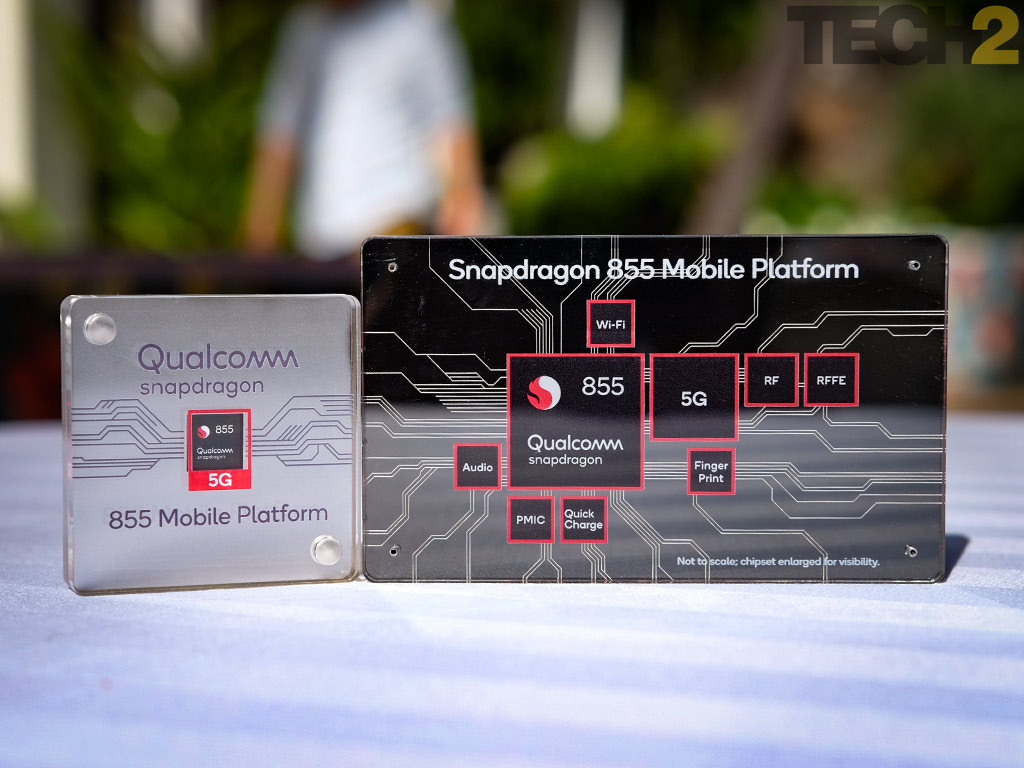 An overview of the Qualcomm Snapdragon 855 mobile platform[/caption]According to Qualcomm, the chip will be 45 percent faster in the CPU department, feature a 20 percent faster GPU, a new DSP (digital signal processor) for 3x faster AI performance and huge improvements to the camera department.Part of this performance gain comes from tweaks to the chip architecture and the shift to a more efficient 7 nm manufacturing process of course, but we’re also seeing a fundamental shift to the design of the CPU.For a long time now, Qualcomm and most other manufactures have opted for a big.LITTLE architecture. This architecture basically involves “big” high performance cores and “LITTLE” high efficiency cores. The new design now features an extremely fast ‘Prime core’, 3x performance cores and 4x efficiency cores. This new design, and the inclusion of a Prime core in particular, are intended to speed up tasks such as opening apps and other single-threaded applications.[caption id="attachment_5681061" align="alignnone" width="1280"]
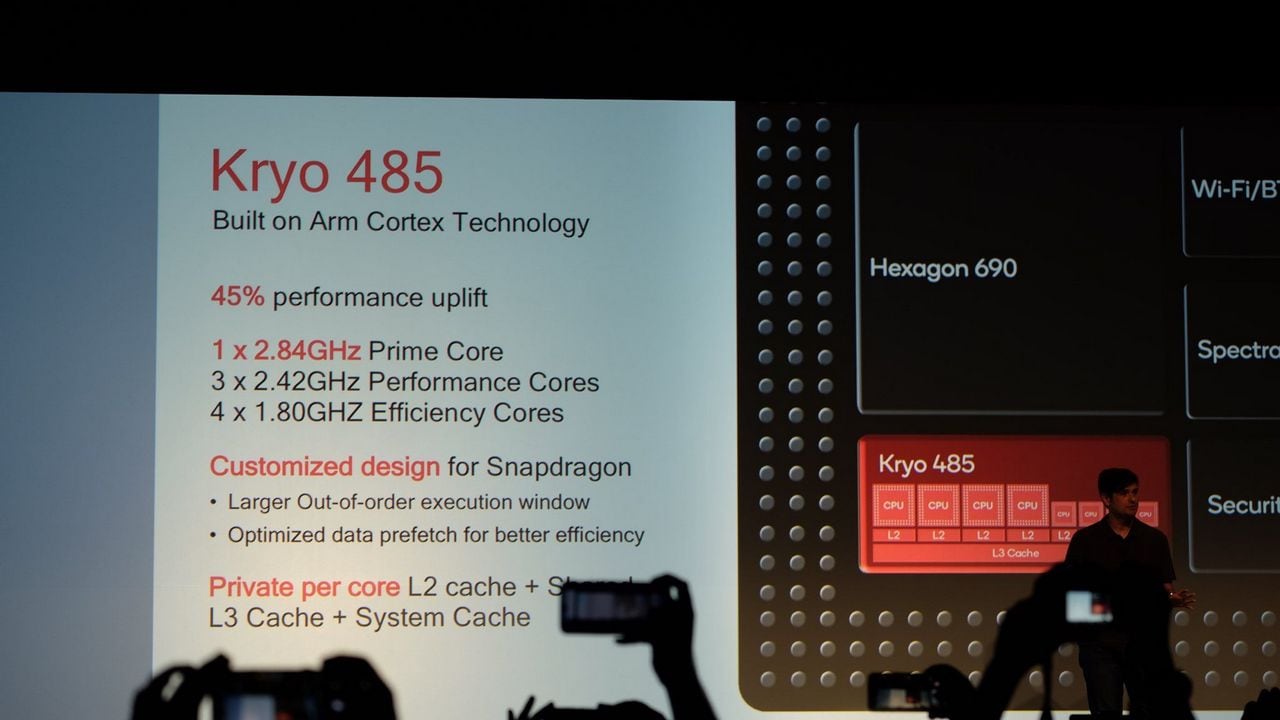 Snapdragon 855 details.[/caption]The main focus, however, is on ensuring that the chip is able to deliver sustained performance to the user. Most chipsets, especially on mobile devices, tend to deliver a very high level of performance for several seconds only. This is bad for tasks such as gaming, where performance is required for a longer duration. AI: 4th generation hardwareOne thing that Qualcomm keeps insisting on highlighting is that its AI hardware is now in its 4th generation, and with good reason. While competitors tend to highlight the inclusion of features like “AI cores”, it’s worth noting that Qualcomm’s chips have indeed supported AI tasks for a long time, it’s just that they haven’t specifically assigned or described a part of their chip as an AI core. As pointed out by Qualcomm’s engineers, the Snapdragon platform assigns processing tasks to whichever core is free and/or best suited to the task at hand (including the CPU and GPU).If anything can be called an AI core, it has to be the Hexagon DSP, which now features a dedicated tensor processing unit that vastly accelerates AI tasks. According to Qualcomm, the current chip is 3x faster than the 845 at AI tasks, and 2x faster than the nearest competition in Android land. The new chip also integrates a computer vision image signal processor (CV-ISP), a first for a mobile platform. This core essentially enables features like real-time bokeh in videos, real-time and on-device text translation and more.[caption id="attachment_5681071" align="alignnone" width="1280"]
 Snapdragon 855 brings 5G.[/caption]Together with the CV-ISP and overall improvements to performance, the 855 essentially ensures that the bulk of essential AI processing tasks happen on device and not on the cloud, making for a much faster, more immersive and convenient experience. Qualcomm has also worked with Google and other companies to fine-tune and optimise AI performance.Cameras: Portrait mode comes to videoIt’s in the camera department that users are likely to notice the biggest improvements. The faster GPU, Spectra ISP (image signal processor) and powerful Hexagon DSP work with the camera to introduce some incredible new features, including the computational photography features that Google introduced with its Pixel line of smartphones. Features equivalent to night sight and Google’s HDR+ are now supported by default (Google uses a dedicated chip for this), but additional features like real-time bokeh in 4K HDR video are also included. Better yet, the background in videos can be replaced in real-timeLike Apple’s chips, the 855 now finally adds support for HEVC and HEIF video and image formats. Without delving too deep, think of HEIF and HEVC as next generation image and video formats that can store a lot more data in very little space. As a result, images will take up less space but also store a whole lot more information. The new formats and other improvements mean that capturing images and video is also a lot more efficient and less of a drain on the battery.Entertainment: Enabling next-gen experiencesForget 4K video. The 855 offers full support for HDR10+, HDR, Dolby Vision, 8K 460 video, AptX codecs (high quality wireless audio), true wireless audio (for truly wireless earbuds) and too many other features to fully list out.There’s now added support for native H.265 and VPN codecs, which is a geeky way of saying video playback is now much less of a strain on the battery.Connectivity: Welcome to a gigabit worldBy far the biggest feature of the Snapdragon 855 is support for gigabit wireless connectivity. 4G connectivity is now faster and more efficient, and also supports 2 Gbps speeds. Support for 5G, via the brand new X50 modem, means that we’re now looking at cellular speeds in excess of 10 Gbps. But that’s not all, the new chip also supports Wi-Fi 6 and 802.11 ay standards, which means that with the right hardware, you can get 10 Gbps speeds even on your home WiFi. Just as a point of comparison, most LAN cables aren’t as fast, and even PCs don’t support such speeds without additional, expensive, add-on cards.Support for 5G also means that the average network performance will also be better. The applications for such tech is tremendous, but we still need to wait for the rollout of 5G and supporting network infrastructure.Disclaimer: The correspondent was invited by Qualcomm India for the Snapdragon Summit at Hawaii, USA. All travel and accommodation expenses were taken care of by Qualcomm.
First Published:Dec 06, 2018, 06:15:54 IST
Advertisement
Advertisement

Why AI notetakers are raising serious privacy and security concerns
AI notetakers promise effortless meeting summaries, but experts warn they could expose confidential conversations, corporate secrets and personal voiceprints. As businesses increasingly adopt AI-powered meeting assistants, questions over data storage, privacy, consent and legal risks are becoming impossible to ignore
5 min read
China's low-cost AI models are changing the global AI race. Here's why Silicon Valley is worried
As Chinese firms continue to improve performance while keeping prices low, the AI race is no longer just about building the smartest model—it is increasingly becoming a battle over who can deliver the best value
2 min read
China's Kimi K3 challenges US AI leaders with frontier-level performance at lower cost
Chinese artificial intelligence startup Moonshot AI has unveiled its latest open-weight AI model, Kimi K3, with early results suggesting it could compete with some of the world's most advanced AI systems developed by leading US companies
2 min read
How did Instagram run ads promoting child abuse in India?
India has issued a notice to Meta after an investigation alleged that Instagram displayed paid advertisements promoting child sexual abuse material. MeitY ordered Meta to remove such Instagram ads and explain within seven days how they were approved
8 min read
Why has India halted WhatsApp’s username feature before launch?
India has halted WhatsApp’s planned username feature, citing concerns about cybercrime, impersonation, and law enforcement challenges. As Meta races to address security concerns, here’s why MeitY has paused the rollout, what the feature does, and how it could influence privacy and online safety in India
3 min read
Advertisement
Advertisement