


Now contact lenses can also display text messages
The innovation is the first step towards "fully pixelated contact lens displays" with the same detail as a television screen.

Scientists have developed a new technology that allows electronic messages sent from mobile phones to be directly projected on to contact lens placed in the recipient's eyes.
The technology, developed by Belgian researchers, allows information such as text messages from a mobile phone to the contact lenses.
Ghent University's Centre of Micro-Systems Technology developed the spherical curved LCD display which can be embedded in contact lenses and handle projected images using wireless technology, 'The Telegraph' reported.
[caption id="attachment_551565" align="alignleft" width="380"]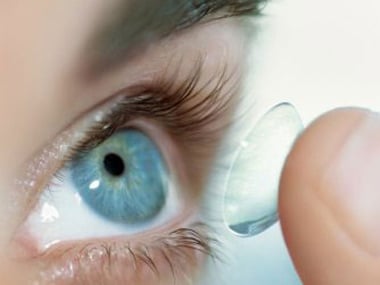 The technology, developed by Belgian researchers, allows information such as text messages from a mobile phone to the contact lenses.[/caption]
"Now that we have established the basic technology, we can start working towards real applications, possibly available in only a few years," said Professor Herbert De Smet.
The new technology allows the whole curved surface of the lens to be used, unlike previous contact lens displays, which are limited to a few small pixels to make up an image.
 More from News Analysis
One application suggested by the researchers is a "one pixel, fully covered contact lens acting as adaptable sunglasses".
"This is not science fiction," said De Smet, the Chief Researcher on the project, adding commercial applications for the lenses will be available within five years.
"This will never replace the cinema screen for films. But for specific applications it may be interesting to show images such as road directions or projecting text messages from our smart phones straight to our eye," said De Smet.
The innovation is the first step towards "fully pixelated contact lens displays" with the same detail as a television screen.
The lenses could also be used for medical purposes, for example to control the light transmission toward the eye's retina in case of a damaged iris, the report said.
For cosmetic purposes, the lens could be used to provide the iris of the eye a tunable colour, allowing the user to change it to suit their mood.
PTI

Why AI notetakers are raising serious privacy and security concerns
China's low-cost AI models are changing the global AI race. Here's why Silicon Valley is worried
China's Kimi K3 challenges US AI leaders with frontier-level performance at lower cost
How did Instagram run ads promoting child abuse in India?
Why has India halted WhatsApp’s username feature before launch?