


Next billion users will come from India: Google, Facebook and others can't afford to ignore them
India is and will remain a “must-present market” on every organisation’s strategic roadmap for the next two decades

About half of the world today lives without access to the internet. Reports like the one released by the 'Queen of the Internet' Mary Meeker suggests that 3.8 billion people, which is roughly 51 percent of the entire global population, are internet users. That still leaves a significant population in the dark. There’s a long way to go before the idea of open and omnipresent information reaches to the globe’s most remote regions. But that gap is shrinking by the year. As the prices of mobile plans and phones continue to hit new lows, millions of new users are going online every quarter.
A goldmine of data and users in the making
While it’s a positive step forward for the world, it’s also a burgeoning goldmine for tech companies who are otherwise running out of new users to enrol. A common trend has emerged among the roadmaps of these behemoths of late. They are all reorienting themselves to ensure their products are there whenever this new wave of users, famously referred to as the Next Billion Users, logs on to the internet for the first time.[caption id="attachment_6316941" align="alignnone" width="1280"]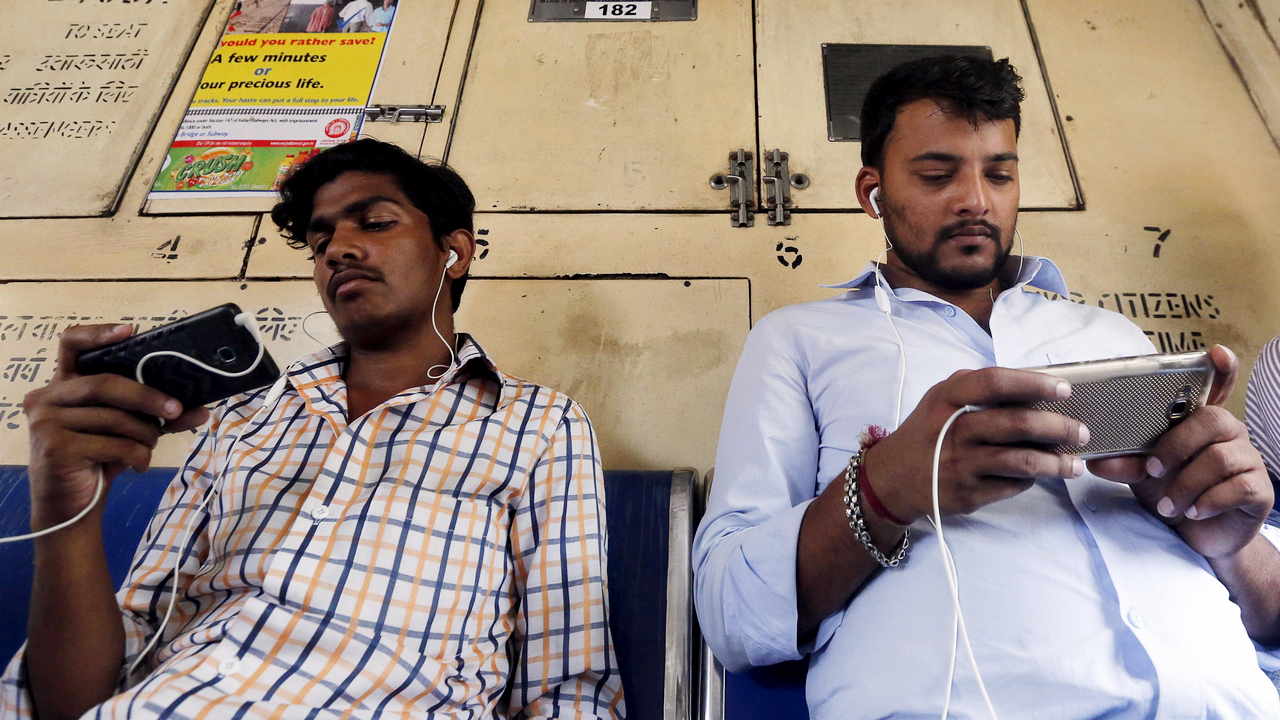
Commuters watch videos on their mobile phones as they travel. Reuters[/caption]The most apparent signs of this shift can be found in India where companies like Facebook and Google have raced to gain a head start before the rest catch up. In the last few years, a number of industries including mobile carriers, internet giants and even the government have come together to fix what has ailed the development of these disconnected areas’ so far. The results are beginning to show too. Studies predict double-digit growth in 2019 and estimate the number of internet users to reach 627 million — primarily driven by the rapid adoption in rural sectors — in India. In addition to products catering to such emerging markets, we’ve witnessed a vast range of initiatives designed to put in place the infrastructure needed to enable this goal of spawning a billion new internet users. That has led to accessible networks, projects which aim to spread awareness as well as educate, and much more. “India is and will remain a “must-present market” on every organisation’s strategic roadmap for the next two decades, primarily because of the huge hitherto unconnected almost billion users. This huge base is not on smartphones, do not use the internet on a daily or monthly basis. Every company is trying to make products for these users. They are making efforts around internet literacy in the hope that this huge base starts using their services in the next few years, start using smartphones and hence further entrenching them in the life of these consumers, in one of the largest population bases in the world,” commented Navkendar Singh, research director of Devices and Ecosystem, India and South Asia, IDC.
KaiOS and the rise of smart feature phones
KaiOS, an operating system targetting affordable non-touchscreen smart feature phones, has played a vital role in building a platform to deliver modern services into the hands of people who can’t afford a smartphone. Its app store offers some of the most widely used apps such as WhatsApp, YouTube, Google Maps and Xender on phones that cost just around $30.KaiOS is also what powers Reliance’s JioPhone and JioPhone 2 which has, in a matter of a couple of months, reached the top and become the country’s most sought after feature phone. On KaiOS, people even have the option to speak to a voice assistant in their regional language and perform actions like sending messages on WhatsApp. Both Reliance and Google have even invested in KaiOS’ parent startup. [caption id="attachment_6150751" align="alignnone" width="1280"]
JioPhone and JioPhone 2.[/caption]At the time of writing, one out of three 4G users in India is from a rural area. While Reliance Jio itself might still lag behind incumbents, it has made possible that statistic. Its disruptive arrival in the telecom space three years ago forced other carriers to revamp their tariffs to be more affordable and competitive. Globally, India now has the cheapest average 4G rate at $0.26 for one gigabyte.
Google's aim to reach the grassroots
Facebook focussing on Express Wi-Fi
India's answer to Big Tech: BharatNet
India’s government has been a proactive presence here as well. Its BharatNet initiative has managed to bring online more than 1,25,000 panchayats through an optical fibre. At the just concluded Union Budget 2019, Finance Minister Nirmala Sitharaman gave a further boost to BharatNet initiatives. Sitharaman said that under the Pradhan Mantri Grameen Digital Saksharta Abhiyan (PMGDISHA), BharatNet would be targeting internet connectivity in local bodies in every Panchayat in India. This activity is expected to be speeded up under the Universal Service Obligation Fund (USOF). PMGDISHA is part of the government's Digital India program.
 More from News Analysis
Designing an internet that speaks and understands major Indian languages
Further, India’s vernacular diversity often eludes western tech companies. According to various analysts, there are more than 200 million non-English users in the country and the number is projected to expand to 550 million in the next three years. While most operating systems and apps bundle support for a wide gamut of local languages in their software, it ends up throwing a wrench in the more advanced functions like detecting misinformation. To attract the next billion users, tech companies will have to reach users in their mother tongue.The absence of ample digital literacy exacerbates Facebook’s struggle with fake news. The social media company does have Indic partners for detecting non-English fake news content but these efforts have barely been able to make a dent. On top of that, Facebook has failed to play a proactive play and reports have previously found some of those fact-checking partners were themselves reporting unverified claims.Plus, regional languages have been a centrepiece of a number of Google products. Its AI is today compatible with tens of Indian languages. Yet, its algorithms on platforms like YouTube and Google are still one of the most active perpetrators of misinformation. Features such as smart recommendations often end up acting in favour of fake news if the user has in the past clicked any related link or video.[caption id="attachment_3937259" align="alignnone" width="640"]
The fact that Indus OS is the second most popular mobile phone OS after Android speaks volumes about the importance of regional languages on mobile[/caption]“Platforms themselves algorithmically control what information appears on your search feed, news feed. They limit the content that can be viewed, creating an atmosphere that is polarised and partisan”, Factly, a fact-checking platform wrote in a study.IndusOS, which develops Indic-first system apps for Android-based skins, has been one of the key drivers of the regional OS trend. It enables phone makers to offer essential apps like the app store, virtual keyboard in a wide range of local languages. At the time of writing, IndusOS’ homegrown app store, Indus App Bazaar is home to 400,000 apps developed by leading companies including Samsung.(Also Read: Indus OS is a good way to consume smartphone content in regional languages)IndusOS’ focus on regional services has numbers to back it up too. It’s now India’s second most used mobile platform. It’s worth noting, though, that technically IndusOS is not an operating system. It runs on Android and partners with local OEMs to preload its set of system apps. India’s second largest mobile operating system is KaiOS.IndusOS’ CEO, Rakesh Deshmukh believes, “100 percent of the next growth in smartphone users is going to come through users who prefer their native language. Keeping this in mind, we have developed Indus App Bazaar, India’s App Store, where users can discover and consume digital content and services in their preferred language.”Like others, however, Deshmukh refuses to address the repercussions of this surge of internet users.With little time to recalibrate their products and hardly any substantial improvements in digital literacy among these new users, companies seem to have overlooked the part that comes after they’ve managed to bring a new user onboard.
Stitching a surprising set of behavioural patterns
Unlike what companies’ pitch suggest or you may think, behavioural patterns of these new, low-income internet users are largely similar to the ones in more established areas.“Users are drawn to new applications and technologies. Not based primarily on pragmatic ends. But mainly for leisure purposes such as entertainment, pornography, social network. These kinds of drivers get people to go online. Of course, when they are there, they engage in other kinds of networks. WhatsApp groups allow them to talk about everything like share wedding photos, share jokes, religious sayings, and all kinds of not very pragmatic content,” stated Payal Arora, who has authored the book The Next Billion Users that explores the digital life beyond the west.As the internet and its various intricacies are still a new concept in villages, a lot of concerns loom over this dramatic shift. Privacy remains at the top of the pyramid and the majority of new users are not aware of what they usually give up on, for free services like Google.Plus, the effects of India’s misinformation woes are gradually trickling down to these low-literacy regions. In the past year, there have been numerous incidents that highlight how companies like Facebook need to come up with better solutions for fake news before putting their foot down to capture the next billion users.Arora believes the absence of education is not to be predominantly blamed for the mob lynchings and other similar cases. “That can be misleading because a number of users are actually well aware that there is a lot of fake content being circulated. There's a larger discussion that needs to be had about the accountability that media systems have to these users. This has become a political strategy. So my argument is that it's not so much about education and awareness. It has to do with politics, the way in which these mainstream has been using misinformation to create polarised public and how they are linked to political parties. That is really the bigger problem,” she added.Scratching the surface of the numbers, companies and the government advertise, also sheds light on the fact that the underlying groundwork necessary to enable India’s next big chunk of internet users is still far from what it should be.India’s rapidly accelerating digital revamp has entered the radar of international startups. Based out of the UK, BuffaloGrid is one of them and its network of solar-powered charging stations are addressing foundational hurdles like the lack of electricity. In addition to allowing villagers to charge their phone, the BuffaloGrid box acts as a Wi-Fi hotspot too. These stations sit in local stores and require the user to go through a setup process, after which they can charge and surf the web. BuffaloGrid says its services are freemium and the user is not charged until a certain point. However, it didn’t say what it costs once the complimentary quota expires.BuffaloGrid also joined hands with WhatsApp earlier this year to spread the latter’s ‘Spread Joy, Not Rumours’ campaign. Locals are shown a short video clip outlining the steps they should take to spot fake news before they can avail BuffaloGrid’s services. “To date over 70,000 people have used BuffaloGrid’s solar charging technology across Bihar, Karnataka and Uttar Pradesh,” said BuffaloGrid’s director in India, Sameer Sinha.“The Indian Government has taken great steps to bring power to rural communities but our research shows there’s a long way to go before every home is connected. Our field research team has spoken to hundreds of people without access to electricity and many more who still experience regular power cuts. We also think Indian telecom players have done an incredible job at connecting communities but the ongoing industry pricing war has stifled innovation and left millions disconnected or dissatisfied,” said BuffaloGrid’s Sinha.
It’s just the beginning
India’s tech landscape has gone through a dramatic upgrade in just the last couple of years. And no tech company wants to be left behind. But there’s a lot that needs to be taken care of to ensure the digital divide is as little as possible.The government often also overlooks the foundational pillars such as electricity while leveraging the idea of a more connected India for political gain. After years of living in the shadows, India’s remote regions are able to step forward through the internet. Now, it’s the government and private players’ responsibility to build a level playing field.Disclaimer: Reliance Industries Ltd which owns Reliance Jio and Jio Phone is the sole beneficiary of Independent Media Trust which controls Network18 Media & Investments Ltd, the publisher of Firstpost and tech2The author is a freelance technology journalist from Ahmedabad. He tweets from @phonesoldier.
The author is a freelance technology journalist from Ahmedabad. He tweets from @phonesoldier

Why AI notetakers are raising serious privacy and security concerns
China's low-cost AI models are changing the global AI race. Here's why Silicon Valley is worried
China's Kimi K3 challenges US AI leaders with frontier-level performance at lower cost
How did Instagram run ads promoting child abuse in India?
Why has India halted WhatsApp’s username feature before launch?