


New technology may help scale up memory storage capacity
The team has designed a memory device which is made up of silver, titanium dioxide and fluorine doped Tin oxide (FTO).

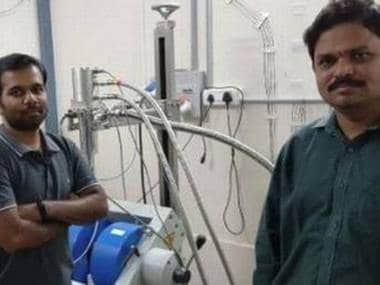
Researchers at Indian Institute of Technology, Hyderabad.[/caption]Researchers at Indian Institute of Technology Hyderabad have demonstrated the control of resistive switching characteristics of titanium dioxide- based resistive random access memory device with magnetic field. The team has designed a memory device which is made up of silver, titanium dioxide and fluorine doped Tin oxide (FTO).Nonvolatile memory devices such as flash memory and magnetic random access memory (MRAM) are key components in many technological devices like hard drives on a computer and memory cards in a phone. Non-volatile memory is typically used for storing information that would be retained even after power is switched off. Ideally, a good memory device should be able to operate with high speed, low power consumption and must possess high density.
Study suggests that the data transport properties (resistive switching behavior) in currently available RRAM based device are mainly controlled by voltage. It would help if resistance switching behavior can be controlled with magnetic field, light and temperature. Researchers say they are exploring magnetic fields because that would give an opportunity to control transport in a remote way.
According to researchers, RRAM devices were fabricated on FTO substrate to study the resistive switching behavior in newly designed device. To build this new device, titanium dioxide paste was used to prepare a thin film on FTO substrate which was followed by heating of film at very high temperature (400 degrees C). “We used silver as top electrode for good conduction as well as its anti-oxidation property whereas fluorine-doped tin oxide was used as bottom electrode,” said researchers.
 More from News Analysis
“As present memory technologies are approaching their scaling limits, we need intensive research to develop nonvolatile memory technologies. Among various NVM technologies, resistive random access memory (RRAM) also has attracted a great deal of scientific and technological interest owing to its easy fabrication, high density, and promising performance,” said Dr. S. N. Jammalamadaka, who did the study along with Dwipak Prasad Sahu.
This finding may be helpful in future RRAM based storage devices which could be operated with magnetic fields. The study was recently published in journal Scientific Reports.
India Science Wire

Why AI notetakers are raising serious privacy and security concerns
China's low-cost AI models are changing the global AI race. Here's why Silicon Valley is worried
China's Kimi K3 challenges US AI leaders with frontier-level performance at lower cost
How did Instagram run ads promoting child abuse in India?
Why has India halted WhatsApp’s username feature before launch?