


NASA's says that the recently found IMAGE satellite is a 'discovery' machine
NASA launched the Imager for Magnetopause-to-Aurora Global Exploration, or IMAGE, mission, on 25 March, 2000.

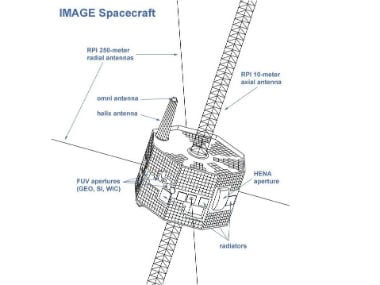
IMAGE satellite which was lost decades ago. NASA.[/caption]The data collected during its years of operation led to some 40 new discoveries about Earth's magnetosphere and plasmasphere, NASA said on 2 February."IMAGE was a discovery machine and a seminal mission that gave us a broader perspective on Earth's environment and its ever-changing magnetosphere," said Jim Green, Director of Planetary Science at NASA Headquarters in Washington, who worked as a co-investigator and Deputy Project Scientist for IMAGE.On 20 January, 2018, amateur astronomer Scott Tilley detected an unexpected signal coming from what he later postulated was NASA's long-lost IMAGE satellite, which had not been in contact since 2005.On 30 January, NASA confirmed that the signal was indeed from the IMAGE spacecraft.NASA launched the Imager for Magnetopause-to-Aurora Global Exploration, or IMAGE, mission, on 25 March, 2000.It was the first mission to use neutral atom, photon and radio imaging techniques to produce large-scale, simultaneous measurements of the charged particles that exist in near-Earth space — namely in our magnetosphere, the magnetic fields that surround our planet, and its inner bubble of cold material called the plasmasphere.Originally designed as a two-year mission, IMAGE was approved twice to continue its operations.But when the spacecraft unexpectedly failed to make contact on a routine pass on 18 December, 2005, its promising tenure seemed to be cut short.Investigations into possible causes of failure suggested that the transmitter controller power source was tripped, possibly by an incoming high-energy cosmic ray or radiation belt particle.It was hypothesised that passing through a dramatic change in energy — such as what happens when a spacecraft experiences total darkness during an eclipse — could potentially reset the spacecraft.But after a 2007 eclipse failed to induce a reboot, the mission was declared over.Before that, however, IMAGE was a powerhouse, NASA said.Many of the discoveries that it had made had their basis in energetic neutral atom, or ENA, imaging, a novel technique pioneered by IMAGE to render the invisible visible.In combination with ENA instruments, IMAGE also used ultraviolet and radio imaging techniques that together led to many of IMAGE's most notable accomplishments.Among them is the confirmation of the plasmaspheric plume, a region of plasma particles that flow backwards toward the Sun on Earth's dayside.Such a backflow had been predicted by models, but never directly observed by spacecraft, NASA said.

Why AI notetakers are raising serious privacy and security concerns
China's low-cost AI models are changing the global AI race. Here's why Silicon Valley is worried
China's Kimi K3 challenges US AI leaders with frontier-level performance at lower cost
How did Instagram run ads promoting child abuse in India?
Why has India halted WhatsApp’s username feature before launch?