


NASA to use asteroid flyby to test tracking capabilities of its worldwide observatory network
NASA will use large telescopes to detect and re-establish the asteroid's precise trajectory.

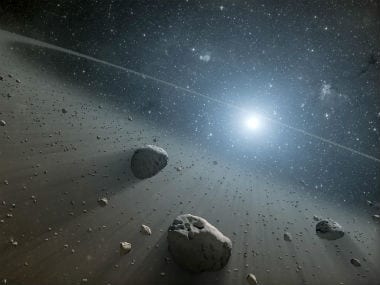
Representational image. NASA JPL[/caption]The flyby would also benefit scientists who work with planetary defence. According to a press statement on NASA's website earlier this week, the target of all this attention is asteroid 2012 TC4, a small asteroid estimated to be between 10 and 30 metres in size.Asteroid TC4 will safely fly past the Earth on October 12, and scientists are certain it will come no closer than 6,800 km from the surface of the Earth. The asteroid has been out of range of telescopes since 2012 when it sped past the Earth at about one-fourth the distance from the Earth to the Moon.For Indian-origin scientist Vishnu Reddy, this is an opportunity for the collaborative observation campaign to utilise the international aspect of the network. "This is a team effort that involves more than a dozen observatories, universities and labs across the globe so we can collectively learn the strengths and limitations of our near-Earth object observation capabilities," said Reddy, Professor at the University of Arizona.Scientists believe that asteroid 2012 TC4 may be slightly larger than the space rock that hit the Earth's atmosphere near Chelyabinsk, Russia, in February 2013. NASA will use large telescopes to detect and re-establish the asteroid's precise trajectory. The new observations are expected to help refine knowledge about its orbit, narrowing the uncertainty about how far it will be from the Earth at its closest approach in October."Scientists have always appreciated knowing when an asteroid will make a close approach to and safely pass the Earth because they can make preparations to collect data to characterise and learn as much as possible about it," said Michael Kelley, Programme Scientist and NASA Headquarters lead for the TC4 observation campaign. "This time, we are adding in another layer of effort, using this asteroid flyby to test the worldwide asteroid detection and tracking network, assessing our capability to work together in response to finding a potential real asteroid threat," Kelley added.Scientists from NASA's Centre for Near-Earth Object Studies (CNEOS) at the Jet Propulsion Laboratory (JPL) in California, have determined that while at closest approach, asteroid 2012 TC4 will pass no closer than 6,800 km from the Earth, it will more likely pass much farther away, as far as 270,000 km, or two-thirds of the distance from the Earth to the Moon.

Why AI notetakers are raising serious privacy and security concerns
China's low-cost AI models are changing the global AI race. Here's why Silicon Valley is worried
China's Kimi K3 challenges US AI leaders with frontier-level performance at lower cost
How did Instagram run ads promoting child abuse in India?
Why has India halted WhatsApp’s username feature before launch?