


MIT engineers have designed an autonomous robot that can navigate through pedestrian traffic
In order for a robot to make its way autonomously through a heavily trafficked environment, it must solve four main challenges.

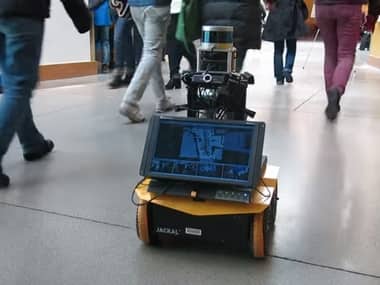
Image Courtesy: MIT[/caption]In drive tests, the robot, which resembles a knee-high kiosk on wheels, successfully avoided collisions while keeping up with the average flow of pedestrians, said the researchers who have detailed their robotic design in a paper scheduled to be presented at the IEEE Conference on Intelligent Robots and Systems to be held in Vancouver, Canada, in September."Socially aware navigation is a central capability for mobile robots operating in environments that require frequent interactions with pedestrians," said lead author of the study Yu Fan (Steven) Chen."For instance, small robots could operate on sidewalks for package and food delivery. Similarly, personal mobility devices could transport people in large, crowded spaces, such as shopping malls, airports, and hospitals," Chen said.

Why AI notetakers are raising serious privacy and security concerns
China's low-cost AI models are changing the global AI race. Here's why Silicon Valley is worried
China's Kimi K3 challenges US AI leaders with frontier-level performance at lower cost
How did Instagram run ads promoting child abuse in India?
Why has India halted WhatsApp’s username feature before launch?