
Advertisement


Sections
Microsoft is also testing a bot that can make phone calls and chat with humans
The bot is currently being tested with over 500 million people in China.

At the Google I/O 2018 demo, remember how Google Duplex totally blew our mind? This was a first for us as we witnessed robots pretending to be humans and making phones calls, and obviously, we were amused and scared in equal measures.[caption id="attachment_4458851" align="alignleft" width="380"]![Microsoft CEO Satya Narayana Nadella. Reuters]() Microsoft CEO Satya Narayana Nadella. Reuters[/caption]While the technology by Google was eventually criticised for potentially risking users privacy and safety, Microsoft is boldly working on a similar tech parallelly.A report by The Verge reveals that Microsoft has been testing a similar AI that is capable of making phone calls, with a million people in China.Called Xiaoice (pronounced “SHAO-ICE”), the new Microsoft technology is essentially a social chatbot, that company CEO Satya Nadella recently showcased at an AI event in London.Nadella revealed that Microsoft has been testing Xiaoice in China and has over 500 million ‘friends’, more than 16 channels for users to interact with it through WeChat and other messaging services.Microsoft has charactered Xiaoice as a friendly bot, which in all its conversations aims at helping humans feel like they are talking to a friend or someone they know. “Xiaoice has her own TV show, it writes poetry, and it does many interesting things,” revealed Nadella. “It’s a bit of a celebrity.”While most of the existing tests with Xiaoice have been in relation to teaching it how to chat and send messages, Microsoft is now also working on allowing the bot to make phone calls.Now, the concept does run on the same line for Google Duplex and Microsoft Xiaoice, but the technology isn’t exactly the same. While the Google Duplex uses the Assistant to make calls on your behalf, Xiaoice holds a phone conversation with you.The Microsoft demonstration of the feature shows how the bot can even predict what the person will say next, and respond quickly. In the video demo, Xiaoice interrupts the user mid-sentence to alert them that there are strong winds and they should close the window before bed.Xiaoice is currently limited to China, and Microsoft has revealed no plans of if and when it plans to test it with other parts of the world. While Xiaoice sounds like a big hit in China, this isn’t the company’s first attempt at a bot experiment. Two years ago, Microsoft started testing its bot called Tay, which ended in a disaster, after people on Twitter quickly taught the bot to be racist.
Microsoft CEO Satya Narayana Nadella. Reuters[/caption]While the technology by Google was eventually criticised for potentially risking users privacy and safety, Microsoft is boldly working on a similar tech parallelly.A report by The Verge reveals that Microsoft has been testing a similar AI that is capable of making phone calls, with a million people in China.Called Xiaoice (pronounced “SHAO-ICE”), the new Microsoft technology is essentially a social chatbot, that company CEO Satya Nadella recently showcased at an AI event in London.Nadella revealed that Microsoft has been testing Xiaoice in China and has over 500 million ‘friends’, more than 16 channels for users to interact with it through WeChat and other messaging services.Microsoft has charactered Xiaoice as a friendly bot, which in all its conversations aims at helping humans feel like they are talking to a friend or someone they know. “Xiaoice has her own TV show, it writes poetry, and it does many interesting things,” revealed Nadella. “It’s a bit of a celebrity.”While most of the existing tests with Xiaoice have been in relation to teaching it how to chat and send messages, Microsoft is now also working on allowing the bot to make phone calls.Now, the concept does run on the same line for Google Duplex and Microsoft Xiaoice, but the technology isn’t exactly the same. While the Google Duplex uses the Assistant to make calls on your behalf, Xiaoice holds a phone conversation with you.The Microsoft demonstration of the feature shows how the bot can even predict what the person will say next, and respond quickly. In the video demo, Xiaoice interrupts the user mid-sentence to alert them that there are strong winds and they should close the window before bed.Xiaoice is currently limited to China, and Microsoft has revealed no plans of if and when it plans to test it with other parts of the world. While Xiaoice sounds like a big hit in China, this isn’t the company’s first attempt at a bot experiment. Two years ago, Microsoft started testing its bot called Tay, which ended in a disaster, after people on Twitter quickly taught the bot to be racist.
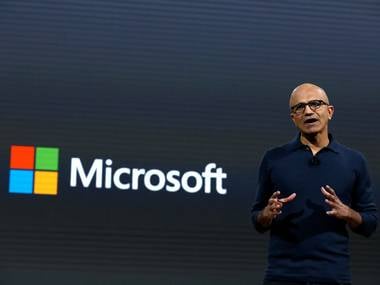 Microsoft CEO Satya Narayana Nadella. Reuters[/caption]While the technology by Google was eventually criticised for potentially risking users privacy and safety, Microsoft is boldly working on a similar tech parallelly.A report by The Verge reveals that Microsoft has been testing a similar AI that is capable of making phone calls, with a million people in China.Called Xiaoice (pronounced “SHAO-ICE”), the new Microsoft technology is essentially a social chatbot, that company CEO Satya Nadella recently showcased at an AI event in London.Nadella revealed that Microsoft has been testing Xiaoice in China and has over 500 million ‘friends’, more than 16 channels for users to interact with it through WeChat and other messaging services.Microsoft has charactered Xiaoice as a friendly bot, which in all its conversations aims at helping humans feel like they are talking to a friend or someone they know. “Xiaoice has her own TV show, it writes poetry, and it does many interesting things,” revealed Nadella. “It’s a bit of a celebrity.”While most of the existing tests with Xiaoice have been in relation to teaching it how to chat and send messages, Microsoft is now also working on allowing the bot to make phone calls.
First Published:May 23, 2018, 10:20:39 IST
Advertisement
Advertisement

Why AI notetakers are raising serious privacy and security concerns
AI notetakers promise effortless meeting summaries, but experts warn they could expose confidential conversations, corporate secrets and personal voiceprints. As businesses increasingly adopt AI-powered meeting assistants, questions over data storage, privacy, consent and legal risks are becoming impossible to ignore
5 min read
China's low-cost AI models are changing the global AI race. Here's why Silicon Valley is worried
As Chinese firms continue to improve performance while keeping prices low, the AI race is no longer just about building the smartest model—it is increasingly becoming a battle over who can deliver the best value
2 min read
China's Kimi K3 challenges US AI leaders with frontier-level performance at lower cost
Chinese artificial intelligence startup Moonshot AI has unveiled its latest open-weight AI model, Kimi K3, with early results suggesting it could compete with some of the world's most advanced AI systems developed by leading US companies
2 min read
How did Instagram run ads promoting child abuse in India?
India has issued a notice to Meta after an investigation alleged that Instagram displayed paid advertisements promoting child sexual abuse material. MeitY ordered Meta to remove such Instagram ads and explain within seven days how they were approved
8 min read
Why has India halted WhatsApp’s username feature before launch?
India has halted WhatsApp’s planned username feature, citing concerns about cybercrime, impersonation, and law enforcement challenges. As Meta races to address security concerns, here’s why MeitY has paused the rollout, what the feature does, and how it could influence privacy and online safety in India
3 min read
Advertisement
Advertisement