
Advertisement


Sections
Microsoft conducts trials of AI-powered automated driving license tests in India
The Harnessing AutoMobiles for Safety or HAMS project is Microsoft’s attempt to automate the process.

Microsoft is testing out an AI-powered tool to automate the process of giving out driver’s licenses in India. The Microsoft Research Project team has collaborated with the Regional Transport Office in Dehradun in the northern state of Uttarakhand.[caption id="attachment_7581301" align="alignnone" width="1280"]![Harnessing AutoMobiles for Safety (HAMS) project led by Microsoft Research. Image: Microsoft.]() Harnessing AutoMobiles for Safety (HAMS) project led by Microsoft Research. Image: Microsoft.[/caption]Harnessing AutoMobiles for Safety or HAMS, replaces the evaluator with just a smartphone attached to the car’s windshield in front of the driver. Now, this can be any smartphone and all it needs are the front and rear cameras along with the regular sensors that are packed inside these devices. The front-facing camera points at the driver while the rear camera is out front. All the components on the phone work together to provide a better evaluation of the driver.Microsoft explains this with an example of a situation when there’s sharp braking in the car. The phone’s accelerometer will be able to detect the sudden jerk, the distance is measured with the vehicle in front using the rear camera, and finally, the front camera tries to capture whether the driver was distracted or fatigued. In this way, the AI-powered system will be able to provide a much better evaluation of a driver’s skill than a human evaluator.HAMS was initially created to monitor drivers and their driving with the ultimate goal of improving road safety. Microsoft said that while exploring ways to achieve this goal, driver training and testing became an important aspect by starting with helping new drivers right from the beginning.Apart from partnering with the Dehradun RTO, HAMS has also collaborated with the Institute of Driving and Traffic Research (IDTR) that’s run by Maruti-Suzuki for training drivers.
Harnessing AutoMobiles for Safety (HAMS) project led by Microsoft Research. Image: Microsoft.[/caption]Harnessing AutoMobiles for Safety or HAMS, replaces the evaluator with just a smartphone attached to the car’s windshield in front of the driver. Now, this can be any smartphone and all it needs are the front and rear cameras along with the regular sensors that are packed inside these devices. The front-facing camera points at the driver while the rear camera is out front. All the components on the phone work together to provide a better evaluation of the driver.Microsoft explains this with an example of a situation when there’s sharp braking in the car. The phone’s accelerometer will be able to detect the sudden jerk, the distance is measured with the vehicle in front using the rear camera, and finally, the front camera tries to capture whether the driver was distracted or fatigued. In this way, the AI-powered system will be able to provide a much better evaluation of a driver’s skill than a human evaluator.HAMS was initially created to monitor drivers and their driving with the ultimate goal of improving road safety. Microsoft said that while exploring ways to achieve this goal, driver training and testing became an important aspect by starting with helping new drivers right from the beginning.Apart from partnering with the Dehradun RTO, HAMS has also collaborated with the Institute of Driving and Traffic Research (IDTR) that’s run by Maruti-Suzuki for training drivers.
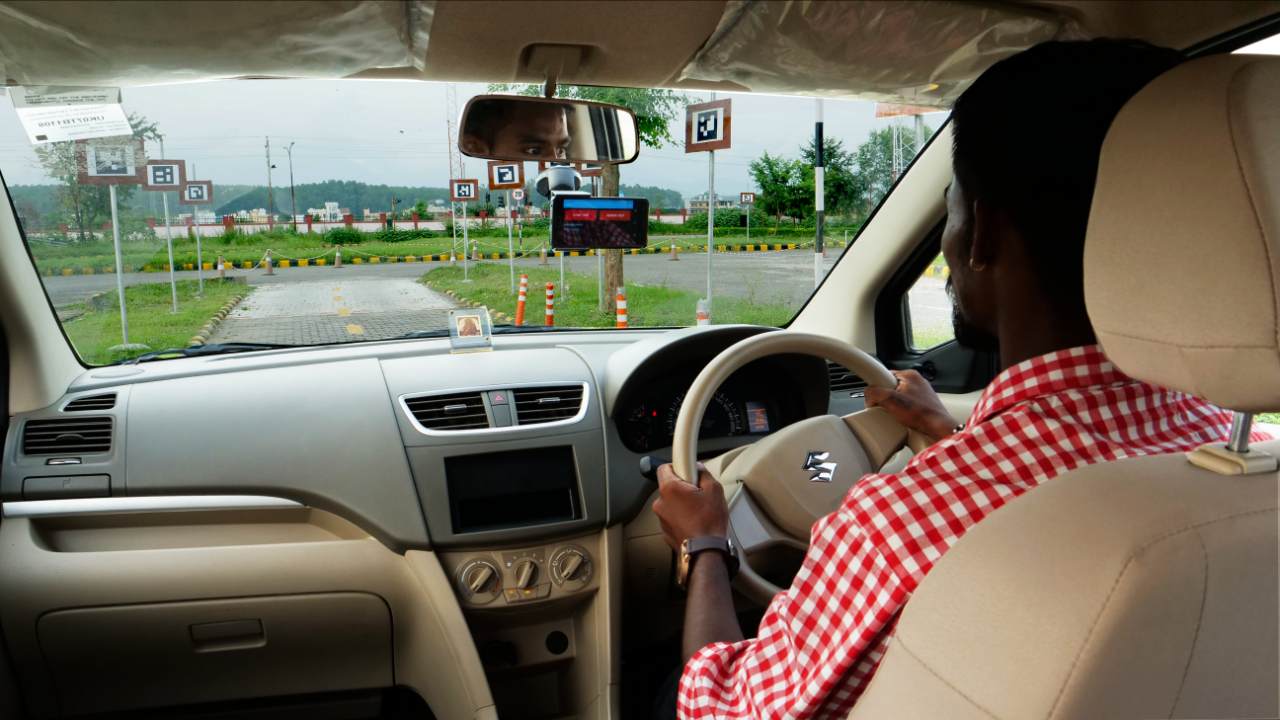 Harnessing AutoMobiles for Safety (HAMS) project led by Microsoft Research. Image: Microsoft.[/caption]Harnessing AutoMobiles for Safety or HAMS, replaces the evaluator with just a smartphone attached to the car’s windshield in front of the driver. Now, this can be any smartphone and all it needs are the front and rear cameras along with the regular sensors that are packed inside these devices. The front-facing camera points at the driver while the rear camera is out front. All the components on the phone work together to provide a better evaluation of the driver.Microsoft explains this with an example of a situation when there’s sharp braking in the car. The phone’s accelerometer will be able to detect the sudden jerk, the distance is measured with the vehicle in front using the rear camera, and finally, the front camera tries to capture whether the driver was distracted or fatigued. In this way, the AI-powered system will be able to provide a much better evaluation of a driver’s skill than a human evaluator.
First Published:Oct 31, 2019, 18:53:18 IST
Advertisement
Advertisement

Why AI notetakers are raising serious privacy and security concerns
AI notetakers promise effortless meeting summaries, but experts warn they could expose confidential conversations, corporate secrets and personal voiceprints. As businesses increasingly adopt AI-powered meeting assistants, questions over data storage, privacy, consent and legal risks are becoming impossible to ignore
5 min read
China's low-cost AI models are changing the global AI race. Here's why Silicon Valley is worried
As Chinese firms continue to improve performance while keeping prices low, the AI race is no longer just about building the smartest model—it is increasingly becoming a battle over who can deliver the best value
2 min read
China's Kimi K3 challenges US AI leaders with frontier-level performance at lower cost
Chinese artificial intelligence startup Moonshot AI has unveiled its latest open-weight AI model, Kimi K3, with early results suggesting it could compete with some of the world's most advanced AI systems developed by leading US companies
2 min read
How did Instagram run ads promoting child abuse in India?
India has issued a notice to Meta after an investigation alleged that Instagram displayed paid advertisements promoting child sexual abuse material. MeitY ordered Meta to remove such Instagram ads and explain within seven days how they were approved
8 min read
Why has India halted WhatsApp’s username feature before launch?
India has halted WhatsApp’s planned username feature, citing concerns about cybercrime, impersonation, and law enforcement challenges. As Meta races to address security concerns, here’s why MeitY has paused the rollout, what the feature does, and how it could influence privacy and online safety in India
3 min read
Advertisement
Advertisement