
Advertisement


Sections
Mega asteroid as big as the Burj Khalifa to fly really close to the Earth today
The asteroid is classified as potentially hazardous but there is no chance of it colliding with our planet.

An asteroid, 162082 (1998 HL1), as big as the Burj Khalifa tower in Dubai is going to fly close to the Earth on 25 October 2019, 10.51 pm IST.Doomsday won't be following it hot on its tail, even though it has been classified as 'potentially hazardous' as it won't enter Earth's atmosphere this time around. The asteroid will be visible via a telescope from today and right through the end of this month.It will be travelling at a speed of 11.21 km per second and at its closest point, 162082 (1998 HL1) will be 0.04155 au or 6.2 million kilometres from Earth.[caption id="attachment_7540251" align="alignnone" width="1280"]![The asteroid 162082 (1998 HL1) during its previous fly by earth. Image credit: Virtual telescope]() The asteroid 162082 (1998 HL1) during its previous flyby earth. Image credit: Virtual telescopes[/caption]1998 HL1 is estimated to measure between 440 and 990 meters in diameter.The last time this asteroid came close to earth was in June this year and next time we will see it is on 15 October 2026, according to NASA’s Jet Propulsion Laboratory.The asteroid is a Near-Earth Object (NEO) and was discovered in 1998 by the Lincoln Laboratory Near-Earth Asteroid Research project (LINEAR) at Socorro, New Mexico. LINEAR is a collaboration between the US Air Force, NASA and MIT’s Lincoln Laboratory to detect and track NEOs.A NEO is a comet, asteroid or is any small Solar System body whose orbit brings it in close proximity with Earth. If a NEO's orbit crosses the Earth's, and the object is larger than 140 meters across, it is considered a potentially hazardous object (PHO).[caption id="attachment_7540231" align="alignnone" width="1280"]
The asteroid 162082 (1998 HL1) during its previous flyby earth. Image credit: Virtual telescopes[/caption]1998 HL1 is estimated to measure between 440 and 990 meters in diameter.The last time this asteroid came close to earth was in June this year and next time we will see it is on 15 October 2026, according to NASA’s Jet Propulsion Laboratory.The asteroid is a Near-Earth Object (NEO) and was discovered in 1998 by the Lincoln Laboratory Near-Earth Asteroid Research project (LINEAR) at Socorro, New Mexico. LINEAR is a collaboration between the US Air Force, NASA and MIT’s Lincoln Laboratory to detect and track NEOs.A NEO is a comet, asteroid or is any small Solar System body whose orbit brings it in close proximity with Earth. If a NEO's orbit crosses the Earth's, and the object is larger than 140 meters across, it is considered a potentially hazardous object (PHO).[caption id="attachment_7540231" align="alignnone" width="1280"]![The orbit which the asteroid (162082) 1998 HL1 will be following. Image credit: JPL]() The orbit which the asteroid (162082) 1998 HL1 will be following. Image credit: JPL[/caption]A NEO is a comet, asteroid or any small Solar System body whose orbit brings it in close proximity with Earth. If a NEO's orbit crosses the Earth's, and the object is larger than 140 meters across, it is considered a potentially hazardous object (PHO). NASA tracks these NEOs and maintains a database.You can watch the asteroid hurtling through space online, here.
The orbit which the asteroid (162082) 1998 HL1 will be following. Image credit: JPL[/caption]A NEO is a comet, asteroid or any small Solar System body whose orbit brings it in close proximity with Earth. If a NEO's orbit crosses the Earth's, and the object is larger than 140 meters across, it is considered a potentially hazardous object (PHO). NASA tracks these NEOs and maintains a database.You can watch the asteroid hurtling through space online, here.
 The asteroid 162082 (1998 HL1) during its previous flyby earth. Image credit: Virtual telescopes[/caption]1998 HL1 is estimated to measure between 440 and 990 meters in diameter.The last time this asteroid came close to earth was in June this year and next time we will see it is on 15 October 2026, according to NASA’s Jet Propulsion Laboratory.The asteroid is a Near-Earth Object (NEO) and was discovered in 1998 by the Lincoln Laboratory Near-Earth Asteroid Research project (LINEAR) at Socorro, New Mexico. LINEAR is a collaboration between the US Air Force, NASA and MIT’s Lincoln Laboratory to detect and track NEOs.
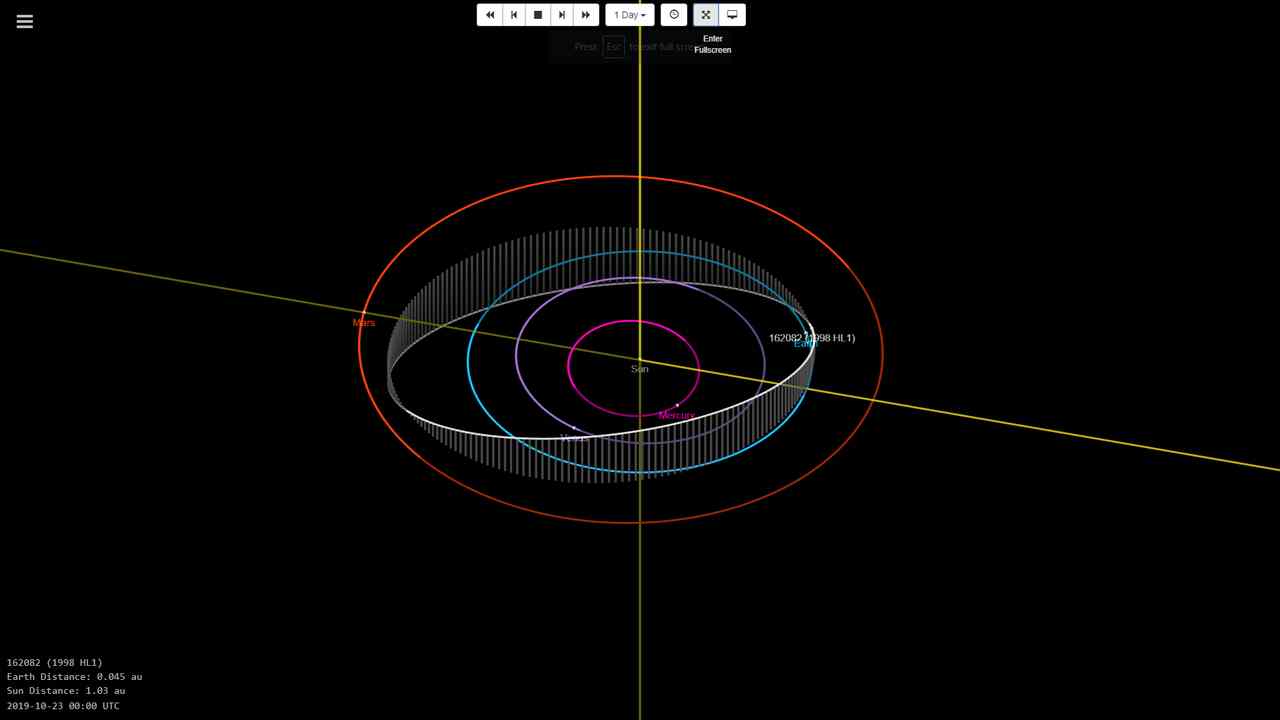 The orbit which the asteroid (162082) 1998 HL1 will be following. Image credit: JPL[/caption]A NEO is a comet, asteroid or any small Solar System body whose orbit brings it in close proximity with Earth. If a NEO's orbit crosses the Earth's, and the object is larger than 140 meters across, it is considered a potentially hazardous object (PHO). NASA tracks these NEOs and maintains a database.You can watch the asteroid hurtling through space online, here.
First Published:Oct 25, 2019, 10:00:12 IST
Advertisement
Advertisement

Why AI notetakers are raising serious privacy and security concerns
AI notetakers promise effortless meeting summaries, but experts warn they could expose confidential conversations, corporate secrets and personal voiceprints. As businesses increasingly adopt AI-powered meeting assistants, questions over data storage, privacy, consent and legal risks are becoming impossible to ignore
5 min read
China's low-cost AI models are changing the global AI race. Here's why Silicon Valley is worried
As Chinese firms continue to improve performance while keeping prices low, the AI race is no longer just about building the smartest model—it is increasingly becoming a battle over who can deliver the best value
2 min read
China's Kimi K3 challenges US AI leaders with frontier-level performance at lower cost
Chinese artificial intelligence startup Moonshot AI has unveiled its latest open-weight AI model, Kimi K3, with early results suggesting it could compete with some of the world's most advanced AI systems developed by leading US companies
2 min read
How did Instagram run ads promoting child abuse in India?
India has issued a notice to Meta after an investigation alleged that Instagram displayed paid advertisements promoting child sexual abuse material. MeitY ordered Meta to remove such Instagram ads and explain within seven days how they were approved
8 min read
Why has India halted WhatsApp’s username feature before launch?
India has halted WhatsApp’s planned username feature, citing concerns about cybercrime, impersonation, and law enforcement challenges. As Meta races to address security concerns, here’s why MeitY has paused the rollout, what the feature does, and how it could influence privacy and online safety in India
3 min read
Advertisement
Advertisement