


Jupiter's equatorial jet streams have been found to be similar to those on Earth: NASA
The new study combines modelling of Jupiter's atmosphere with detailed observations made over the course of five years.

A NASA-led team has found that gravity waves force an east-west jet stream speeding through the atmosphere high above Jupiter's equator to change direction on a schedule almost as predictable as a Tokyo train.[caption id="attachment_2428640" align="alignleft" width="380"]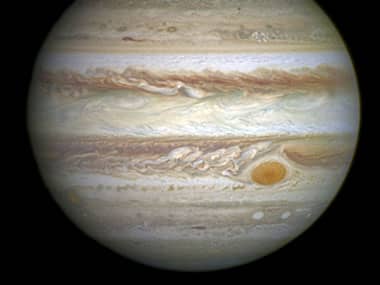 File photo of Jupiter. Reuters.[/caption]The findings, published in the Journal of Geophysical Research-Planets, could help scientists better understand the dynamic atmosphere of Jupiter and other planets, including those beyond our solar system.Similar equatorial jet streams have been identified on Saturn and on Earth, where a rare disruption of the usual wind pattern complicated weather forecasts in early 2016.The new study combines modelling of Jupiter's atmosphere with detailed observations made over the course of five years from NASA's Infrared Telescope Facility, or IRTF, in Hawaii."Jupiter is much bigger than Earth, much farther from the Sun, rotates much faster, and has a very different composition, but it turns out to be an excellent laboratory for understanding this equatorial phenomenon," said study lead author Rick Cosentino, postdoctoral fellow at NASA's Goddard Space Flight Center in Greenbelt, Maryland.Jupiter's cycle is called the quasi-quadrennial oscillation, or QQO, and it lasts about four Earth years.Saturn has its own version of the phenomenon, the quasi-periodic oscillation, with a duration of about 15 Earth years.Researchers have a general understanding of these patterns but are still working out how much various types of atmospheric waves contribute to driving the oscillations and how similar the phenomena are to each other.Previous studies of Jupiter had identified the QQO by measuring temperatures in the stratosphere to infer wind speed and direction.The new set of measurements span one full cycle of the QQO and covers a much larger area of Jupiter.Observations extended over a large vertical range and spanned latitudes from about 40 degrees north to about 40 degrees south.The team found that the equatorial jet extends quite high into Jupiter's stratosphere.Because the measurements covered such a large region, the researchers could eliminate several kinds of atmospheric waves from being major contributors to the QQO, leaving gravity waves as the primary driver.Their model assumes gravity waves are produced by convection in the lower atmosphere and travel up into the stratosphere, where they force the QQO to change direction.

Why AI notetakers are raising serious privacy and security concerns
China's low-cost AI models are changing the global AI race. Here's why Silicon Valley is worried
China's Kimi K3 challenges US AI leaders with frontier-level performance at lower cost
How did Instagram run ads promoting child abuse in India?
Why has India halted WhatsApp’s username feature before launch?