


ISRO is extending its quality protocols to improve emergency response and critical care services in Indian hospitals
The ISRO practices which have been adapted for critical care include quality control, minimum standards and periodic critical review of ICU design.

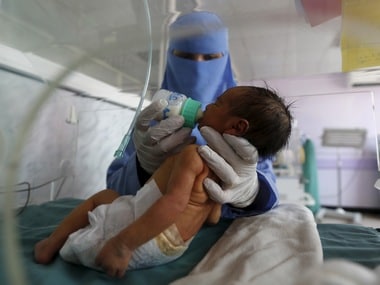
A nurse feeds a newborn baby in a special care unit. Reuters.[/caption]Now the Indian Space Research Organisation (ISRO), often praised for its top quality and error-free execution of complex space projects, is actually going to extend its quality protocols to help emergency and critical care services in Indian hospitals. The space agency has worked with healthcare bodies to develop the first set of quality protocols for emergency and critical care services, drawing from its own quality protocols for space engineering projects.While medical science has developed a lot, patient care at times suffers due to human and equipment errors particularly in emergency and critical care setups. Doctors are under stress as they are often racing against time. Lives can be saved if these errors can be minimized through the adoption of quality protocols.“When I discussed this with Dr K Kasturirangan, former Chairman of ISRO, a few years ago he pointed out that intensive and emergency care unit is like a space vehicle launch site where there can be no room for error. This led to the idea of adapting some of the appropriate best practices of ISRO into healthcare setups,” Dr Alexander Thomas, President of Association of Healthcare Providers-India (AHPI), told India Science Wire.Further discussions led to the identification of two high mortality areas – emergency medicine and critical care medicine – for adapting best quality practices. Experts from the Society for Emergency Medicine-India and the Indian Society for Critical Care Medicine, Quality Council of India as well as Planet Aerospace collaborated with ISRO to develop the two quality manuals. The documents were released at the National Health Conclave in New Delhi recently.While there is a difference in working on engineering projects and a medical emergency, quality procedures from one sector can be adapted to the other. The ISRO practices which have been adapted for critical care include making quality an integral component of critical care; minimum standards and periodic critical review of intensive care unit design; ensuring quality certification and calibration of all equipment; quantitative and qualitative performance assessment of all staff deployed for intensive care; periodic co-performance audits to ensure adherence to checklists; and evaluation benchmarked on Key Performance Indicators.“Checklists ensure that errors are minimized and every aspect of a particular procedure is executed while protocols ensure that minimum standards of a particular modality are uniformly followed,” the guidelines explain. Since communication gaps are one of the major reasons for error in intensive care units, it has been suggested that a communication checklist be maintained for each patient and signed by doctors. These sheets should also cover communication with patient relatives and communication during shift handovers.Dr Thomas said the quality guidelines would be disseminated in the medical community but their adoption would depend on individual hospitals as the guidelines were voluntary in nature.India Science Wire

Why AI notetakers are raising serious privacy and security concerns
China's low-cost AI models are changing the global AI race. Here's why Silicon Valley is worried
China's Kimi K3 challenges US AI leaders with frontier-level performance at lower cost
How did Instagram run ads promoting child abuse in India?
Why has India halted WhatsApp’s username feature before launch?