
Advertisement


Sections
Google celebrates Johann Sebastian Bach with first ever AI-powered doodle
The Machine Learning used in the doodle was trained on 306 of Bach’s chorale harmonisations.

It's always fun when you switch on your Google browser and find those Google-theme bubbles doing the dance next to the logo because you know there is a new doodle today. However, it's even more fun when the doodle is an interactive one. Today's doodle is one such, and it's even more special if you are a Bach fan!Johann Sebastian Bach, world-renowned German composer, and musician is being celebrated in the first ever AI-powered Doodle![caption id="attachment_6305761" align="alignnone" width="1024"]![A cartoon caricature of Johann Sebastian Bach.]() A cartoon caricature of Johann Sebastian Bach.[/caption]The doodle gives you a preview of how notes and melodies work, and how harmonies are formed. Once you get a little hang of that, it then lets you create your own. Google will ask you to compose a two measure melody of your choice, which Google then harmonises using Machine Learning. Believe me, how much ever bad your melody is, the AI is going to make your choice of notes sound really awesome, at least to you it would.You can download the music you create and even share it on your social media platforms.Here is the one I created. I am convinced that Bach's blood runs in my veins!
A cartoon caricature of Johann Sebastian Bach.[/caption]The doodle gives you a preview of how notes and melodies work, and how harmonies are formed. Once you get a little hang of that, it then lets you create your own. Google will ask you to compose a two measure melody of your choice, which Google then harmonises using Machine Learning. Believe me, how much ever bad your melody is, the AI is going to make your choice of notes sound really awesome, at least to you it would.You can download the music you create and even share it on your social media platforms.Here is the one I created. I am convinced that Bach's blood runs in my veins!![Coconet was trained on 306 of Bach’s chorale harmonizations.]() Coconet was trained on 306 of Bach’s chorale harmonizations.[/caption]As the doodle reveals when the harmony is being processed, Coconet was trained on 306 of Bach’s chorale harmonisations. Apparently, Bach's chorales always have four voices, each carrying their own melodic line, while creating a rich harmonic progression when played together. This structure created a mould for the machine learning model to be trained.Johann Sebastian Bach was born in the small German town of Eisenach on this day in 1685. From the age of 10, he was brought up by his elder brother, who was also a musician. Primarily known as an exceptional organist during his lifetime, Bach also understood how to build and repair the complex inner mechanisms of pipe organs. He lived to see only a handful of his works published, but more than 1,000 that survived in manuscript form are now published and performed all over the world.
Coconet was trained on 306 of Bach’s chorale harmonizations.[/caption]As the doodle reveals when the harmony is being processed, Coconet was trained on 306 of Bach’s chorale harmonisations. Apparently, Bach's chorales always have four voices, each carrying their own melodic line, while creating a rich harmonic progression when played together. This structure created a mould for the machine learning model to be trained.Johann Sebastian Bach was born in the small German town of Eisenach on this day in 1685. From the age of 10, he was brought up by his elder brother, who was also a musician. Primarily known as an exceptional organist during his lifetime, Bach also understood how to build and repair the complex inner mechanisms of pipe organs. He lived to see only a handful of his works published, but more than 1,000 that survived in manuscript form are now published and performed all over the world.
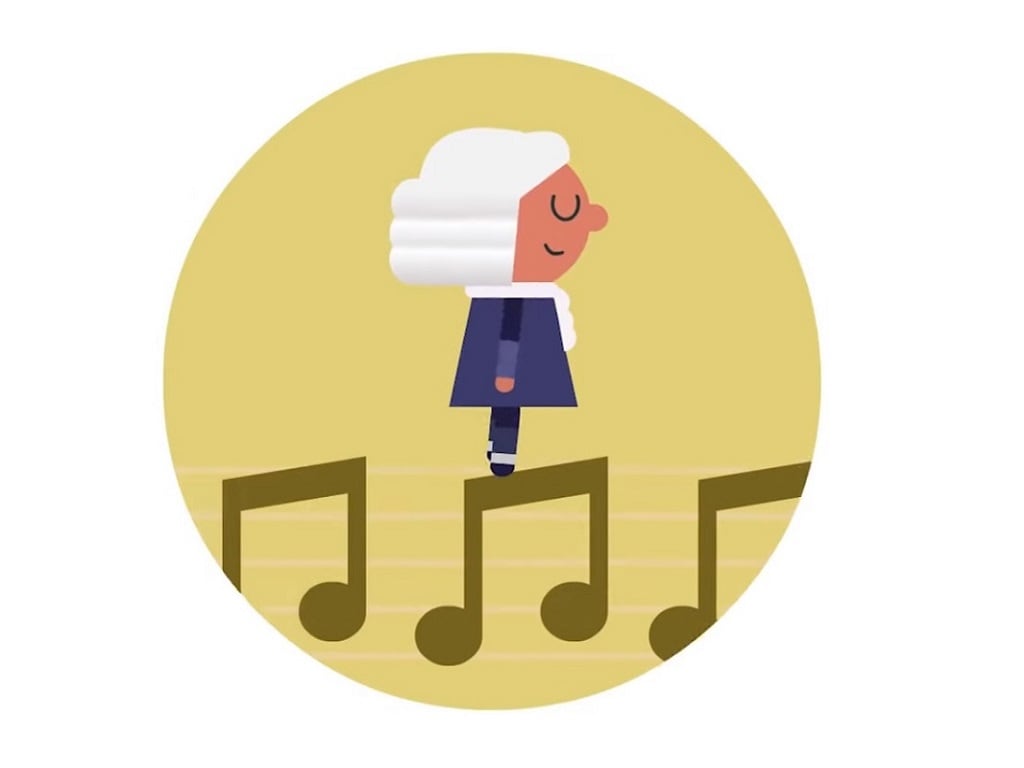 A cartoon caricature of Johann Sebastian Bach.[/caption]The doodle gives you a preview of how notes and melodies work, and how harmonies are formed. Once you get a little hang of that, it then lets you create your own. Google will ask you to compose a two measure melody of your choice, which Google then harmonises using Machine Learning. Believe me, how much ever bad your melody is, the AI is going to make your choice of notes sound really awesome, at least to you it would.You can download the music you create and even share it on your social media platforms.Here is the one I created. I am convinced that Bach's blood runs in my veins!
Google says, "The model used in today's Doodle was developed by Magenta Team AI Resident Anna Huang, who developed Coconet: a versatile model that can be used in a wide range of musical tasks—such as harmonizing melodies or composing from scratch."[caption id="attachment_6305781" align="alignnone" width="1280"]
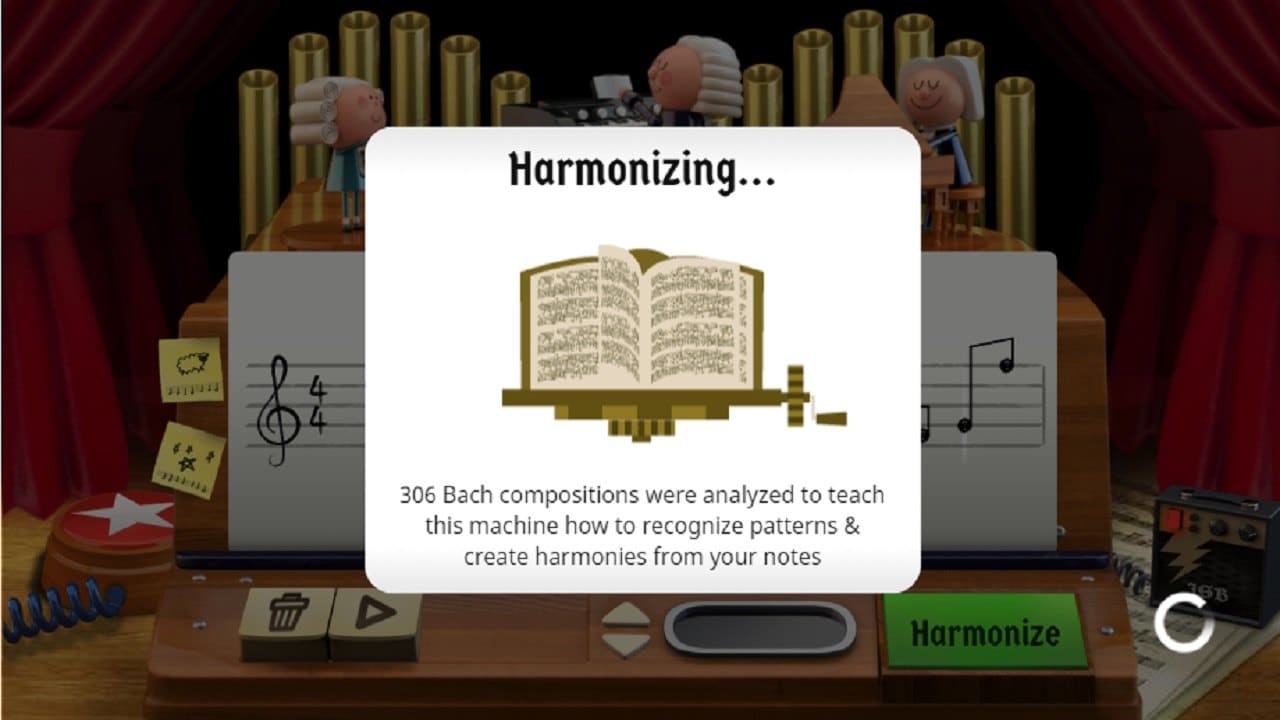 Coconet was trained on 306 of Bach’s chorale harmonizations.[/caption]As the doodle reveals when the harmony is being processed, Coconet was trained on 306 of Bach’s chorale harmonisations. Apparently, Bach's chorales always have four voices, each carrying their own melodic line, while creating a rich harmonic progression when played together. This structure created a mould for the machine learning model to be trained.Johann Sebastian Bach was born in the small German town of Eisenach on this day in 1685. From the age of 10, he was brought up by his elder brother, who was also a musician. Primarily known as an exceptional organist during his lifetime, Bach also understood how to build and repair the complex inner mechanisms of pipe organs. He lived to see only a handful of his works published, but more than 1,000 that survived in manuscript form are now published and performed all over the world.
First Published:Mar 22, 2019, 08:11:10 IST
Advertisement
Advertisement

Why AI notetakers are raising serious privacy and security concerns
AI notetakers promise effortless meeting summaries, but experts warn they could expose confidential conversations, corporate secrets and personal voiceprints. As businesses increasingly adopt AI-powered meeting assistants, questions over data storage, privacy, consent and legal risks are becoming impossible to ignore
5 min read
China's low-cost AI models are changing the global AI race. Here's why Silicon Valley is worried
As Chinese firms continue to improve performance while keeping prices low, the AI race is no longer just about building the smartest model—it is increasingly becoming a battle over who can deliver the best value
2 min read
China's Kimi K3 challenges US AI leaders with frontier-level performance at lower cost
Chinese artificial intelligence startup Moonshot AI has unveiled its latest open-weight AI model, Kimi K3, with early results suggesting it could compete with some of the world's most advanced AI systems developed by leading US companies
2 min read
How did Instagram run ads promoting child abuse in India?
India has issued a notice to Meta after an investigation alleged that Instagram displayed paid advertisements promoting child sexual abuse material. MeitY ordered Meta to remove such Instagram ads and explain within seven days how they were approved
8 min read
Why has India halted WhatsApp’s username feature before launch?
India has halted WhatsApp’s planned username feature, citing concerns about cybercrime, impersonation, and law enforcement challenges. As Meta races to address security concerns, here’s why MeitY has paused the rollout, what the feature does, and how it could influence privacy and online safety in India
3 min read
Advertisement
Advertisement