


IRNSS-1H mission failure attributed to pyro elements, for the non-separation of the heat shield, suspects ISRO
One fortunate aspect of the failure is that ISRO has all the flight data as the rocket was not lost during its one way journey.

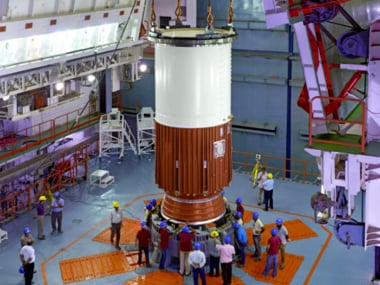
The core stage of the PSLV-C39 during assembly. Image: ISRO[/caption]As a result of the heat shield not separating the 1,425 kg navigation satellite IRNSS-1H got stuck inside it resulting in the failure of the around Rs 250 crore mission.Normally, the heat shield will be separated soon after the rocket crosses the earth's atmosphere.According to K Sivan, director, Vikram Sarabhai Space Centre (VSSC), all the systems during the rocket's flight worked well while the only suspect place is the pyro elements.The VSSC is part of the Indian Space Research Organisation (ISRO)."Tests are going on to find out the reasons for the failure of heat shield separation. Each test takes around 72 hours," Sivan told IANS.One fortunate aspect of the failure is that ISRO has all the flight data as the rocket was not lost during its one-way journey.Sivan said the heat shield would separate after onboard computers give the command to ignite the explosives. The explosives would then ignite and explode to separate the two parts of the heat shield joined by bolts.

Why AI notetakers are raising serious privacy and security concerns
China's low-cost AI models are changing the global AI race. Here's why Silicon Valley is worried
China's Kimi K3 challenges US AI leaders with frontier-level performance at lower cost
How did Instagram run ads promoting child abuse in India?
Why has India halted WhatsApp’s username feature before launch?