
Advertisement


Sections
Facebook and Twitter shrug off responsibility, make promises that aren't enough
Facebook, Twitter testified before Congress, acknowledging that they were slow to act, ill-prepared.

Facebook’s chief operating officer Sheryl Sandberg and Twitter’s CEO Jack Dorsey appeared on 5 September in the US Congress to defend their respective companies from doubts over their preparedness to combat foreign interference to influence US politics.This comes just one year after both Sandberg and Dorsey, told the same panel that Russia had interfered during the 2016 US elections by using inauthentic accounts to send misleading political messages.[caption id="attachment_5130111" align="alignnone" width="1024"]![Twitter CEO Jack Dorsey and Facebook COO Sheryl Sandberg arrive to testify before a Senate Intelligence Committee hearing on foreign influence operations on social media platforms. Image: Reuters]() Twitter CEO Jack Dorsey and Facebook COO Sheryl Sandberg arrive to testify before a Senate Intelligence Committee hearing on foreign influence operations on social media platforms. Image: Reuters[/caption]While Sandberg and Dorsey did okay, their promises weren’t enough for us to believe that tech giants are going to see an overhaul in their systems, or if they are really going to be regulated by lawmakers.Google, on the other hand, simply did not show up.Let’s take a quick look at what happened.Facebook and Twitter acknowledged that they were slow to act and ill preparedLawmakers are now, more than ever asking these companies to assure that the tech space has taken adequate measures and is prepared for the midterm elections that are approaching.Senator Richard Burr, who is the chairman of the Senate Intelligence Committee, who opened the hearing said that they have “learned about how vulnerable social media is to corruption and misuse. The very worst examples of this are absolutely chilling and a threat to our democracy."While both Facebook and Twitter argued strongly that they had taken steps to clean up their platforms before the 2018 elections approach, they did acknowledge that they were slow to act and ill-prepared in the past.[caption id="attachment_5129431" align="alignnone" width="1280"]
Twitter CEO Jack Dorsey and Facebook COO Sheryl Sandberg arrive to testify before a Senate Intelligence Committee hearing on foreign influence operations on social media platforms. Image: Reuters[/caption]While Sandberg and Dorsey did okay, their promises weren’t enough for us to believe that tech giants are going to see an overhaul in their systems, or if they are really going to be regulated by lawmakers.Google, on the other hand, simply did not show up.Let’s take a quick look at what happened.Facebook and Twitter acknowledged that they were slow to act and ill preparedLawmakers are now, more than ever asking these companies to assure that the tech space has taken adequate measures and is prepared for the midterm elections that are approaching.Senator Richard Burr, who is the chairman of the Senate Intelligence Committee, who opened the hearing said that they have “learned about how vulnerable social media is to corruption and misuse. The very worst examples of this are absolutely chilling and a threat to our democracy."While both Facebook and Twitter argued strongly that they had taken steps to clean up their platforms before the 2018 elections approach, they did acknowledge that they were slow to act and ill-prepared in the past.[caption id="attachment_5129431" align="alignnone" width="1280"]![Facebook COO Sheryl Sandberg testifies before a Senate Intelligence Committee hearing on foreign influence operations on social media platforms on Capitol Hill in Washington, U.S., September 5, 2018. REUTERS/Joshua Roberts - RC11AE857540]() Facebook COO Sheryl Sandberg testifies before a Senate Intelligence Committee hearing on foreign influence operations on social media platforms. Image: Reuters[/caption]Sandberg said in a statement, “We were too slow to spot this and too slow to act. That's on us. This interference was completely unacceptable. It violated the values of our company and of the country we love."Dorsey, on the other hand, said, “We found ourselves unprepared and ill-equipped for the immensity of the problems we've acknowledged. Abuse, harassment, troll armies, propaganda through bots and human coordination, disinformation campaigns and divisive filter bubbles -- that's not a healthy public square."Can US lawmakers really figure out constructive ways to aid social media companies solve such complex problems?From the kind of questions that the Senate posed, it looks like they might, after all, have ways in which they can help these companies. While most questions were posed pointing towards the companies’ efforts to keep Russia and Iran from meddling with elections, what was interesting was that the senators asked companies things like, were they ‘American enough’ and how much money was made by the companies due to Russian efforts in 2016.For those unaware, Iran has been responsible for a big disinformation operation on Facebook which targeted thousands of people around the world. Facebook then stopped stealth misinformation campaigns from Iran and also Russia, shutting down accounts as part of its battle against fake news ahead of elections in the United States and elsewhere.Nothing much came out of the hearing, the promises were half-bakedFacebook and Twitter assured that they are working hard to filter foreign interference that sows discord in America especially during elections, but that’s about it. They pledged to protect their respective platforms against manipulation but did not explain ways that they will do so.Sandberg said that Facebook will fight the problem with new technology and manpower. "We are even more determined than our adversaries, and we will continue to fight back," she said. She stressed that Facebook is working towards hiring more people to review content and is also investing more heavily in artificial intelligence that can spot fake accounts.[caption id="attachment_5129391" align="alignnone" width="1280"]
Facebook COO Sheryl Sandberg testifies before a Senate Intelligence Committee hearing on foreign influence operations on social media platforms. Image: Reuters[/caption]Sandberg said in a statement, “We were too slow to spot this and too slow to act. That's on us. This interference was completely unacceptable. It violated the values of our company and of the country we love."Dorsey, on the other hand, said, “We found ourselves unprepared and ill-equipped for the immensity of the problems we've acknowledged. Abuse, harassment, troll armies, propaganda through bots and human coordination, disinformation campaigns and divisive filter bubbles -- that's not a healthy public square."Can US lawmakers really figure out constructive ways to aid social media companies solve such complex problems?From the kind of questions that the Senate posed, it looks like they might, after all, have ways in which they can help these companies. While most questions were posed pointing towards the companies’ efforts to keep Russia and Iran from meddling with elections, what was interesting was that the senators asked companies things like, were they ‘American enough’ and how much money was made by the companies due to Russian efforts in 2016.For those unaware, Iran has been responsible for a big disinformation operation on Facebook which targeted thousands of people around the world. Facebook then stopped stealth misinformation campaigns from Iran and also Russia, shutting down accounts as part of its battle against fake news ahead of elections in the United States and elsewhere.Nothing much came out of the hearing, the promises were half-bakedFacebook and Twitter assured that they are working hard to filter foreign interference that sows discord in America especially during elections, but that’s about it. They pledged to protect their respective platforms against manipulation but did not explain ways that they will do so.Sandberg said that Facebook will fight the problem with new technology and manpower. "We are even more determined than our adversaries, and we will continue to fight back," she said. She stressed that Facebook is working towards hiring more people to review content and is also investing more heavily in artificial intelligence that can spot fake accounts.[caption id="attachment_5129391" align="alignnone" width="1280"]![Twitter CEO Jack Dorsey testifies before a Senate Intelligence Committee hearing on foreign influence operations on social media platforms on Capitol Hill in Washington, U.S., September 5, 2018. REUTERS/Joshua Roberts - RC175B286490]() Twitter CEO Jack Dorsey testifies before a Senate Intelligence Committee hearing on foreign influence operations on social media platforms. Image: Reuters[/caption]Dorsey, holding his phone throughout the meeting, tweeted some of his opening statement to the Senate.He added that the platform is planning to label automated accounts or bots. He did say that “It's really a question of the implementation, but we are interested in it, and we are going to do something along those lines,” which is not very convincing.While the questions aimed at the companies were important and necessary, from the entire hearing we cannot gather much about what the companies are actually going to about the misinformation on their platforms. In fact, in the scheme of things, it looks like if something really going to happen in terms of regulating Facebook and Twitter, it is going to happen on the back end. It is not going to happen in public.Google did not bother joining the hearingGoogle decided to pass on the chance to defend itself. It simply did not show up at the hearing. Its empty chair might just intensify the pressure against the company from lawmakers.The Panel had earlier refused Google’s offer to send its legal and policy Chief Kent Walker. It however accepted company CEO Sundar Pichai.“I’m deeply disappointed that Google — one of the most influential digital platforms in the world — chose not to send its own top corporate leadership to engage this committee,” said Senator Mark Warner.Google’s absence, especially just two months away from the mid-term elections, does not show well on the company’s part. It is glaring and disappointing for many, given the company’s size and its influence. The move might have just put the company to further scrutiny than before.Republican Senator Marco Rubio said the company might have skipped the hearing because it was “arrogant.”What now?Social media platforms will now face questions from the Department of Justice (DOJ) over allegations of political bias, an issue flagged by US President Donald Trump. The meeting will take place on 25 September, and concerns that social media platforms are “intentionally stifling the free exchange of ideas” will be discussed.The statement was released by the DOJ on 5 September, however, it does not explicitly mention Facebook and Twitter. It neither known which state attorneys general would attend.
Twitter CEO Jack Dorsey testifies before a Senate Intelligence Committee hearing on foreign influence operations on social media platforms. Image: Reuters[/caption]Dorsey, holding his phone throughout the meeting, tweeted some of his opening statement to the Senate.He added that the platform is planning to label automated accounts or bots. He did say that “It's really a question of the implementation, but we are interested in it, and we are going to do something along those lines,” which is not very convincing.While the questions aimed at the companies were important and necessary, from the entire hearing we cannot gather much about what the companies are actually going to about the misinformation on their platforms. In fact, in the scheme of things, it looks like if something really going to happen in terms of regulating Facebook and Twitter, it is going to happen on the back end. It is not going to happen in public.Google did not bother joining the hearingGoogle decided to pass on the chance to defend itself. It simply did not show up at the hearing. Its empty chair might just intensify the pressure against the company from lawmakers.The Panel had earlier refused Google’s offer to send its legal and policy Chief Kent Walker. It however accepted company CEO Sundar Pichai.“I’m deeply disappointed that Google — one of the most influential digital platforms in the world — chose not to send its own top corporate leadership to engage this committee,” said Senator Mark Warner.Google’s absence, especially just two months away from the mid-term elections, does not show well on the company’s part. It is glaring and disappointing for many, given the company’s size and its influence. The move might have just put the company to further scrutiny than before.Republican Senator Marco Rubio said the company might have skipped the hearing because it was “arrogant.”What now?Social media platforms will now face questions from the Department of Justice (DOJ) over allegations of political bias, an issue flagged by US President Donald Trump. The meeting will take place on 25 September, and concerns that social media platforms are “intentionally stifling the free exchange of ideas” will be discussed.The statement was released by the DOJ on 5 September, however, it does not explicitly mention Facebook and Twitter. It neither known which state attorneys general would attend.
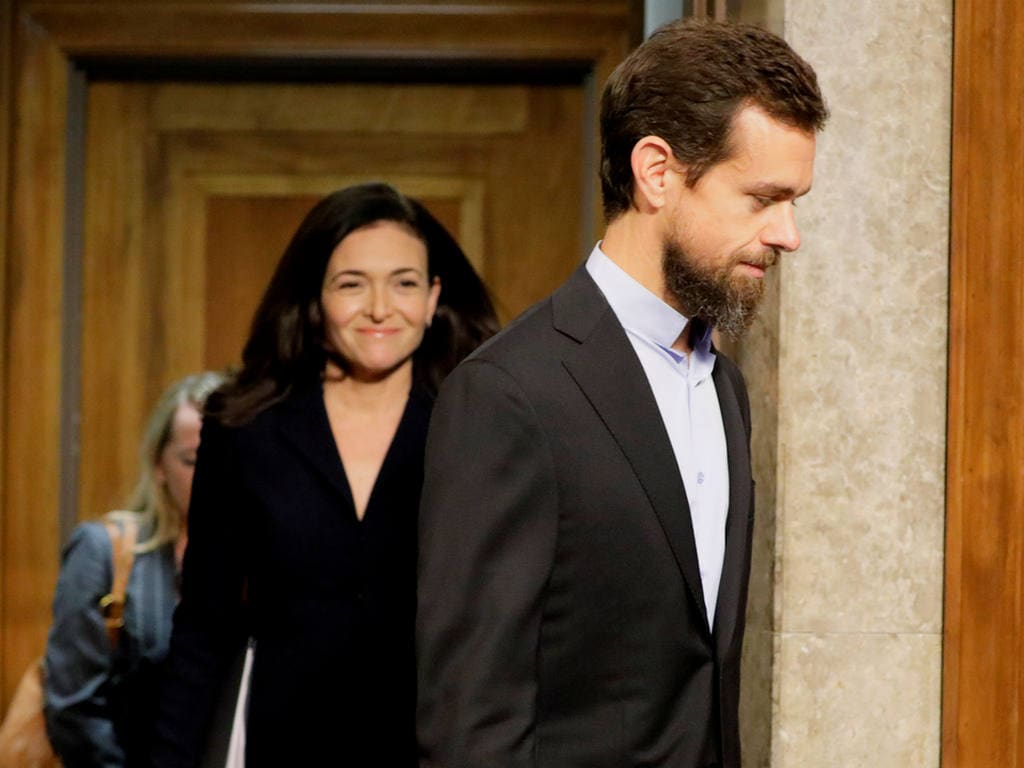 Twitter CEO Jack Dorsey and Facebook COO Sheryl Sandberg arrive to testify before a Senate Intelligence Committee hearing on foreign influence operations on social media platforms. Image: Reuters[/caption]While Sandberg and Dorsey did okay, their promises weren’t enough for us to believe that tech giants are going to see an overhaul in their systems, or if they are really going to be regulated by lawmakers.Google, on the other hand, simply did not show up.Let’s take a quick look at what happened.Facebook and Twitter acknowledged that they were slow to act and ill preparedLawmakers are now, more than ever asking these companies to assure that the tech space has taken adequate measures and is prepared for the midterm elections that are approaching.Senator Richard Burr, who is the chairman of the Senate Intelligence Committee, who opened the hearing said that they have “learned about how vulnerable social media is to corruption and misuse. The very worst examples of this are absolutely chilling and a threat to our democracy."While both Facebook and Twitter argued strongly that they had taken steps to clean up their platforms before the 2018 elections approach, they did acknowledge that they were slow to act and ill-prepared in the past.[caption id="attachment_5129431" align="alignnone" width="1280"]
 Facebook COO Sheryl Sandberg testifies before a Senate Intelligence Committee hearing on foreign influence operations on social media platforms. Image: Reuters[/caption]Sandberg said in a statement, “We were too slow to spot this and too slow to act. That's on us. This interference was completely unacceptable. It violated the values of our company and of the country we love."Dorsey, on the other hand, said, “We found ourselves unprepared and ill-equipped for the immensity of the problems we've acknowledged. Abuse, harassment, troll armies, propaganda through bots and human coordination, disinformation campaigns and divisive filter bubbles -- that's not a healthy public square."Can US lawmakers really figure out constructive ways to aid social media companies solve such complex problems?From the kind of questions that the Senate posed, it looks like they might, after all, have ways in which they can help these companies. While most questions were posed pointing towards the companies’ efforts to keep Russia and Iran from meddling with elections, what was interesting was that the senators asked companies things like, were they ‘American enough’ and how much money was made by the companies due to Russian efforts in 2016.For those unaware, Iran has been responsible for a big disinformation operation on Facebook which targeted thousands of people around the world. Facebook then stopped stealth misinformation campaigns from Iran and also Russia, shutting down accounts as part of its battle against fake news ahead of elections in the United States and elsewhere.Nothing much came out of the hearing, the promises were half-bakedFacebook and Twitter assured that they are working hard to filter foreign interference that sows discord in America especially during elections, but that’s about it. They pledged to protect their respective platforms against manipulation but did not explain ways that they will do so.Sandberg said that Facebook will fight the problem with new technology and manpower. "We are even more determined than our adversaries, and we will continue to fight back," she said. She stressed that Facebook is working towards hiring more people to review content and is also investing more heavily in artificial intelligence that can spot fake accounts.[caption id="attachment_5129391" align="alignnone" width="1280"]
 Twitter CEO Jack Dorsey testifies before a Senate Intelligence Committee hearing on foreign influence operations on social media platforms. Image: Reuters[/caption]Dorsey, holding his phone throughout the meeting, tweeted some of his opening statement to the Senate.He added that the platform is planning to label automated accounts or bots. He did say that “It's really a question of the implementation, but we are interested in it, and we are going to do something along those lines,” which is not very convincing.While the questions aimed at the companies were important and necessary, from the entire hearing we cannot gather much about what the companies are actually going to about the misinformation on their platforms. In fact, in the scheme of things, it looks like if something really going to happen in terms of regulating Facebook and Twitter, it is going to happen on the back end. It is not going to happen in public.Google did not bother joining the hearingGoogle decided to pass on the chance to defend itself. It simply did not show up at the hearing. Its empty chair might just intensify the pressure against the company from lawmakers.The Panel had earlier refused Google’s offer to send its legal and policy Chief Kent Walker. It however accepted company CEO Sundar Pichai.“I’m deeply disappointed that Google — one of the most influential digital platforms in the world — chose not to send its own top corporate leadership to engage this committee,” said Senator Mark Warner.Google’s absence, especially just two months away from the mid-term elections, does not show well on the company’s part. It is glaring and disappointing for many, given the company’s size and its influence. The move might have just put the company to further scrutiny than before.Republican Senator Marco Rubio said the company might have skipped the hearing because it was “arrogant.”What now?Social media platforms will now face questions from the Department of Justice (DOJ) over allegations of political bias, an issue flagged by US President Donald Trump. The meeting will take place on 25 September, and concerns that social media platforms are “intentionally stifling the free exchange of ideas” will be discussed.The statement was released by the DOJ on 5 September, however, it does not explicitly mention Facebook and Twitter. It neither known which state attorneys general would attend.
First Published:Sep 06, 2018, 17:22:33 IST
Advertisement
Advertisement

Why AI notetakers are raising serious privacy and security concerns
AI notetakers promise effortless meeting summaries, but experts warn they could expose confidential conversations, corporate secrets and personal voiceprints. As businesses increasingly adopt AI-powered meeting assistants, questions over data storage, privacy, consent and legal risks are becoming impossible to ignore
5 min read
China's low-cost AI models are changing the global AI race. Here's why Silicon Valley is worried
As Chinese firms continue to improve performance while keeping prices low, the AI race is no longer just about building the smartest model—it is increasingly becoming a battle over who can deliver the best value
2 min read
China's Kimi K3 challenges US AI leaders with frontier-level performance at lower cost
Chinese artificial intelligence startup Moonshot AI has unveiled its latest open-weight AI model, Kimi K3, with early results suggesting it could compete with some of the world's most advanced AI systems developed by leading US companies
2 min read
How did Instagram run ads promoting child abuse in India?
India has issued a notice to Meta after an investigation alleged that Instagram displayed paid advertisements promoting child sexual abuse material. MeitY ordered Meta to remove such Instagram ads and explain within seven days how they were approved
8 min read
Why has India halted WhatsApp’s username feature before launch?
India has halted WhatsApp’s planned username feature, citing concerns about cybercrime, impersonation, and law enforcement challenges. As Meta races to address security concerns, here’s why MeitY has paused the rollout, what the feature does, and how it could influence privacy and online safety in India
3 min read
Advertisement
Advertisement