
Advertisement


Sections
CMU researchers develop algorithm that suggests telescopic shapes for robots that expand or shrink
The algorithm can be used to build robots that can navigate past obstacles, fit into tiny spaces and collapse for easy transportation.

[caption id="attachment_3879291" align="alignleft" width="380"]![Image: CMU]() Image: CMU[/caption]Researchers from the Carnegie Mellon University (CMU) have developed an algorithm that suggests telescopic shapes for devices and structures. The algorithm can be used to build robots that can navigate past obstacles, fit into tiny spaces and collapse for easy transportation. Given a curve, the computer suggests a telescopic structure following the curve. Any 3D mesh can be collapsed into a curve, so the method can be used to make robots that mimic the appearance of animals, such as a lizard, a giraffe or a brachiosaurus.Keenan Crane, assistant professor of computer science said, "Telescoping mechanisms are very useful for designing deployable structures. They can collapse down into really small volumes and, when you need them, are easily expanded." The resulting structures can be 3D printed for use. One of the applications apart from robotics, is to create collapsible structures for shelters. The researchers have used 3D printing to demonstrate a collapsible frame for a tent.The simple to use tool allows even novices to design complex collapsible structures. Then algorithm automatically adjusts the structure to minimise the wastage of space, and to ensure that the expanded structures has no parts that bump into each other. Once portions of the telescope have been extended, they can be twisted and turned into new shapes as the segments have a circular cross section.
Image: CMU[/caption]Researchers from the Carnegie Mellon University (CMU) have developed an algorithm that suggests telescopic shapes for devices and structures. The algorithm can be used to build robots that can navigate past obstacles, fit into tiny spaces and collapse for easy transportation. Given a curve, the computer suggests a telescopic structure following the curve. Any 3D mesh can be collapsed into a curve, so the method can be used to make robots that mimic the appearance of animals, such as a lizard, a giraffe or a brachiosaurus.Keenan Crane, assistant professor of computer science said, "Telescoping mechanisms are very useful for designing deployable structures. They can collapse down into really small volumes and, when you need them, are easily expanded." The resulting structures can be 3D printed for use. One of the applications apart from robotics, is to create collapsible structures for shelters. The researchers have used 3D printing to demonstrate a collapsible frame for a tent.The simple to use tool allows even novices to design complex collapsible structures. Then algorithm automatically adjusts the structure to minimise the wastage of space, and to ensure that the expanded structures has no parts that bump into each other. Once portions of the telescope have been extended, they can be twisted and turned into new shapes as the segments have a circular cross section.
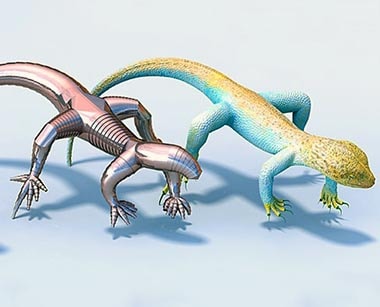 Image: CMU[/caption]Researchers from the Carnegie Mellon University (CMU) have developed an algorithm that suggests telescopic shapes for devices and structures. The algorithm can be used to build robots that can navigate past obstacles, fit into tiny spaces and collapse for easy transportation. Given a curve, the computer suggests a telescopic structure following the curve. Any 3D mesh can be collapsed into a curve, so the method can be used to make robots that mimic the appearance of animals, such as a lizard, a giraffe or a brachiosaurus.Keenan Crane, assistant professor of computer science said, "Telescoping mechanisms are very useful for designing deployable structures. They can collapse down into really small volumes and, when you need them, are easily expanded." The resulting structures can be 3D printed for use. One of the applications apart from robotics, is to create collapsible structures for shelters. The researchers have used 3D printing to demonstrate a collapsible frame for a tent.
First Published:Aug 01, 2017, 06:53:00 IST
Advertisement
Advertisement

Why AI notetakers are raising serious privacy and security concerns
AI notetakers promise effortless meeting summaries, but experts warn they could expose confidential conversations, corporate secrets and personal voiceprints. As businesses increasingly adopt AI-powered meeting assistants, questions over data storage, privacy, consent and legal risks are becoming impossible to ignore
5 min read
China's low-cost AI models are changing the global AI race. Here's why Silicon Valley is worried
As Chinese firms continue to improve performance while keeping prices low, the AI race is no longer just about building the smartest model—it is increasingly becoming a battle over who can deliver the best value
2 min read
China's Kimi K3 challenges US AI leaders with frontier-level performance at lower cost
Chinese artificial intelligence startup Moonshot AI has unveiled its latest open-weight AI model, Kimi K3, with early results suggesting it could compete with some of the world's most advanced AI systems developed by leading US companies
2 min read
How did Instagram run ads promoting child abuse in India?
India has issued a notice to Meta after an investigation alleged that Instagram displayed paid advertisements promoting child sexual abuse material. MeitY ordered Meta to remove such Instagram ads and explain within seven days how they were approved
8 min read
Why has India halted WhatsApp’s username feature before launch?
India has halted WhatsApp’s planned username feature, citing concerns about cybercrime, impersonation, and law enforcement challenges. As Meta races to address security concerns, here’s why MeitY has paused the rollout, what the feature does, and how it could influence privacy and online safety in India
3 min read
Advertisement
Advertisement