


Chinese quantum satellite sends an 'unbreakable code', the answer to hack-proof communication
China launched the world's first quantum satellite last August, to help establish "hack proof" communications such as safe phone calls, or bank data.

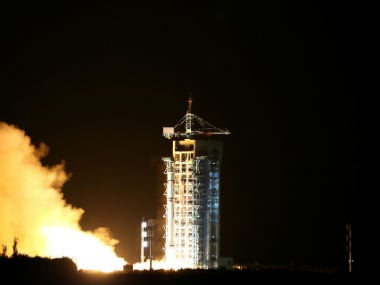
China launched world's first quantum satellite. Reuters.[/caption]China launched the world's first quantum satellite last August, to help establish "hack proof" communications, a development the Pentagon has called a "notable advance". The official Xinhua news agency said the latest experiment was published in the journal Nature on Thursday, where reviewers called it a "milestone".
The satellite sent quantum keys to ground stations in China between 645 km (400 miles) and 1,200 km (745 miles) away at a transmission rate up to 20 orders of magnitude more efficient than an optical fibre, Xinhua cited Pan Jianwei, lead scientist on the experiment from the state-run Chinese Academy of Sciences, as saying.
"That, for instance, can meet the demand of making an absolute safe phone call or transmitting a large amount of bank data," Pan said. Any attempt to eavesdrop on the quantum channel would introduce detectable disturbances to the system, Pan said.
"Once intercepted or measured, the quantum state of the key will change, and the information being intercepted will self-destruct," Xinhua said. The news agency said there were "enormous prospects" for applying this new generation of communications in defence and finance. China still lags behind the United States and Russia in space technology, although President Xi Jinping has prioritised advancing its space programme, citing national security and defence.China insists its space programme is for peaceful purposes, but the US Defense Department has highlighted its increasing space capabilities, saying it was pursuing activities aimed at preventing adversaries from using space-based assets in a crisis.
 More from News Analysis
Why AI notetakers are raising serious privacy and security concerns
China's low-cost AI models are changing the global AI race. Here's why Silicon Valley is worried
China's Kimi K3 challenges US AI leaders with frontier-level performance at lower cost
How did Instagram run ads promoting child abuse in India?
Why has India halted WhatsApp’s username feature before launch?