


China launches two navigation satellites; will provide services for Belt and Road initiative
Named after the Chinese term for the plough or the Big Dipper constellation, the BeiDou project was formally initiated in 1994. It began to serve China in 2000 and the Asia-Pacific region at the end of 2012.

China, which is building its own navigation system to rival United States GPS, has launched two BeiDou-3 satellites into space through a single carrier rocket.[caption id="attachment_2947262" align="alignleft" width="380"]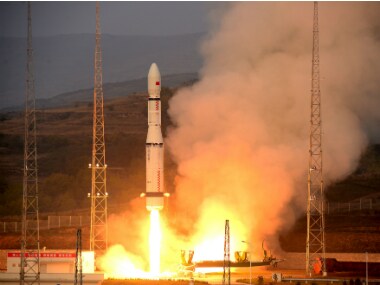 Representational image. Reuters[/caption]The satellites were launched aboard a Long March-3B carrier rocket last night from Xichang Satellite Launch Center in the southwestern province of Sichuan, state-run news agency Xinhua said today.The two newly-launched satellites represent the third phase of the BeiDou Navigation Satellite System.This system will provide services for countries involved in the Belt and Road Initiative, and form a complete global satellite navigation system by 2020, by which time China plans to have more than 30 satellites.If everything goes according to the plan, China will become the third country in the world after the US and Russia to operate its own navigation system.Named after the Chinese term for the plough or the Big Dipper constellation, the BeiDou project was formally initiated in 1994. It began to serve China in 2000 and the Asia-Pacific region at the end of 2012.Compared to earlier generation satellites, the BeiDou-3 is able to send signals that are better compatible with other satellite navigation systems and provide satellite-based augmentation, as well as search and rescue services in accordance with international standards."New technology has significantly improved the performance of the BeiDou-3, with the signal accuracy in space higher than half a meter while its positioning accuracy has reached 2.5 to five meters," said Yang Changfeng, chief designer of the BeiDou system."Launches featuring two or more satellites on a single carrier rocket will be conducted regularly," Ye Chengmin, deputy chief designer of the Long March-3A carrier rocket said. All the BeiDou satellites currently in space were sent up from Xichang Satellite Launch Center, said Lin Yunan, head of the human resources department of the center. The BeiDou-3 satellites and the carrier rocket were developed by China Academy of Space Technology and China Academy of Launch Vehicle Technology, respectively.

Why AI notetakers are raising serious privacy and security concerns
China's low-cost AI models are changing the global AI race. Here's why Silicon Valley is worried
China's Kimi K3 challenges US AI leaders with frontier-level performance at lower cost
How did Instagram run ads promoting child abuse in India?
Why has India halted WhatsApp’s username feature before launch?