
Advertisement


Sections
Baba Ramdev's Patanjali launches messaging app Kimbho that has ambitions to take on WhatsApp
We took a look at the app and cannot help but notice its similarity to WhatsApp, 'its rival'.

After paving into the FMCG sector, then dipping toes in telecom recently with the Patanjali SIM, Yoga guru Baba Ramdev has now entered the digital sector with the launch of a ‘swadeshi’ version of WhatsApp, or what they like to call, the Kimbho app. But the app has suddenly disappeared from the Google Play Store list.[caption id="attachment_4489373" align="alignleft" width="380"]![Kimbho App. Google PlayStore.]() Kimbho App. Google PlayStore.[/caption]The app, which is being called the Bharat first messaging app, was launched on 30 May in New Delhi. Patanjali spokesperson SK Tijarawala tweeted that the app is a #SwadeshiMessagingPlatform. According to him, Kimbho is a Sanskrit word which means “How are you?”So they literally looked up what 'What's up' is called in Sanskrit? Great!We took a look at the app and cannot help but notice its similarities to WhatsApp. To begin with, the logo is pretty much the same as WhatsApp's. Except the telephone icon in the middle of the chat bubbles in WhatsApp, Kimbho's logo has a conch in that chat bubble, assuming that is how people would call each other in the ancient ages. Though Kimbho is entirely different in terms of the shade green they have used in the logo, a lot punchy and brighter, we must say.Entering the app, the registration is quite basic like every other platform, you add your number and verify using an OTP sent by Kimbho. After that, all your saved contacts appear in your contact list. Since it is in the beta stage (beta 0.95), it could be missing some details required for messaging apps.The app's homepage has three tabs: Chats, Contacts, Activity. In Chat, your chats with your contacts will appear. In the Contacts section, there are contacts and three other features. These include Create New Group, Broadcast Lists, Follow Celebrities, and Kimbho Team.While the former two are similar to WhatsApp, Follow Celebrities page is empty, one can assume it to be like Instagram or Twitter where users can explore follow celebrities accounts. Finally, there is Kimbho Team where users can seek help regarding the app.As of now, users are free to send messages to their friends even if they are not a part of the Kimbho, which is quite a strange. Inside the chat, you can see various options. It includes Quickies (quite a name!), shortcut to Gallery, stickers, voice recorder, and paint. In stickers, there are three sets of stickers. It includes funny caricatures of young aged man, an old middle-aged man and a middle-aged woman.In the Quickies section, there is a list of questionable intuitive messages. It includes suggestions like Namaste, Ram Ram, You know what I mean, Good Luck and many other.[caption id="attachment_4489381" align="alignnone" width="1280"]
Kimbho App. Google PlayStore.[/caption]The app, which is being called the Bharat first messaging app, was launched on 30 May in New Delhi. Patanjali spokesperson SK Tijarawala tweeted that the app is a #SwadeshiMessagingPlatform. According to him, Kimbho is a Sanskrit word which means “How are you?”So they literally looked up what 'What's up' is called in Sanskrit? Great!We took a look at the app and cannot help but notice its similarities to WhatsApp. To begin with, the logo is pretty much the same as WhatsApp's. Except the telephone icon in the middle of the chat bubbles in WhatsApp, Kimbho's logo has a conch in that chat bubble, assuming that is how people would call each other in the ancient ages. Though Kimbho is entirely different in terms of the shade green they have used in the logo, a lot punchy and brighter, we must say.Entering the app, the registration is quite basic like every other platform, you add your number and verify using an OTP sent by Kimbho. After that, all your saved contacts appear in your contact list. Since it is in the beta stage (beta 0.95), it could be missing some details required for messaging apps.The app's homepage has three tabs: Chats, Contacts, Activity. In Chat, your chats with your contacts will appear. In the Contacts section, there are contacts and three other features. These include Create New Group, Broadcast Lists, Follow Celebrities, and Kimbho Team.While the former two are similar to WhatsApp, Follow Celebrities page is empty, one can assume it to be like Instagram or Twitter where users can explore follow celebrities accounts. Finally, there is Kimbho Team where users can seek help regarding the app.As of now, users are free to send messages to their friends even if they are not a part of the Kimbho, which is quite a strange. Inside the chat, you can see various options. It includes Quickies (quite a name!), shortcut to Gallery, stickers, voice recorder, and paint. In stickers, there are three sets of stickers. It includes funny caricatures of young aged man, an old middle-aged man and a middle-aged woman.In the Quickies section, there is a list of questionable intuitive messages. It includes suggestions like Namaste, Ram Ram, You know what I mean, Good Luck and many other.[caption id="attachment_4489381" align="alignnone" width="1280"]![Kimbho has Quickies section, paint, and a help team section.]() Kimbho has Quickies section, paint, and a help team section.[/caption]In the app's third section is the activity section, where users can get updates about the activities of their friends, and is expected to be different from the chat section somehow.You can change your profile pictures and use the already fed pictures in Kimbho, or Gallery, or via camera.It also has a paint section, above three apps, near settings. This has different objects to write which include a quill, pencil, pen, and a paint brush.Since the app is still in beta stage, features like VoIP and video calls are yet to be a part of the system.[caption id="attachment_4489387" align="alignnone" width="1280"]
Kimbho has Quickies section, paint, and a help team section.[/caption]In the app's third section is the activity section, where users can get updates about the activities of their friends, and is expected to be different from the chat section somehow.You can change your profile pictures and use the already fed pictures in Kimbho, or Gallery, or via camera.It also has a paint section, above three apps, near settings. This has different objects to write which include a quill, pencil, pen, and a paint brush.Since the app is still in beta stage, features like VoIP and video calls are yet to be a part of the system.[caption id="attachment_4489387" align="alignnone" width="1280"]![Some of the stickers in the Kimbho app.]() Some of the stickers in the Kimbho app.[/caption]However, the biggest question is privacy. The Kimbho team claims that “Every message is end-to-end encrypted and secured by (Advanced Encryption Standard)". French security researcher, Elliot Anderson has already tweeted his reservations about the app.The researcher also claims that the app is a blatant copy of an existing messaging app. The launch of Kimbho has led to a flood of reactions on Twitter.
Some of the stickers in the Kimbho app.[/caption]However, the biggest question is privacy. The Kimbho team claims that “Every message is end-to-end encrypted and secured by (Advanced Encryption Standard)". French security researcher, Elliot Anderson has already tweeted his reservations about the app.The researcher also claims that the app is a blatant copy of an existing messaging app. The launch of Kimbho has led to a flood of reactions on Twitter.
 Kimbho App. Google PlayStore.[/caption]The app, which is being called the Bharat first messaging app, was launched on 30 May in New Delhi. Patanjali spokesperson SK Tijarawala tweeted that the app is a #SwadeshiMessagingPlatform. According to him, Kimbho is a Sanskrit word which means “How are you?”So they literally looked up what 'What's up' is called in Sanskrit? Great!We took a look at the app and cannot help but notice its similarities to WhatsApp. To begin with, the logo is pretty much the same as WhatsApp's. Except the telephone icon in the middle of the chat bubbles in WhatsApp, Kimbho's logo has a conch in that chat bubble, assuming that is how people would call each other in the ancient ages. Though Kimbho is entirely different in terms of the shade green they have used in the logo, a lot punchy and brighter, we must say.Entering the app, the registration is quite basic like every other platform, you add your number and verify using an OTP sent by Kimbho. After that, all your saved contacts appear in your contact list. Since it is in the beta stage (beta 0.95), it could be missing some details required for messaging apps.The app's homepage has three tabs: Chats, Contacts, Activity. In Chat, your chats with your contacts will appear. In the Contacts section, there are contacts and three other features. These include Create New Group, Broadcast Lists, Follow Celebrities, and Kimbho Team.
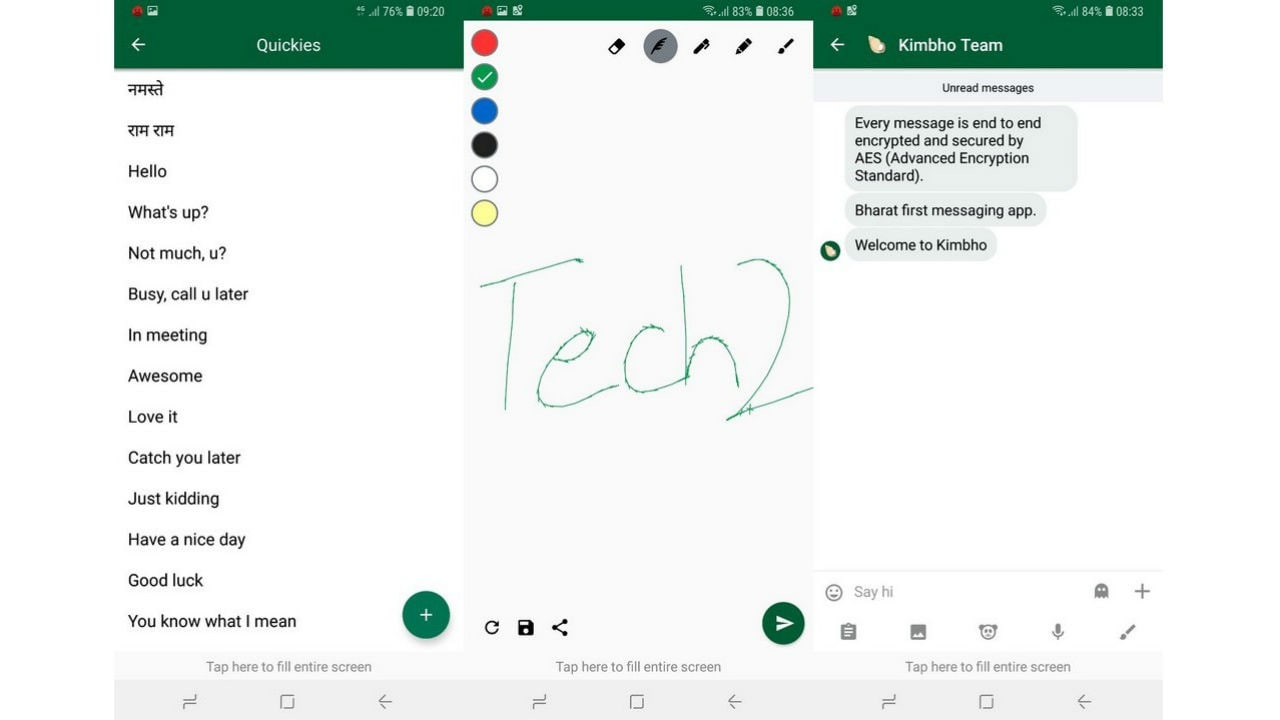 Kimbho has Quickies section, paint, and a help team section.[/caption]In the app's third section is the activity section, where users can get updates about the activities of their friends, and is expected to be different from the chat section somehow.You can change your profile pictures and use the already fed pictures in Kimbho, or Gallery, or via camera.It also has a paint section, above three apps, near settings. This has different objects to write which include a quill, pencil, pen, and a paint brush.Since the app is still in beta stage, features like VoIP and video calls are yet to be a part of the system.[caption id="attachment_4489387" align="alignnone" width="1280"]
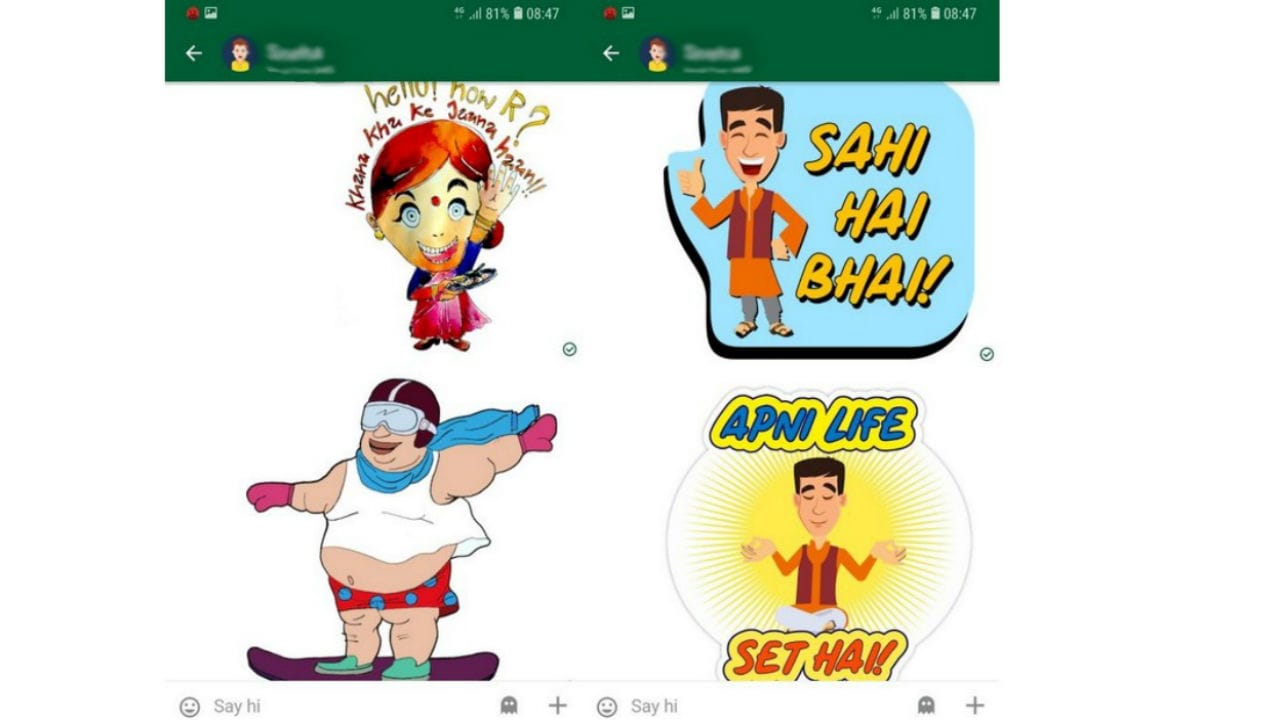 Some of the stickers in the Kimbho app.[/caption]However, the biggest question is privacy. The Kimbho team claims that “Every message is end-to-end encrypted and secured by (Advanced Encryption Standard)". French security researcher, Elliot Anderson has already tweeted his reservations about the app.The researcher also claims that the app is a blatant copy of an existing messaging app. The launch of Kimbho has led to a flood of reactions on Twitter.
With #KIMBHO one thing is clear that Ramdev is in full mood to come up with Indian version of Tinder called #SAMBHOG— Ritik Kalra (@ritikkalra) May 30, 2018 The official version of the app is yet to be seen in full swing. Ram Ram!
First Published:May 31, 2018, 11:34:14 IST
Advertisement
Advertisement

Why AI notetakers are raising serious privacy and security concerns
AI notetakers promise effortless meeting summaries, but experts warn they could expose confidential conversations, corporate secrets and personal voiceprints. As businesses increasingly adopt AI-powered meeting assistants, questions over data storage, privacy, consent and legal risks are becoming impossible to ignore
5 min read
China's low-cost AI models are changing the global AI race. Here's why Silicon Valley is worried
As Chinese firms continue to improve performance while keeping prices low, the AI race is no longer just about building the smartest model—it is increasingly becoming a battle over who can deliver the best value
2 min read
China's Kimi K3 challenges US AI leaders with frontier-level performance at lower cost
Chinese artificial intelligence startup Moonshot AI has unveiled its latest open-weight AI model, Kimi K3, with early results suggesting it could compete with some of the world's most advanced AI systems developed by leading US companies
2 min read
How did Instagram run ads promoting child abuse in India?
India has issued a notice to Meta after an investigation alleged that Instagram displayed paid advertisements promoting child sexual abuse material. MeitY ordered Meta to remove such Instagram ads and explain within seven days how they were approved
8 min read
Why has India halted WhatsApp’s username feature before launch?
India has halted WhatsApp’s planned username feature, citing concerns about cybercrime, impersonation, and law enforcement challenges. As Meta races to address security concerns, here’s why MeitY has paused the rollout, what the feature does, and how it could influence privacy and online safety in India
3 min read
Advertisement
Advertisement