
Advertisement


Sections
Astronomers confirm that Earth's tiny companion in its orbit around the sun is an asteroid and not space debris
The asteroid is similar to other near Earth objects, or NEOs, and was originally discovered in 2016.

Astronomers from the University of Arizona have confirmed that an object known as (469219) 2016 HO3 is an asteroid and not a piece of space debris, such as a burnt out rocket booster. The tiny object measures no more than 100 meters across, and the astronomers had to use one of the largest Earth based telescopes to study the object. The telescope is known as the Large Binocular Telescope (LBT), and is situated on Mount Graham in Arizona.[caption id="attachment_4162745" align="alignleft" width="380"]![Image: UA]() Image: UA[/caption]The asteroid is similar to other near Earth objects, or NEOs, and was originally discovered in 2016. The object is a companion to Earth, and moves around the Sun in such a way that it appears to orbit the Earth, but is not gravitationally bound to Earth. The object is relatively easy to reach, and is a promising target for future explorations. The findings were presented in the annual Division for Planetary Sciences Conference of the American Astronomical Society in Utah.Vishnu Reddy, the team lead for the study, says, "In an effort to constrain its rotation period and surface composition, we observed 2016 HO3 on April 14 and 18 with the Large Binocular Telescope and the Discovery Channel Telescope. The derived rotation period and the spectrum of emitted light are not uncommon among small NEOs, suggesting that 2016 HO3 is a natural object of similar provenance to other small NEOs."The object is of interest as some interpret its presence as evidence that the Earth has not cleared its orbit around the Sun, and has failed to capture 2016 HO3. The official definition of a planet according to the International Astronomical Union (IAU) is "A celestial body that (a) is in orbit around the Sun, (b) has sufficient mass for its self-gravity to overcome rigid body forces so that it assumes a hydrostatic equilibrium (nearly round) shape, and (c) has cleared the neighbourhood around its orbit." This implies that according to the official definition of a planet according to the International Astronomical Union, the Earth fails to qualify as a planet for the same reason that Pluto is no longer considered as a planet.
Image: UA[/caption]The asteroid is similar to other near Earth objects, or NEOs, and was originally discovered in 2016. The object is a companion to Earth, and moves around the Sun in such a way that it appears to orbit the Earth, but is not gravitationally bound to Earth. The object is relatively easy to reach, and is a promising target for future explorations. The findings were presented in the annual Division for Planetary Sciences Conference of the American Astronomical Society in Utah.Vishnu Reddy, the team lead for the study, says, "In an effort to constrain its rotation period and surface composition, we observed 2016 HO3 on April 14 and 18 with the Large Binocular Telescope and the Discovery Channel Telescope. The derived rotation period and the spectrum of emitted light are not uncommon among small NEOs, suggesting that 2016 HO3 is a natural object of similar provenance to other small NEOs."The object is of interest as some interpret its presence as evidence that the Earth has not cleared its orbit around the Sun, and has failed to capture 2016 HO3. The official definition of a planet according to the International Astronomical Union (IAU) is "A celestial body that (a) is in orbit around the Sun, (b) has sufficient mass for its self-gravity to overcome rigid body forces so that it assumes a hydrostatic equilibrium (nearly round) shape, and (c) has cleared the neighbourhood around its orbit." This implies that according to the official definition of a planet according to the International Astronomical Union, the Earth fails to qualify as a planet for the same reason that Pluto is no longer considered as a planet.
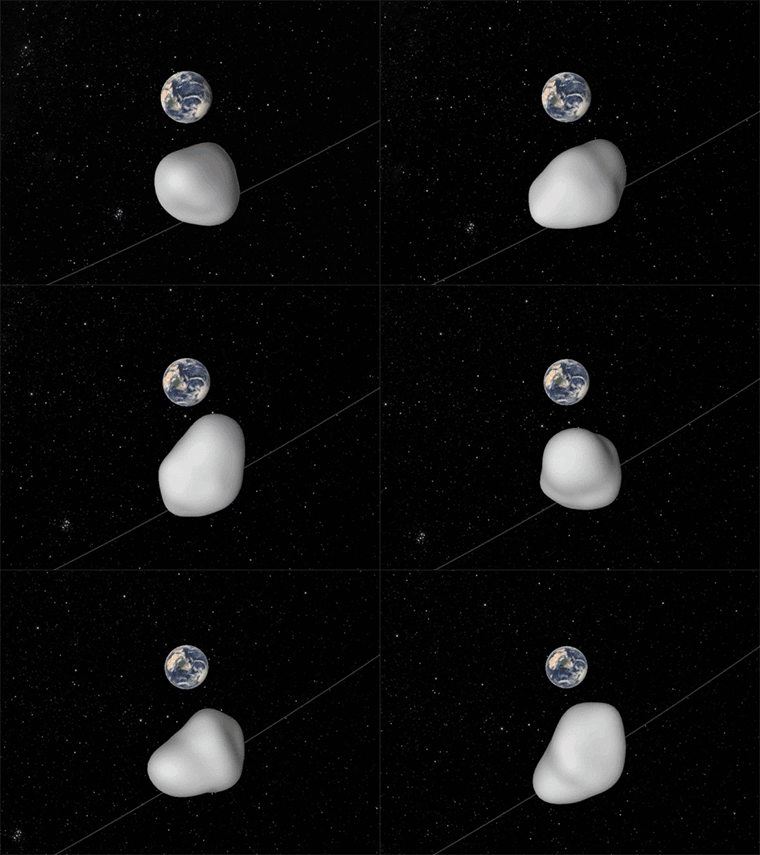 Image: UA[/caption]The asteroid is similar to other near Earth objects, or NEOs, and was originally discovered in 2016. The object is a companion to Earth, and moves around the Sun in such a way that it appears to orbit the Earth, but is not gravitationally bound to Earth. The object is relatively easy to reach, and is a promising target for future explorations. The findings were presented in the annual Division for Planetary Sciences Conference of the American Astronomical Society in Utah.Vishnu Reddy, the team lead for the study, says, "In an effort to constrain its rotation period and surface composition, we observed 2016 HO3 on April 14 and 18 with the Large Binocular Telescope and the Discovery Channel Telescope. The derived rotation period and the spectrum of emitted light are not uncommon among small NEOs, suggesting that 2016 HO3 is a natural object of similar provenance to other small NEOs."The object is of interest as some interpret its presence as evidence that the Earth has not cleared its orbit around the Sun, and has failed to capture 2016 HO3. The official definition of a planet according to the International Astronomical Union (IAU) is "A celestial body that (a) is in orbit around the Sun, (b) has sufficient mass for its self-gravity to overcome rigid body forces so that it assumes a hydrostatic equilibrium (nearly round) shape, and (c) has cleared the neighbourhood around its orbit." This implies that according to the official definition of a planet according to the International Astronomical Union, the Earth fails to qualify as a planet for the same reason that Pluto is no longer considered as a planet.
First Published:Oct 21, 2017, 17:47:25 IST
Advertisement
Advertisement

Why AI notetakers are raising serious privacy and security concerns
AI notetakers promise effortless meeting summaries, but experts warn they could expose confidential conversations, corporate secrets and personal voiceprints. As businesses increasingly adopt AI-powered meeting assistants, questions over data storage, privacy, consent and legal risks are becoming impossible to ignore
5 min read
China's low-cost AI models are changing the global AI race. Here's why Silicon Valley is worried
As Chinese firms continue to improve performance while keeping prices low, the AI race is no longer just about building the smartest model—it is increasingly becoming a battle over who can deliver the best value
2 min read
China's Kimi K3 challenges US AI leaders with frontier-level performance at lower cost
Chinese artificial intelligence startup Moonshot AI has unveiled its latest open-weight AI model, Kimi K3, with early results suggesting it could compete with some of the world's most advanced AI systems developed by leading US companies
2 min read
How did Instagram run ads promoting child abuse in India?
India has issued a notice to Meta after an investigation alleged that Instagram displayed paid advertisements promoting child sexual abuse material. MeitY ordered Meta to remove such Instagram ads and explain within seven days how they were approved
8 min read
Why has India halted WhatsApp’s username feature before launch?
India has halted WhatsApp’s planned username feature, citing concerns about cybercrime, impersonation, and law enforcement challenges. As Meta races to address security concerns, here’s why MeitY has paused the rollout, what the feature does, and how it could influence privacy and online safety in India
3 min read
Advertisement
Advertisement