


Android 4.1 Jelly Bean finally crawls past Gingerbread
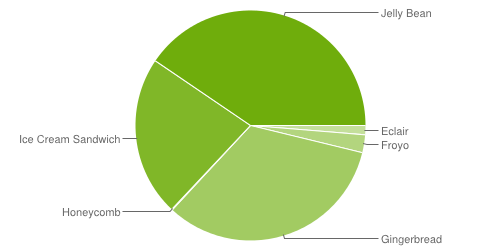
A testimony to this fact is that Gingerbread which was released in December 2010 still continues to run on 33 percent of Android devices.

Google's operating system Android is the world's most popular, running on nearly 75 percent of the smartphones in the world. However one of the major criticisms of the Android OS continues to be the fragmentation of updates.
For users who have a two or three-year old Android device, getting an update to the latest version of the OS can often be a long, fruitless wait. A testimony to this fact is that Gingerbread which was released in December 2010 still continues to run on 33 percent of Android devices.
But it seems that OEM's (original equipment manufacturers) are finally rolling out smartphones with the latest version of Android to users. According to the latest data put out by Google on its Android developers blogs, Jelly Bean's version 4.1 is now running on 34 percent of devices.

As far as the 4.2 build of Jelly Bean is concerned, the number of devices running the version is only 6.5 percent. Build 4.2 build was announced last November and clearly not many devices have got the update to the build.
 More from News Analysis
Android version 4.0 aka Ice Cream Sandwich is running on 22.5 percent devices. Ice-Cream Sandwich was announced in 2011. If one were to add up the numbers of Ice Cream Sandwich ( a two-year-old OS) and Gingerbread ( a three year-old OS) you can still see that more than fifty percent of Android devices don't have access to the latest build, which isn't great news for Google.
Android updates do matter, especially for users. A new build often carries fixes and important security updates which are key to protecting users who often store a lot of private data on their smartphones and tablets. In addition to that, we've seen Google introduce better performance, more personalisation etc with newer versions of Android.
When users don't get updates, it can be frustrating given that Android is supposed to be an 'open source' system. But very often OEM's don't roll out the latest update to older phones and some countries get updates later than others even for premium end models, so it's not fair to lay the blame just on Google.
In contract, Apple's latest OS updates are rolled out to almost all users, except in cases where Apple has stopped producing the device in question. Example iOS 6 wasn't rolled out to the third generation iPod Touch and the first-generation iPad. iOS 6 however had a 93 percent adoption rate as Apple told developers at its annual developer's conference.
Clearly both OEM's and Google need to ensure that more and more users get access to the latest builds of Android.

Why AI notetakers are raising serious privacy and security concerns
China's low-cost AI models are changing the global AI race. Here's why Silicon Valley is worried
China's Kimi K3 challenges US AI leaders with frontier-level performance at lower cost
How did Instagram run ads promoting child abuse in India?
Why has India halted WhatsApp’s username feature before launch?