


A moon-sized celestial object's collision with Earth in the early days gave us Gold, Platinum, says study
The study determined the total amount of material delivered to Earth may have been two to five times greater than previously thought.

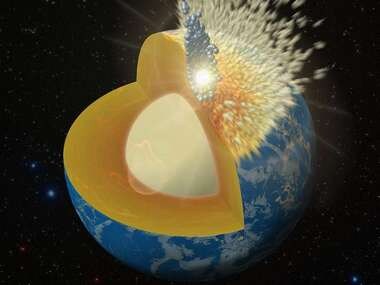
Our planet was bombarded by objects early in its life. Southwest Research Institute[/caption]The team determined the total amount of material delivered to Earth may have been two to five times greater than previously thought, and the impacts altered Earth in a profound way while depositing familiar elements like gold."These results have far-reaching implications for Moon-forming theories and beyond," said Simone Marchi of Southwest Research Institute in the US. "Interestingly, our findings elucidate the role of large collisions in delivering precious metals like gold and platinum found here on Earth," Marchi added.Planetary collisions are at the core of our solar system's formation. Scientists have long believed that after the Moon's formation, the early Earth experienced a long period of bombardment that diminished about 3.8 billion years ago.During this period, called "late accretion," collisions with Moon-sized planetary bodies, known as planetesimals, embedded extensive amounts of metal and rock-forming minerals into the Earth's mantle and crust.It is estimated that approximately 0.5 percent of Earth's present mass was delivered during this stage of planetary evolution. The new study confirms how massive collisions delivered metal to early Earth.With the support of NASA, researchers at the Southwest Research Institute and the University of Maryland created high-resolution impact simulations that showed significant portions of a large planetesimal's core could penetrate all the way down to merge with Earth's core — or bounced back into space and escape the planet entirely.The study published in the journal Nature Geoscience found evidence of more massive accretion onto the Earth than previously thought after the Moon's formation. The mantle abundances of certain trace elements such as platinum, iridium, and gold, which tend to bond chemically with metallic iron, are much higher than what would be expected to result from core formation.This discrepancy can most easily be explained by late accretion after core formation was complete, the study said.

Why AI notetakers are raising serious privacy and security concerns
China's low-cost AI models are changing the global AI race. Here's why Silicon Valley is worried
China's Kimi K3 challenges US AI leaders with frontier-level performance at lower cost
How did Instagram run ads promoting child abuse in India?
Why has India halted WhatsApp’s username feature before launch?