


'My boss has AI psychosis': Employee says manager trusts Claude over staff, sparks debate on AI dependence at work
A Reddit post describing a manager's growing dependence on Anthropic's AI chatbot Claude has struck a chord online. The employee claimed their boss increasingly relied on the chatbot's advice over human judgement, prompting others to share similar workplace experiences and raising fresh concerns about excessive trust in AI.

Artificial intelligence is increasingly becoming a co-worker in offices around the world. It drafts emails, analyses spreadsheets, writes code and even helps shape business strategies. But when AI begins to outweigh human judgement, where should organisations draw the line?
That question has fuelled a heated discussion online after a Reddit user described what they called "AI psychosis" in the workplace. In a post that has since gone viral, the employee claimed their manager had become so reliant on Anthropic's AI chatbot, Claude, that its responses were being treated as definitive business decisions, even when they clashed with the realities of day-to-day operations.
The story has resonated with thousands of readers, many of whom responded with similar accounts of executives placing increasing faith in AI-generated recommendations, sometimes at the expense of employees' expertise.
'We need to appease Claude'
The Reddit user, who titled the post "My boss has AI psychosis and we're f****d", described an office environment where Claude had become an unexpected authority figure.
 More from Tech
According to the employee, meetings increasingly revolved around conversations their manager had with the chatbot. Rather than using AI as a tool to support decision-making, the boss reportedly treated Claude's projections as targets the team was expected to achieve.
"Go to meeting. Boss shares the conversation he had with Claude and stone cold serious tells us we need to appease Claude and meet 'his' projections," the employee wrote.
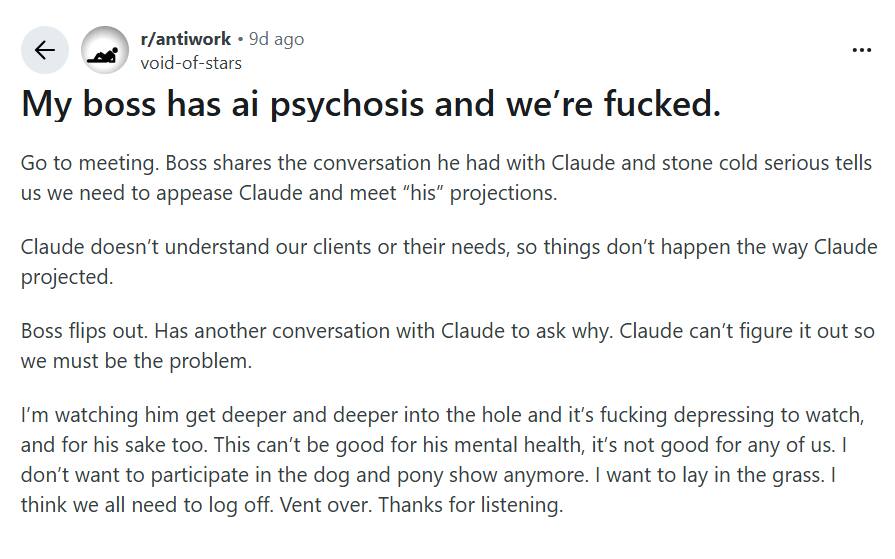
Problems emerged when those predictions failed to match real-world client requirements.
The employee claimed that instead of questioning the AI's limitations, the manager blamed staff for failing to deliver outcomes that aligned with Claude's expectations. Whenever projects deviated from the chatbot's recommendations, the boss reportedly returned to Claude for further explanations, only reinforcing their confidence in the system.
The situation, the employee said, had become emotionally draining for the entire team.
"I'm watching him get deeper and deeper into the hole and it's depressing to watch," the post read. "This can't be good for his mental health, it's not good for any of us... I think we all need to log off."
Netizens react
The post quickly attracted responses from users who claimed they had witnessed similar behaviour in their own organisations.
Several commenters expressed concern that some workplaces were beginning to treat AI outputs as objective truth rather than one input among many.
One user wrote, "I don't want everything to be AI. I want real people. I don't see how so many people bought into this, and I hope when the bubble pops, it pops gloriously."
Another suggested the trend reflected a broader desire for certainty in decision-making, commenting: "I swear we're all just finding out how many people wanted nothing more than some kind of entity which gives them all the answers and does all the thinking for them."
Others described more tangible business consequences.
One commenter claimed their chief executive now ran virtually every decision through an AI chatbot before approving it. According to the post, product launches had stalled for months because AI-generated criticism made leadership reluctant to sign off on new features.
Another user recounted arriving at work to discover that their CEO had distributed lengthy AI-generated assessments criticising multiple departments and outlining what employees should do differently.
While the authenticity of anonymous online posts cannot be independently verified, the discussion highlights a growing debate surrounding AI's role in the workplace.
Most technology companies position AI as a decision-support tool designed to enhance productivity rather than replace human judgement. Experts have consistently warned that large language models can generate inaccurate information, misinterpret context and produce convincing but incorrect conclusions, making human oversight essential, particularly in business-critical decisions.
As AI becomes increasingly embedded in corporate workflows, the Reddit thread serves as a reminder that the challenge may no longer be getting people to use artificial intelligence. Instead, it may be ensuring they know when not to rely on it.

Satya Nadella outlines Microsoft's MAI strategy as Excel model matches GPT-5.6 at lower cost
Yelp to bring reviews and ratings to ChatGPT under OpenAI partnership: Report
Did Samsung leave its most intriguing Galaxy Z Fold 8 prototype behind? Here's how it differed: Report
Apple's iOS 27 beta code hints at Restricted Mode for financed iPhones with missed payments
Apple Maps to power navigation and hands-free driving in Ford's 2027 EVs