
Advertisement


Sections
Video Volunteers: How Goa's Canacona forest reserve was saved from an 'afforestation' project
How a few determined local residents demanded accountability and challenged decisions taken by a government department. When threatened by the lumbering bureaucratic attitude of Goa’s forest officials, local residents took steps such as filing the RTI and mobilising a public call-to-action based on video proof with scientifically-backed research.

The Goan Forest Department received government funds to the tune of INR 54 Lakhs (USD 80,000) in 2010. What they decided to do then defies logic. After systematically cutting down more than a million native, indigenous trees and plants in South Goa’s Canacona forest reserve, they bought and planted ornamental saplings in the cleared space to “increase forest cover”.![Goa-Forest-Warriors_800x450]() The so-called ‘afforestation’ project saw 1.1 million local trees being cut down and replaced by expensive plants of no practical value. “Our forests were being replaced with unknown trees which were useless as fodder for cattle or for making traditional, medicinal cures,” says Sanjay Gaonkar, a resident of Canacona district. Sanjay also points out that this created a monoculture environment in the reserve, completely destroying the biodiversity of the forest, and making it impossible for residents to gather forest produce, an activity which until then had contributed to their livelihoods. The situation seemed hopeless.
The so-called ‘afforestation’ project saw 1.1 million local trees being cut down and replaced by expensive plants of no practical value. “Our forests were being replaced with unknown trees which were useless as fodder for cattle or for making traditional, medicinal cures,” says Sanjay Gaonkar, a resident of Canacona district. Sanjay also points out that this created a monoculture environment in the reserve, completely destroying the biodiversity of the forest, and making it impossible for residents to gather forest produce, an activity which until then had contributed to their livelihoods. The situation seemed hopeless.
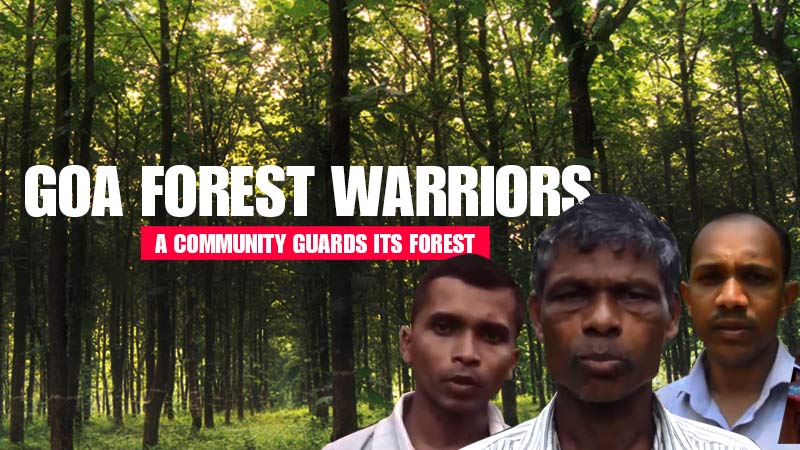 The so-called ‘afforestation’ project saw 1.1 million local trees being cut down and replaced by expensive plants of no practical value. “Our forests were being replaced with unknown trees which were useless as fodder for cattle or for making traditional, medicinal cures,” says Sanjay Gaonkar, a resident of Canacona district. Sanjay also points out that this created a monoculture environment in the reserve, completely destroying the biodiversity of the forest, and making it impossible for residents to gather forest produce, an activity which until then had contributed to their livelihoods. The situation seemed hopeless.
We screened the video for the residents of 13 villages around Canacona, night after night, and informed the residents about the forest department’s activities and its environmental repercussionsThis was when Video Volunteers Community Correspondent Devidas Gaonkar decided to capture the anguish of the people on video, who roundly criticised the Forest Department for its decision. Devidas and Sanjay then went on to form an association called Jungle Bachao Samiti (Save the Jungle Association), organising residents to participate in a community movement to save the Canacona forests. “We screened the video for the residents of 13 villages around Canacona, night after night, and informed the residents about the forest department’s activities and its environmental repercussions,” says Devidas.The committee also used Devidas’ video to explain the problem at hand in local colleges, to gain the support of Goa’s youth and screened it for prominent local politicians and the district’s elected representatives. This was a prelude to filing a Right to Information (RTI) application to know why and how much the government was spending to destroy Canacona’s forests. The community united, under the banner of the association, in 2013 in the fight to save the forests, their home.
It took another 1.5 years of constant advocacy, knowledge-sharing and the courage to ask for administrative accountability, before the battle was won. But it was.But victory did not come easy. It took another 1.5 years of constant advocacy, knowledge-sharing and the courage to ask for administrative accountability, before the battle was won. The forest department finally agreed not to sow foreign plants in the reserve and stick to indigenous trees in any further afforestation programs. As of 2015, the Canacona reserve is safe.There’s a lesson here — on how a few determined local residents can demand accountability and challenge decisions taken by a government department. When threatened by the lumbering bureaucratic attitude of Goa’s forest officials, local residents took steps such as filing the RTI and mobilising a public call-to-action based on video proof with scientifically-backed research. With the support of the scientific community, community-backed protests and demonstrations took off and attracted media coverage. For now, this seems the best playbook to ensure that communities have a say in what happens to their forests. Text by Sangeeta Rane.
First Published:Jun 15, 2017, 13:32:59 IST
Advertisement
Advertisement

Video Volunteers: In Jharkhand's Gumla, a district hospital is providing a model for efficient maternal healthcare
Shanti Baraik Sardar Hospital in Jharkhand's Gumla district is a model for efficient maternal healthcare in the state.
Video Volunteers: Role of local self governance bodies in promoting maternal health in Rajasthan
Local self-governance bodies are promoting maternal health and awareness in Jambuda Village, Udaipur, Rajasthan with the help of community participation.
Video Volunteers: How Rajasthan Medicare Relief Society built a Primary Healthcare Centre in Bhoola village in Sirohi
Rajasthan Medicare Relief Society along with support from the community built a primary healthcare centre in Bhoola village, in Sirohi district, Rajasthan.
Video Volunteers: Medical negligence and abuse rampant in Jharkhand hospital
Nearly 45,000 women die due to childbirth-related causes every year in India. With disrespectful care and the poor state of government hospitals, women may not seek maternal healthcare altogether.
Video Volunteers: In Bihar’s Arwal young boys are being kidnapped and forced into slavery
Between 2015 and 2016, six boys aged between 8 and 16 years went missing in Karpi block of Arwal district in Bihar. Two of them returned after managing to escape their captors. They have harrowing tales to recount. “These men hit me on my face and I fell unconscious. When I woke up I was in a different place. They told me it was Ludhiana,” recalls Manoj Kumar*. He as made to chop wood from nine in the morning till six every evening. “There were eight of us. The other boys were from Sultanpur, Aurangabad, Agra,Jharkhand. Twenty men guarded us. They would beat us if we didn’t chop wood and not give us food. There was no payment at all. They killed four boys. And threw them in the river nearby.” Chilling as his story is, Manoj’s impassive recounting of the horrific ordeal reveals how normalised such violence had been in his life as a slave.
Zafar Iqbal reports from Arwal, Bihar for Video Volunteers.
Advertisement
Advertisement