


Why the BJP is the party of anger
Hindutva is defined by its negative aspects, by what others should not have or not do. It isn't really an ideology in that sense so much as an expression of resentment.

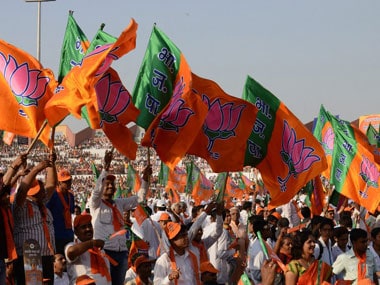
BJP flags seen in this file photo. AFP[/caption]This, as much as Hindutva, has ensured the BJP's rise in states like Gujarat, Delhi, Madhya Pradesh, Punjab, Rajasthan and KarnatakaAfter it took power in Delhi, the BJP deliberately de-emphasised the first aspect of its appeal, and rode on the second. This was to appease its allies more than from a change of heart or a letting go of ideology.The result of this switch was the demotion of LK Advani, the real hero of the party's popularity, in favour of Atal Bihari Vajpayee. This demotion came not because of merit but pragmatism. The BJP under Vajpayee seemed little different from the Congress, and that made it palatable.After the loss of 2004, however, the instinct of the party on Hindutva has reasserted itself through the grassroots. The 2002 riots in Gujarat again polarised India in the way the Babri Masjid issue had. It would not be incorrect to say that those who saw the BJP's point of view subscribed in both instances to the "they started it" theory, and blamed Muslims for events in which they were ultimately victims.The riots also gave the cadre a new figure, Narendra Modi, in place of Advani as their champion. Modi's elevation on merit as the man to lead the 2014 campaign officially discards the BJP's Vajpayee compromise and returns the party to its angry identity.In effect, Modi's taking charge has brought the BJP back to the stage of 20 years ago.In a parallel, but not unrelated development, the isolation of the BJP has also returned. The party has since 2004 lost its allies in Andhra Pradesh, Jammu & Kashmir, Orissa, Bengal and Bihar. It is now left only with its fellow communalists, the Sikh Shiromani Akali Dal and the Marathi chauvinists of the Shiv Sena, who have no problem with or agree with the BJP on those original issues.[embedalsosee]Today it is unclear to outsiders what the BJP's current position on those three issues is. But clarity is not needed for its supporters. In his person, Modi represents those negative thrusts, and this why he refuses to climb down from his insistence that he did no wrong during the communal violence that took place on his watch. This stubbornness is not off-putting to either the regular or the prospective BJP voter. Modi knows this and has deliberately left the riots unresolved (for instance by not commenting on his minister's conviction for the killing of 95 Gujaratis). There is not much gain for him in softening his or his party's appeal because what he needs is consolidation along the early 1990s model.We must not be surprised at the fact that even after taking the national role, Modi has not let go of the issues that make many people wary of him. His comments in speeches and interviews are laced with material to get him headlines but because of his resentful, Hindutva side rather than his developmental side. This is quite deliberate and we must expect more of this as his strategy reveals itself.
Aakar Patel is a writer and columnist. He is a former newspaper editor, having worked with the Bhaskar Group and Mid Day Multimedia Ltd.

Rahul Gandhi, Kharge lead protest near PM residence; Centre says Parliament discussion was offered
Parliament's Monsoon Session from July 20: Key bills, numbers game to dominate agenda
Major blow to Uddhav Thackeray as six Lok Sabha MPs join Shinde camp
12 years and counting: NDA leaders felicitate PM Modi as he trumps Nehru's tenure record
‘Trust, progress and welfare’: PM Modi celebrates 12 years in office, highlights big policy moves