


The rebranding of Narendra Modi gets under way
Modi's tone and tenor ahead of the Sadbhavana Mission point to a leader who is conscious that a bigger political destiny awaits and who wants to present a "kinder, gentler" image of himself.

At 9 am today, Gujarat Chief Minister Narendra Modi begins an effort to change his karma. His three-day Sadbhavana Mission for “peace, harmony and togetherness”, which gets under way at the Gujarat University Convention Hall in Ahmedabad, is manifestly an effort to present a kinder, gentler side of the man who for long has been seen as the sword arm of Hindutva resurgence.The reasons for Modi’s rebranding efforts are plain to see. In his perception, owing to a curious alignment of political planets, a larger political destiny – perhaps at the national level, perhaps even as Prime Minister - awaits him. The chatter in recent days, following the Supreme Court order in the Gulbarg Society case and a US Congressional Report that actually envisaged Modi as Prime Minister, have reinforced that perception.[caption id="attachment_85941" align="alignleft" width="380" caption="With the Sadbhavana Mission, Narendra Modi is looking to change his political karma."]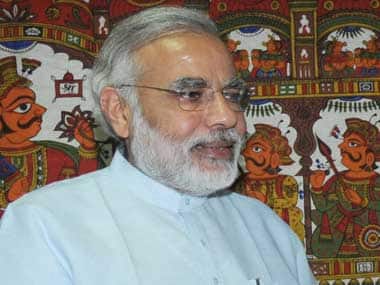 [/caption]The only impediment on that karmic journey is the fact that, whether rightly or wrongly, the shadow of the 2002 Gujarat riots hangs over him. For all his and his supporters’ efforts to dismiss the charges that have dogged his administration as myth-making by “pseudo-secularists”, the taint of 2002 has proved hard to wash away.The Gujarati pride that Modi has fostered – on the strength of his muscular assertion of a Hindutva identity - has not proved scaleable beyond the State’s borders, given the multiplicity of social factors that get greater traction at the national level. Even his own party, the BJP, which had projected itself as a vehicle of Hindutva in the 1980s and 1990s, has progressively scaled back that core identity so as to make itself presentable to queasy alliance partners.In a larger sense, Modi has been rebranding himself even over the past few years by shifting the narrative in Gujarat towards development. That has worked to a large extent, and today, even his worst political detractors will concede Gujarat’s primacy on the index of industrial development.Yet, there was one element missing in that rebranding exercise: the absence of a formal process of reconciliation over the events of 2002, an acknowledgement that even if the State government was not complicit in the riots (as has been alleged), it was perhaps negligent in protecting its citizens when rioters ruled the day following the Godhra train massacre.It is that missing piece that Modi’s Sadbhavana Mission hopes to address.That comes across strikingly in the tone of Modi’s two recent letters to the people of Gujarat in the context of his three-day fast, which begins today. At one level, it invokes the kind of peaceable, “secular” language that has long been derided by BJP supporters.When a recent commentary on Firstpost suggested that some form of atonement by Modi – perhaps an apology – would help, it drew incendiary responses from many readers. Modi, they thundered, has nothing to apologise for.Yet, Modi’s public pronouncements – in the form of his letters to the people of Gujarat - and the overarching message from his Sadbhavana Mission amount to the nearest thing to personal and administrative atonement.Modi’s challenge now is that at precisely the moment that marks a rhetorical climbdown for himso as to make himself acceptable to a broader spectrum of political partners and a larger geography, his detractors are stepping up the stridency of their attacks on him. The intention is perhaps to project him as a polarising influence, not as a man of “sadbhavana”. Over the next three days, we’re likely to see many more challenges to the narrative that Modi and the BJP want to see unfold. How they respond to it and what kind of resonance the Sadbhavana Mission enjoys could shape, in a larger sense, India’s political destiny.
Venky Vembu attained his first Fifteen Minutes of Fame in 1984, on the threshold of his career, when paparazzi pictures of him with Maneka Gandhi were splashed in the world media under the mischievous tag ‘International Affairs’. But that’s a story he’s saving up for his memoirs… Over 25 years, Venky worked in The Indian Express, Frontline newsmagazine, Outlook Money and DNA, before joining FirstPost ahead of its launch. Additionally, he has been published, at various times, in, among other publications, The Times of India, Hindustan Times, Outlook, and Outlook Traveller.

Rahul Gandhi, Kharge lead protest near PM residence; Centre says Parliament discussion was offered
Parliament's Monsoon Session from July 20: Key bills, numbers game to dominate agenda
Major blow to Uddhav Thackeray as six Lok Sabha MPs join Shinde camp
12 years and counting: NDA leaders felicitate PM Modi as he trumps Nehru's tenure record
‘Trust, progress and welfare’: PM Modi celebrates 12 years in office, highlights big policy moves