
Advertisement


Sections
The problem with Brand Anna: Turning protest into salesmanship
When we reduce political leaders to brands, politics becomes no more than an exercise in salesmanship, positioning citizens as mindless consumers who can be relied on to offer the right Pavlovian response to the right messaging.

"We are no doubt in the Great Age of the Brand," declared marketing guru Tom Peters. And so we are. Everything and everyone is a brand these days, be it our politicians, athletes, movie stars, or even our nation (Go Brand India!). It's a synonym for not just reputation or image, but all things aspirational. We want to buy it, wear it, and above all, be it. The ultimate marker of success in new India is to become a brand.Little wonder then that the media has spent the last couple of days touting Brand Anna, which is now one of the top ten brands online with a Klout scoring higher than Big B, Vodafone, and MTV. "The brand Anna thing at the moment in this country has overtaken all the other brands, be it in politics, cinema or sports. Anna is selling nationalism to the people of this country," Centre for Media Studies (CMS) Director PN Vasanti told the Economic Times.Even the large turnout at the protests is being analysed in terms of customer behaviour. As management professor Harshvardhan Verma describes it, "If you look at any strong brand, the measure of its success is its patronage and commitment, willingness to go out of your way to procure your preferred brand. Going by these parameters, Anna Hazare emerges as a very strong brand."But is this accurate – or, more importantly, a good thing? Can we understand politics and political behaviour purely in terms of the market, where leaders are recast as corporate symbols that citizens buy into? And insofar that Anna is a brand, is his newly-acquired status a curse or a blessing?Everyone's a brand[caption id="attachment_74008" align="alignleft" width="380" caption="The more serious charge against Anna is that he is merely a brand, as in a PR-created symbol bereft of substance. Reuters"] [/caption]One effect of our twenty-year love affair with liberalisation is the rise of ManagementSpeak, or the tendency to use corporate terminology and concepts to analyse almost any issue, be it politics, marriage, religion, or sports. Countless bestsellers apply lessons of the boardroom to almost every aspect of life, or vice-versa. Think of it as the MBA theory of everything. And our everyday language reflects this paradigm, including our addiction to the word "brand."These days, everyone's a brand, including you, dear reader. It's a word so often mis- and over-used that it's in danger of losing all meaning. Take, for instance, the various media stories on Brand Anna which offer a perfect example of lazy ManagementSpeak. "Branding Anna Hazare" uses Hazare's life-story to offer branding tips, including this priceless gem:
 [/caption]When we reduce political leaders or parties to brands, we also imply that politics is no more than an exercise in salesmanship, positioning citizens as mindless consumers who can be relied on to offer the appropriate Pavlovian response to the right messaging. Flattering as Brand Anna may sound, this is political cynicism by other means. As Prasoon Joshi rightly observed, "What we are seeing in India (now) could be a phenomenon, a thought process. It is much bigger and broader than a brand."But principled objections aside, here's the more vexing question: In a media-saturated culture, where everything is reduced to a slogan or catchy sound-byte, can leaders avoid being transformed into a brand – whether they choose to or not? And are we the people – especially the middle class – conditioned by 24X7 media to respond political personalities and events in predictably consumerist ways? To buy the t-shirt, don the Anna cap, and wave those banners on cue from the omnipresent camera. And what happens to that bigger "phenomenon" or "thought process" when it is taken up by a market-driven culture determined to turn everyone and everything into a commodity to be peddled at prime-time?Also read: Firstpost's ebook People's Movement, a collection of articles that offer a 360 degree view of Anna Hazare's agitation.Coming in Part II tomorrow: From Gandhi to Obama and now Anna: how leaders are turned into brands in a consumerist culture; why it spells political disaster for them; and what the future looks like for both Anna the leader and Anna the brand.
 [/caption]One effect of our twenty-year love affair with liberalisation is the rise of ManagementSpeak, or the tendency to use corporate terminology and concepts to analyse almost any issue, be it politics, marriage, religion, or sports. Countless bestsellers apply lessons of the boardroom to almost every aspect of life, or vice-versa. Think of it as the MBA theory of everything. And our everyday language reflects this paradigm, including our addiction to the word "brand."These days, everyone's a brand, including you, dear reader. It's a word so often mis- and over-used that it's in danger of losing all meaning. Take, for instance, the various media stories on Brand Anna which offer a perfect example of lazy ManagementSpeak. "Branding Anna Hazare" uses Hazare's life-story to offer branding tips, including this priceless gem:
Find that one strong connect with the consumer that is relevant and timeless, and reposition if you must: When Anna started working on water conservation, he quickly realised that corruption was a larger, universal problem, one that could be fought forever, so that Brand Anna could live forever. Marlboro talked of freedom, an idea that easily extends all over the world. Today, even though the tobacco industry is struggling, Marlboro’s appeal has gone beyond its product.The Marlboro Man is to freedom as Hazare is to anti-corruption. Right!Dumb analogies aside, the more serious charge against Anna is that he is merely a brand, as in a PR-created symbol bereft of substance. Articles in both Mint and Open magazine detail Team Anna's carefully honed media strategy as evidence to buttress the charge. Choreographed TV appearances, YouTube videos, Twitter campaigns, presence of media professionals on Team Anna, selective use of Gandhian rhetoric and imagery et al."To some, comparing Hazare’s campaign to advertising sounds cynical, but some also feel that the mass hysteria being witnessed at the Ramlila Ground is not only a true response to people’s frustrations, but also partly a manipulation of their emotions by various forces, including the media," writes Mayank Austen Soofi.Continues on the next pageIt is easy enough to puncture this sweeping proposition. For starters, the Hazare protests received media attention only after they gained momentum, when people started to stream into Jantar Mantar back in April, taking everyone – including the organizers – by surprise. As for the second round of protests, they were galvanised not by clever marketing but by Hazare's arrest.As a fellow Firstpost writer points out, true credit for repositioning him as the new Gandhi should go not to Team Anna, but the ruling party: "[C]ome the morning after Independence Day, we found ourselves transported back to the days of the British Raj: preemptive arrests along with calls for a jail bharo movement. As a grizzled Anna Hazare supporter on television put it, 'It has become like a British government. As of this day, I am naming Manmohan Singh government as the sarkar of Churchill.'"Perils of the brand paradigmTo misread the Hazare phenomenon as a pure branding exercise does little credit to Anna, his supporters, or the nation. And it speaks to the hazards of applying marketing concepts to the political arena, be it to flatter or dismiss a leader. "Invoking the language of branding in politics.. is missing the point. We are not contrived creations to be managed and manipulated. We are individuals with characteristics and personalities, failings... Branding is about managing assets and resources for commercial ends – and let’s keep it to that," writes branding consultant Sandy Belfer.[caption id="attachment_74012" align="alignleft" width="380" caption="When we reduce political leaders to brands, we also imply that politics is no more than an exercise in salesmanship. Reuters"]
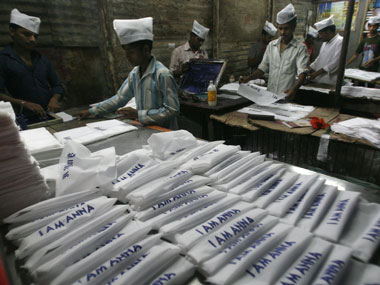 [/caption]When we reduce political leaders or parties to brands, we also imply that politics is no more than an exercise in salesmanship, positioning citizens as mindless consumers who can be relied on to offer the appropriate Pavlovian response to the right messaging. Flattering as Brand Anna may sound, this is political cynicism by other means. As Prasoon Joshi rightly observed, "What we are seeing in India (now) could be a phenomenon, a thought process. It is much bigger and broader than a brand."But principled objections aside, here's the more vexing question: In a media-saturated culture, where everything is reduced to a slogan or catchy sound-byte, can leaders avoid being transformed into a brand – whether they choose to or not? And are we the people – especially the middle class – conditioned by 24X7 media to respond political personalities and events in predictably consumerist ways? To buy the t-shirt, don the Anna cap, and wave those banners on cue from the omnipresent camera. And what happens to that bigger "phenomenon" or "thought process" when it is taken up by a market-driven culture determined to turn everyone and everything into a commodity to be peddled at prime-time?Also read: Firstpost's ebook People's Movement, a collection of articles that offer a 360 degree view of Anna Hazare's agitation.Coming in Part II tomorrow: From Gandhi to Obama and now Anna: how leaders are turned into brands in a consumerist culture; why it spells political disaster for them; and what the future looks like for both Anna the leader and Anna the brand.
First Published:Aug 31, 2011, 14:01:09 IST
Advertisement
Advertisement

Rahul Gandhi, Kharge lead protest near PM residence; Centre says Parliament discussion was offered
The developments come amid the continuing CJP-led agitation at Jantar Mantar, where protesters have vowed to continue their sit-in despite recent clashes with Delhi Police
2 min read
Parliament's Monsoon Session from July 20: Key bills, numbers game to dominate agenda
The Monsoon Session of Parliament will begin on July 20 and continue till August 13, with the government expected to push several key legislations, including constitutional amendment bills
2 min read
Major blow to Uddhav Thackeray as six Lok Sabha MPs join Shinde camp
In a major political setback for Shiv Sena (UBT) chief Uddhav Thackeray, six of the party's nine Lok Sabha MPs joined the Eknath Shinde-led Shiv Sena in Mumbai on Monday
2 min read
12 years and counting: NDA leaders felicitate PM Modi as he trumps Nehru's tenure record
Leaders of the National Democratic Alliance (NDA) on Wednesday felicitated Prime Minister Narendra Modi on completing 12 years in office and becoming India's longest-serving continuously elected Prime Minister
3 min read
‘Trust, progress and welfare’: PM Modi celebrates 12 years in office, highlights big policy moves
Prime Minister Narendra Modi on Tuesday marked 12 years in office. He described the period as one dedicated to "trust, development and public welfare" while highlighting key achievements of his government
3 min read
Advertisement
Advertisement