


Arun Jaitley's outburst is justified: The Supreme Court is playing God
Friday's newspapers tell us that the Supreme Court has ordered a special investigation team to probe charges of wife-swapping among navy officers. Pardon me, but isn’t this the job of the police?

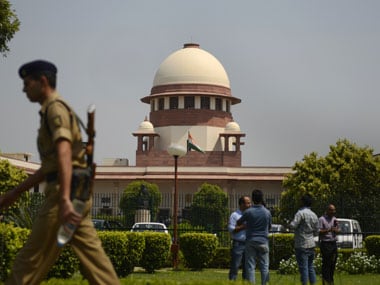
File image of the Supreme Court of India. AFP[/caption]Excuse me, but can the courts order governments to decide what to do with their budgets and how? This bit of court meddling had Jaitley fuming: “We have the National Disaster Response Fund and the State Disaster Response Fund and now we are being asked to create a third fund. The appropriation bill is being passed. Now outside this appropriation bill, we are being told to create this fund. How will I do that? India’s budget-making is being subject to judicial review,” he was quoted as saying.Yes, it is possible to argue that when governance standards are poor in states and even at the Centre, someone has to step up to render justice. But, surely, the answer is to strengthen governments and their ability to enforce the law, not weaken it further by sidelining elected governments through judicial processes? How often can courts order the police or bureaucrats to operate under court orders? How far can this process continue without a complete breakdown of the constitutional order? Why would the police listen to anybody, when the courts inject themselves into the power equation?And while we are discussing a lack of governance, whatever gave the judiciary the idea that it is well-governed itself? With over four crore cases piling up in various courts, surely the judiciary is no paragon of competent governance. And when a Shanti Bhushan makes an allegation in open court that eight of the last 16 Supreme Court chief justices were corrupt, the only thing the court did was give an embarrassed shrug and move on.So much for being the conscience-keeper of the nation.If there is a case for judicial interference in the legislative process, the failure of the judiciary on multiple fronts is equal reason for the executive to poke its collective nose into judicial turf.To prove that the judicial over-reach is not an occasional thing, let’s look at the kind of orders the judiciary has been passing of late.A few days ago, the Supreme Court wanted licences for dance bars in Maharashtra to be issued in two days. Are dance bars a priority even for the apex courts?The court has been trying hard to reform the Board for the Control of Cricket in India (BCCI), when this is a private body doing its own thing. Why should cricket get so much time from the court when over 60,000 cases are pending before it?Towards the end of last month, the court ordered the Reserve Bank of India to set up a panel to chase bad loans. After probing black money, will the court decide how banks should collect their dues?Then the court decided that allowing religious structures to encroach on public spaces is an “insult to God”. One supposes the Supreme Court knows God’s mind better than the faithful. It is, after all, playing god in India.The Supreme Court, in its avatar as protector of the environment, drove non-CNG cabs off the road in Delhi a few weeks ago before modifying its orders a bit on wiser counsel. Earlier it banned diesel SUVs above a certain size from being registered in the capital, taking on the role of a pollution expert. That it did little to lower Delhi’s ambient pollution levels did not deter the court.The court also found time to pontificate on the need to connect backward states with air links, and asked Air India, already bleeding due to excessive political meddling in commercial operations, to indicate whether or not if it will fly to Shimla.Then the court rapped states for non-implementation of the food security law. It never asked itself if this reluctance may have been caused by the foolishness of the law itself. And, of course, it gave the Centre notice on the implementation of the rural job creation scheme, MNREGA.The court also wanted a human rights body for Delhi — no doubt, helping a few brother judges to find post-retirement jobs.More recently, the Supreme Court effectively told the Speaker of the Uttarakhand Assembly how to do his job, including the counting of votes in the trust-vote. So the Speaker’s domain has been breached, too. When the Arunachal Pradesh crisis was going on, the Supreme Court directly violated the Constitution by issuing a notice to the governor — something that is forbidden under Article 361 of the Constitution. It was only when the attorney-general pointed this out that the court withdrew the notice reluctantly, but decided it would examine the governor’s actions anyway.Given that the Supreme Court has been setting such a bad example on judicial restraint, high courts have also been busy throwing their weight about.The Bombay High Court asked the IPL to shift its matches outside the state after April in view of the water shortage in many parts of the state. As if the use of recycled water on Mumbai’s cricket pitches would otherwise be available to thirsty people in Marathwada.Then it wanted the Maharashtra government to ensure that the weight of school bags was reduced as per its orders.Every year, the High Court also orders the Brihanmumbai Municipal Corporation to repair potholes.A Delhi High Court judge, after receiving a poor response to calls to 100 (the police), got the Chief Justice to convert his experience into a formal PIL.To top it all, the Chief Justice of India announced the other day that the time had come to audit the government’s performance. One wonders if he has not read the Constitution, which says the people will audit the government’s performance once in five years through an election. Does the judiciary want to usurp even the sovereignty of the voter?
R Jagannathan is the Editor-in-Chief of Firstpost.

Rahul Gandhi, Kharge lead protest near PM residence; Centre says Parliament discussion was offered
Parliament's Monsoon Session from July 20: Key bills, numbers game to dominate agenda
Major blow to Uddhav Thackeray as six Lok Sabha MPs join Shinde camp
12 years and counting: NDA leaders felicitate PM Modi as he trumps Nehru's tenure record
‘Trust, progress and welfare’: PM Modi celebrates 12 years in office, highlights big policy moves