
Advertisement


Sections
Rahul Gandhi's charges against Narendra Modi: Weak evidence likely to harm Congress more
Will Congress vice-president Rahul Gandhi succeed in unseating Prime Minister Narendra Modi from power by “proving” the latter corrupt?

 Congress vice-president Rahul Gandhi. PTI[/caption]However, what is more important is that if Rahul’s charges are taken to the logical conclusion then Congress chief ministers of the time, along with those belonging to some Opposition parties as well will also be held “guilty” as they had received similar bribes from the aforesaid companies; their names are mentioned in the same “seized diaries” that contain the words “CM Gujarat”. May be Rahul has more incriminating evidence against Modi that some Congress cheerleaders are claiming. But the germane point is whether it is a good political strategy to revive the fortunes of the Congress.From the point of view of its long-term interests, a Rahul-led Congress should work in a manner so that people “vote for him” , rather than "vote against Modi”. In other words, he should work on why people should vote for him and the Congress, rather than on why people should vote against Modi and the BJP. But Rahul seems to prefer “vote against Modi” strategy. It is a part of this strategy that has made the Congress the junior-most partner in Bihar. It is a part of this strategy that is likely to make Congress a junior partner of the Samajwadi Party in the forthcoming Assembly polls in Uttar Pradesh. It is part of this strategy that has virtually made Congress a junior partner of even the Trinamool Congress in opposing Modi’s demonetisation drive (see how West Bengal Chief Minister Mamata Banerjee has used the anti-demonetisation campaigns as an opportunity in projecting herself to be the national leader who could be the pivot around whom non-BJP parties could gather to present a combined fight against Modi in 2019).And it is a part of this very strategy that seems to have made Rahul following Delhi Chief Minister Arvind Kejriwal’s trademark of accusing the opponents of corruption and irregularities without caring for evidence and established norms/procedures. In the process, Rahul seems to have ignored the Congress' record of fighting corruption in recent years. One is not mentioning here the plethora of corruption charges against the Congress during the 10-year rule of UPA (2004-14). What is being pointed out instead is the futility of the Congress' attempts in establishing corruption charges against the BJP leaders in recent years.One may mention here the much talked about Coffin Gate, Tehelka scandal and Purti scam. The Coffin Scam was a result of the faulty approach adopted by the Comptroller and Auditor General of India’s (CAG) report which alleged corruptions in the purchase of coffins for the dead soldiers during the Kargil war that took place in 1999 between India and Pakistan. According to the CAG, the Vajpayee government incurred a heavy loss of $1, 87,000 in the entire transaction. In this specific case, 500 caskets, each worth $2500, were purchased from Buitron and Baiza, a company based in the United States, rendering funeral services. The CAG presumed it to be 13 times the original amount. However, the ambassadors from both the countries –India and the US – had declared in writing that those caskets had a cost worth $2,768 each. But, when the issue was made into a scam by the Congress, the Central Bureau of Investigation (CBI) investigated the case and filed a chargesheet against three Indian Army officers in August 2009. However, in December 2013, a special CBI court found no evidence and discharged all the accused. The case was closed. And this happened during the UPA regime itself.[caption id="attachment_3168702" align="alignright" width="380"]
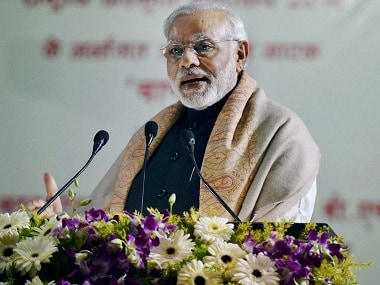 Prime Minister Narendra Modi. PTI[/caption]The Tehelka scam has been the most ludicrous in India’s history of scandals. A highly partisan and controversial journalist, claiming to be the representative of a non-existent defence firm, traps some officials in the name of procuring a non-existent weapon system and then generalises that the then defence minister George Fernandes and his staff are indulging in corruption, indicating that the proposed deal to buy Barak missiles for the Navy from Israel is one such incident that had witnessed kickbacks. In fact, such heat was generated in the process that the Congress party made the life of the then Vajpayee government miserable and boycotted Fernandes in Parliament. They, along with the partisan journalists, boycotted two commissions of inquiry that the Vajpayee government set up under two respected retired Supreme Court judges – Justice SN Phukan and Justice Venkataswami. So much so that to a great extent the Congress under Sonia Gandhi won the elections in 2004 on the basis of the two scandals of Coffin Gate and Tehelka by successfully building the public perception over misleading and fabricated evidences against the government of the day.When the Congress-led UPA came to power in 2004, the two judicial commissions were dismissed by the government and everything was handed over for investigations to the CBI, which, in turn, filed a First Information Report (FIR) on 10 October, 2006. But again, nothing concrete emerged. On 24 December, 2013, after investigating for more than seven years, the CBI decided to close the matter as it did not find any evidence on the allegations. And the UPA government was very much there then.The Purti scam revolved around the Purti Power and Sugar Ltd (now Purti Group) that the BJP leader Nitin Gadkari, then PWD minister in Maharashtra, had floated in 1995. Apparently, in 2010 the company got a loan of Rs 1.64 billion from a firm which allegedly had obtained hefty road contracts under Gadkari's term as PWD minister. Gadkari's son Nikhil was allegedly a director with the company (IRB) at the time. Gadkari argued that there was nothing wrong in having contractors invest in one's firms, but Opposition leaders argued that all this suggests a quid pro quo for political favours granted by Gadkari.Accordingly, in 2013, the Income Tax Department “discovered” tax evasion by Purti and a judicial commission was set up to look into the charges. This was at a time when Gadkari was about to get his second term as the national president of the BJP. He had to quit the post, a development that suddenly brought Modi to the reckoning as BJP’s prime ministerial candidate. But what happened? The judicial commission concluded that Gadkari had played no role or had no concern with the scam. And on May 13, 2014 the I-T department of Maharashtra cleared Gadkari's name and gave him a clean chit saying there is no enquiry/investigation presently pending. This allowed Gadkari to successfully contest the election to the Lok Sabha. In the process, two non-BJP leaders were made to eat the humble pie – then Congress Union Minister Manish Tewari apologised to Gadkari on April 30, 2014, when he was dragged in to a defamation suit by the latter; Delhi Chief Minister Arvind Kejriwal did likewise subsequently in the Delhi High Court.In fact, many Congress leaders privately agree that but for this mishandling of Purti scam by the Congress leadership, Modi could not have become the prime minister, the argument being that a Gadkari-led BJP would not have allowed the then Gujarat chief minister to nurture a national dream.Be that as it may, the fact remains that leveling corruption charges against the political opponents has not exactly been a credible and rewarding political strategy for the Congress in recent years. And that being the case, Rahul’s charges against Modi, that too seemingly on very weak evidence, may do the Congress more harm than good.I have often argued that India needs a strong Congress and a strong BJP as these are the two credible national parties in a large democracy such as ours. But the continuous poll-reversals of the Congress, be it national, state or local, suggests that “the vote against Modi" strategy is not working for Rahul Gandhi. He has to change so that people will be tempted to vote “for” Congress. And he can bring about such a change, provided he allows the Congress to catapult its other bright and young leaders like Jyotiraditya Scindia, Milind Murali Deora, Sachin Pilot and Shashi Tharoor to big league politics, not the old and known sycophants who argue that the Congress cannot survive without the brand of Nehru-Gandhis.
First Published:Dec 22, 2016, 18:22:40 IST
Advertisement
Advertisement

Rahul Gandhi, Kharge lead protest near PM residence; Centre says Parliament discussion was offered
The developments come amid the continuing CJP-led agitation at Jantar Mantar, where protesters have vowed to continue their sit-in despite recent clashes with Delhi Police
2 min read
Parliament's Monsoon Session from July 20: Key bills, numbers game to dominate agenda
The Monsoon Session of Parliament will begin on July 20 and continue till August 13, with the government expected to push several key legislations, including constitutional amendment bills
2 min read
Major blow to Uddhav Thackeray as six Lok Sabha MPs join Shinde camp
In a major political setback for Shiv Sena (UBT) chief Uddhav Thackeray, six of the party's nine Lok Sabha MPs joined the Eknath Shinde-led Shiv Sena in Mumbai on Monday
2 min read
12 years and counting: NDA leaders felicitate PM Modi as he trumps Nehru's tenure record
Leaders of the National Democratic Alliance (NDA) on Wednesday felicitated Prime Minister Narendra Modi on completing 12 years in office and becoming India's longest-serving continuously elected Prime Minister
3 min read
‘Trust, progress and welfare’: PM Modi celebrates 12 years in office, highlights big policy moves
Prime Minister Narendra Modi on Tuesday marked 12 years in office. He described the period as one dedicated to "trust, development and public welfare" while highlighting key achievements of his government
3 min read
Advertisement
Advertisement