
Advertisement


Sections
NDA govt takes away Jammu and Kashmir's special status, introduces bill to bifurcate state into two UTs
With the scrapping of Article 370, Article 35A — which gave exclusive rights to the state's residents in government jobs and land — ceased to exist. The developments evoked mixed reactions from across the country and also sparked a few protests.

The Narendra Modi government on Monday revoked Article 370, taking away Jammu and Kashmir's special status that allowed it an exemption from the applicability of the Constitution of India, capping days of speculation, anxiety and suspense over the reasons behind the recent build-up of troops in the region. The Rajya Sabha also cleared a bill to allow the bifurcation of the state into two Union Territories — Jammu and Kashmir, and Ladakh — amid uproar from the Opposition parties.With the scrapping of Article 370, Article 35A — which gave exclusive rights to the state's residents in government jobs and land — ceased to exist. The development evoked mixed reactions from across the country and also sparked a few protests.Earlier, after a Union Cabinet meeting, Home Minister Amit Shah announced in Rajya Sabha the government's decision to scrap Article 370 of the Constitution and said that President Ram Nath Kovind has signed a notification to this effect.Moving the Jammu and Kashmir Reorganisation Bill, 2019, for discussion and passage in the Rajya Sabha, Shah claimed that Article 370 did not allow proper integration of Jammu and Kashmir with India and asserted that BJP-led government had the "political will" to take decisions concerning the "temporary" provision in the Constitution.[caption id="attachment_7114291" align="alignleft" width="380"]![A protest in Delhi after the Centre scrapped Article 370. Reuters]() A protest in Delhi after the Centre scrapped Article 370. Reuters[/caption]He also moved Jammu and Kashmir Reservation (Second Amendment) Bill, 2019, aimed at providing 10 percent reservation to economically weaker sections, and a resolution for abrogating Article 370."Article 370 has been regarded as a temporary provision and it had to go. It should have gone long back. But nobody showed (the) will power to do so due to vote bank politics. We are not worried about vote banks nor do we lack political will under Prime Minister Narendra Modi," he said. The bill and the resolution were both approved by the Upper House.What did the resolution, order sayThe resolution moved by Shah said the president, on the recommendation of the Parliament, is pleased to declare that, as from 5 August, 2019, all clauses of the Article 370 shall cease to be operative except clause (1).In his separate order called Constitution (Application to Jammu and Kashmir) Order, 2019, Kovind said that he, in "concurrence" with the "Jammu and Kashmir government", promulgated the order stating that provisions of the Indian Constitution are applicable in the state.It said that the order should "supersede the Constitution (Application to Jammu and Kashmir) Order, 1954".Opposition parties slam Modi govtFormer chief ministers of Jammu and Kashmir Omar Abdullah and Mehbooba Mufti called the Centre's move to scrap Article 370 "disastrous" and said it may lead to "catastrophic consequences".Terming the government's move "unilateral and shocking", Abdullah said it was a total "betrayal of trust" of the people of Jammu and Kashmir."Government of India's unilateral and shocking decisions are a total betrayal of the trust that the people of Jammu and Kashmir had reposed in India when the state acceded to it in 1947," he said, adding, "The decisions will have far-reaching and dangerous consequences."Abdullah accused the Centre of resorting to "deceit and stealth" in recent weeks to lay the ground for these "disastrous decisions". Mufti and Omar Abdullah, who were under house arrest since Sunday night, were detained on Monday evening. Jammu and Kashmir People's Conference leaders Sajjad Lone and Imran Ansari were also held. In sharp reactions, Congress leader Ghulam Nabi Azad alleged that the government has wiped out Jammu and Kashmir's identity, while former home minister P Chidambaram termed the day as a "black day" in India's history.During the debate on the resolution in Rajya Sabha, Chidambaram said, "You cannot modify Article 370 by an order under Article 370. It (Article) enables you to modify such other provisions under the Constitution. It's beyond my comprehension to understand how you can modify the Article... I know this is your manifesto promise. You said you will repeal Article 370. But in repealing Article 370, you are unleashing forces which you cannot control."Hitting out at the NDA in Rajya Sabha, senior Congress leader Kapil Sibal said, "You don't want to debate (on the resolution on Article 370). Why are you in such a hurry? Did you hold any consultation with any stakeholders? Is this your meaning of democracy because you have the numbers in the House? You talk about 'sabka saath, sabka vishwas, sabka vikas'. But you will walk alone just because you have the numbers? If you think this is a historic day, then I feel you will also see many such historic days in the future. We will stand here and protect the Constitution." Before the Trinamool Congress walked out from the Rajya Sabha, the party's national spokesperson Derek O'Brien said, "Trinamool is against the Constitutional immorality and ‘procedural harakiri’ committed today." Senior BJP leaders Arun Jaitley, Sushma Swaraj, Ram Madhav and several other BJP leaders, however, welcomed the Union government's decision calling it a "bold and historic" move towards national integration. Jaitley complimented Modi and Shah, saying "a historical wrong has been undone". BJP workers also held celebrations in various parts of the country.The Pakistan Foreign Office condemned the revoking of Article 370 and said, "Jammu and Kashmir is an internationally-recognised disputed territory. No unilateral step by the Government of India can change this disputed status, as enshrined in the United Nations Security Council (UNSC) resolutions. Nor will this ever be acceptable to the people of Jammu and Kashmir, and Pakistan." Pakistan's ruling Pakistan Tehreek-e-Insaf (PTI) said in a statement, "As the party to this international dispute, Pakistan will exercise all possible options to counter the illegal steps. Pakistan reaffirms its abiding commitment to the Kashmir cause and its political, diplomatic and moral support to the people of India-administered Jammu and Kashmir for realisation of their inalienable right to self-determination." Pakistan prime minister Imran Khan termed India's move to revoke Article 370 as "illegal" and said it will "further deteriorate" relations between the nuclear-capable neighbours. He made the remarks while speaking with his Malaysian counterpart Mahathir Mohamad on the situation in Kashmir. Meanwhile, the Ministry of External Affairs briefed the envoys of the P5 nations — US, UK, Russia, China, and France — on the developments related to the scrapping of Article 370. The Left parties staged a demonstration at the Jantar Mantar in New Delhi. The protesters included senior Left leaders like CPM general-secretary Sitaram Yechury, Prakash Karat, CPI general secretary D Raja, CPI(ML) general secretary Dipankar Bhattacharya, Brinda Karat and Atul Anjan among others. Why move is being criticisedMany natives, intellectuals, activists, and political leaders raised their apprehensions about the consequences following the government's decisions on Monday.Since the developments came at a time when Jammu and Kashmir was under President's Rule, one of the concerns raised by people on social media was how did Kovind make the order "in concurrence of the government of state of Jammu and Kashmir". Some pointed out that since the governor and president both act on the advice of the Central government, the move to repeal Article 370 has entirely been taken by the Central government.Senior advocate Prashant Bhushan also tweeted that the move was "unconstitutional" because bifurcation of Jammu and Kashmir and amendments to Article 370 required consent of the elected Assembly of the State.Another reason for the criticism is that with Article 35A gone, people from anywhere in India will be able to buy property and permanently settle in the state. This has caused tension in the region, as many believe that it will lead to a change in the demography.What's next for the two UTsThe Jammu and Kashmir Reorganisation Bill, 2019, will be tabled in the Lok Sabha on Tuesday and the Centre is confident of getting the bill passed in the Lower House.Once the Parliament approves the bill, a delimitation exercise will be carried out after which the Union Territory of Jammu and Kashmir will have a Lieutenant Governor and the strength of the Assembly will be 107, which will be further enhanced to 114.The present strength of the assembly is 87, which includes four seats of the Ladakh region. Ladakh will now become a separate UT, but without a legislature. Twenty-four seats of the Assembly will continue to remain vacant as they fall in the area of Pakistan- occupied Kashmir (PoK)."...the number of seats in the Legislative Assembly of the Union Territory of Jammu and Kashmir shall be increased from 107 to 114, and delimitation of the constituencies may be determined by the Election Commission in the manner hereinafter provided," according to the Jammu and Kashmir Reorganisation Bill.The Union Territory of Ladakh will have Kargil and Leh districts, it said.There will be a council of ministers, the bill said, consisting of not more than 10 percent of the total number of members in the Legislative Assembly, with the chief minister at the head to aid and advise the Lieutenant Governor in the exercise of his functions in relation to matters with respect to which the Legislative Assembly has powers to make laws.It said that the new Union Territory will have reservation in the Assembly seats. "The number of seats to be reserved for the Scheduled Castes and the Scheduled Tribes in the Legislative Assembly, having regard to the relevant provisions of the Constitution," it said.With inputs from agencies
A protest in Delhi after the Centre scrapped Article 370. Reuters[/caption]He also moved Jammu and Kashmir Reservation (Second Amendment) Bill, 2019, aimed at providing 10 percent reservation to economically weaker sections, and a resolution for abrogating Article 370."Article 370 has been regarded as a temporary provision and it had to go. It should have gone long back. But nobody showed (the) will power to do so due to vote bank politics. We are not worried about vote banks nor do we lack political will under Prime Minister Narendra Modi," he said. The bill and the resolution were both approved by the Upper House.What did the resolution, order sayThe resolution moved by Shah said the president, on the recommendation of the Parliament, is pleased to declare that, as from 5 August, 2019, all clauses of the Article 370 shall cease to be operative except clause (1).In his separate order called Constitution (Application to Jammu and Kashmir) Order, 2019, Kovind said that he, in "concurrence" with the "Jammu and Kashmir government", promulgated the order stating that provisions of the Indian Constitution are applicable in the state.It said that the order should "supersede the Constitution (Application to Jammu and Kashmir) Order, 1954".Opposition parties slam Modi govtFormer chief ministers of Jammu and Kashmir Omar Abdullah and Mehbooba Mufti called the Centre's move to scrap Article 370 "disastrous" and said it may lead to "catastrophic consequences".Terming the government's move "unilateral and shocking", Abdullah said it was a total "betrayal of trust" of the people of Jammu and Kashmir."Government of India's unilateral and shocking decisions are a total betrayal of the trust that the people of Jammu and Kashmir had reposed in India when the state acceded to it in 1947," he said, adding, "The decisions will have far-reaching and dangerous consequences."Abdullah accused the Centre of resorting to "deceit and stealth" in recent weeks to lay the ground for these "disastrous decisions". Mufti and Omar Abdullah, who were under house arrest since Sunday night, were detained on Monday evening. Jammu and Kashmir People's Conference leaders Sajjad Lone and Imran Ansari were also held. In sharp reactions, Congress leader Ghulam Nabi Azad alleged that the government has wiped out Jammu and Kashmir's identity, while former home minister P Chidambaram termed the day as a "black day" in India's history.During the debate on the resolution in Rajya Sabha, Chidambaram said, "You cannot modify Article 370 by an order under Article 370. It (Article) enables you to modify such other provisions under the Constitution. It's beyond my comprehension to understand how you can modify the Article... I know this is your manifesto promise. You said you will repeal Article 370. But in repealing Article 370, you are unleashing forces which you cannot control."Hitting out at the NDA in Rajya Sabha, senior Congress leader Kapil Sibal said, "You don't want to debate (on the resolution on Article 370). Why are you in such a hurry? Did you hold any consultation with any stakeholders? Is this your meaning of democracy because you have the numbers in the House? You talk about 'sabka saath, sabka vishwas, sabka vikas'. But you will walk alone just because you have the numbers? If you think this is a historic day, then I feel you will also see many such historic days in the future. We will stand here and protect the Constitution." Before the Trinamool Congress walked out from the Rajya Sabha, the party's national spokesperson Derek O'Brien said, "Trinamool is against the Constitutional immorality and ‘procedural harakiri’ committed today." Senior BJP leaders Arun Jaitley, Sushma Swaraj, Ram Madhav and several other BJP leaders, however, welcomed the Union government's decision calling it a "bold and historic" move towards national integration. Jaitley complimented Modi and Shah, saying "a historical wrong has been undone". BJP workers also held celebrations in various parts of the country.The Pakistan Foreign Office condemned the revoking of Article 370 and said, "Jammu and Kashmir is an internationally-recognised disputed territory. No unilateral step by the Government of India can change this disputed status, as enshrined in the United Nations Security Council (UNSC) resolutions. Nor will this ever be acceptable to the people of Jammu and Kashmir, and Pakistan." Pakistan's ruling Pakistan Tehreek-e-Insaf (PTI) said in a statement, "As the party to this international dispute, Pakistan will exercise all possible options to counter the illegal steps. Pakistan reaffirms its abiding commitment to the Kashmir cause and its political, diplomatic and moral support to the people of India-administered Jammu and Kashmir for realisation of their inalienable right to self-determination." Pakistan prime minister Imran Khan termed India's move to revoke Article 370 as "illegal" and said it will "further deteriorate" relations between the nuclear-capable neighbours. He made the remarks while speaking with his Malaysian counterpart Mahathir Mohamad on the situation in Kashmir. Meanwhile, the Ministry of External Affairs briefed the envoys of the P5 nations — US, UK, Russia, China, and France — on the developments related to the scrapping of Article 370. The Left parties staged a demonstration at the Jantar Mantar in New Delhi. The protesters included senior Left leaders like CPM general-secretary Sitaram Yechury, Prakash Karat, CPI general secretary D Raja, CPI(ML) general secretary Dipankar Bhattacharya, Brinda Karat and Atul Anjan among others. Why move is being criticisedMany natives, intellectuals, activists, and political leaders raised their apprehensions about the consequences following the government's decisions on Monday.Since the developments came at a time when Jammu and Kashmir was under President's Rule, one of the concerns raised by people on social media was how did Kovind make the order "in concurrence of the government of state of Jammu and Kashmir". Some pointed out that since the governor and president both act on the advice of the Central government, the move to repeal Article 370 has entirely been taken by the Central government.Senior advocate Prashant Bhushan also tweeted that the move was "unconstitutional" because bifurcation of Jammu and Kashmir and amendments to Article 370 required consent of the elected Assembly of the State.Another reason for the criticism is that with Article 35A gone, people from anywhere in India will be able to buy property and permanently settle in the state. This has caused tension in the region, as many believe that it will lead to a change in the demography.What's next for the two UTsThe Jammu and Kashmir Reorganisation Bill, 2019, will be tabled in the Lok Sabha on Tuesday and the Centre is confident of getting the bill passed in the Lower House.Once the Parliament approves the bill, a delimitation exercise will be carried out after which the Union Territory of Jammu and Kashmir will have a Lieutenant Governor and the strength of the Assembly will be 107, which will be further enhanced to 114.The present strength of the assembly is 87, which includes four seats of the Ladakh region. Ladakh will now become a separate UT, but without a legislature. Twenty-four seats of the Assembly will continue to remain vacant as they fall in the area of Pakistan- occupied Kashmir (PoK)."...the number of seats in the Legislative Assembly of the Union Territory of Jammu and Kashmir shall be increased from 107 to 114, and delimitation of the constituencies may be determined by the Election Commission in the manner hereinafter provided," according to the Jammu and Kashmir Reorganisation Bill.The Union Territory of Ladakh will have Kargil and Leh districts, it said.There will be a council of ministers, the bill said, consisting of not more than 10 percent of the total number of members in the Legislative Assembly, with the chief minister at the head to aid and advise the Lieutenant Governor in the exercise of his functions in relation to matters with respect to which the Legislative Assembly has powers to make laws.It said that the new Union Territory will have reservation in the Assembly seats. "The number of seats to be reserved for the Scheduled Castes and the Scheduled Tribes in the Legislative Assembly, having regard to the relevant provisions of the Constitution," it said.With inputs from agencies
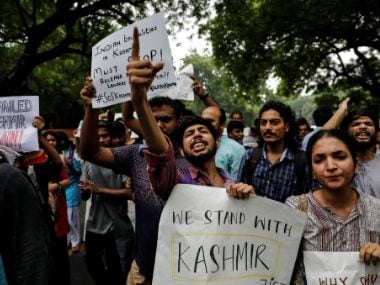 A protest in Delhi after the Centre scrapped Article 370. Reuters[/caption]He also moved Jammu and Kashmir Reservation (Second Amendment) Bill, 2019, aimed at providing 10 percent reservation to economically weaker sections, and a resolution for abrogating Article 370."Article 370 has been regarded as a temporary provision and it had to go. It should have gone long back. But nobody showed (the) will power to do so due to vote bank politics. We are not worried about vote banks nor do we lack political will under Prime Minister Narendra Modi," he said. The bill and the resolution were both approved by the Upper House.What did the resolution, order sayThe resolution moved by Shah said the president, on the recommendation of the Parliament, is pleased to declare that, as from 5 August, 2019, all clauses of the Article 370 shall cease to be operative except clause (1).In his separate order called Constitution (Application to Jammu and Kashmir) Order, 2019, Kovind said that he, in "concurrence" with the "Jammu and Kashmir government", promulgated the order stating that provisions of the Indian Constitution are applicable in the state.It said that the order should "supersede the Constitution (Application to Jammu and Kashmir) Order, 1954".Opposition parties slam Modi govtFormer chief ministers of Jammu and Kashmir Omar Abdullah and Mehbooba Mufti called the Centre's move to scrap Article 370 "disastrous" and said it may lead to "catastrophic consequences".Terming the government's move "unilateral and shocking", Abdullah said it was a total "betrayal of trust" of the people of Jammu and Kashmir."Government of India's unilateral and shocking decisions are a total betrayal of the trust that the people of Jammu and Kashmir had reposed in India when the state acceded to it in 1947," he said, adding, "The decisions will have far-reaching and dangerous consequences."Abdullah accused the Centre of resorting to "deceit and stealth" in recent weeks to lay the ground for these "disastrous decisions". Mufti and Omar Abdullah, who were under house arrest since Sunday night, were detained on Monday evening. Jammu and Kashmir People's Conference leaders Sajjad Lone and Imran Ansari were also held. In sharp reactions, Congress leader Ghulam Nabi Azad alleged that the government has wiped out Jammu and Kashmir's identity, while former home minister P Chidambaram termed the day as a "black day" in India's history.During the debate on the resolution in Rajya Sabha, Chidambaram said, "You cannot modify Article 370 by an order under Article 370. It (Article) enables you to modify such other provisions under the Constitution. It's beyond my comprehension to understand how you can modify the Article... I know this is your manifesto promise. You said you will repeal Article 370. But in repealing Article 370, you are unleashing forces which you cannot control."Hitting out at the NDA in Rajya Sabha, senior Congress leader Kapil Sibal said, "You don't want to debate (on the resolution on Article 370). Why are you in such a hurry? Did you hold any consultation with any stakeholders? Is this your meaning of democracy because you have the numbers in the House? You talk about 'sabka saath, sabka vishwas, sabka vikas'. But you will walk alone just because you have the numbers? If you think this is a historic day, then I feel you will also see many such historic days in the future. We will stand here and protect the Constitution." Before the Trinamool Congress walked out from the Rajya Sabha, the party's national spokesperson Derek O'Brien said, "Trinamool is against the Constitutional immorality and ‘procedural harakiri’ committed today." Senior BJP leaders Arun Jaitley, Sushma Swaraj, Ram Madhav and several other BJP leaders, however, welcomed the Union government's decision calling it a "bold and historic" move towards national integration. Jaitley complimented Modi and Shah, saying "a historical wrong has been undone". BJP workers also held celebrations in various parts of the country.The Pakistan Foreign Office condemned the revoking of Article 370 and said, "Jammu and Kashmir is an internationally-recognised disputed territory. No unilateral step by the Government of India can change this disputed status, as enshrined in the United Nations Security Council (UNSC) resolutions. Nor will this ever be acceptable to the people of Jammu and Kashmir, and Pakistan." Pakistan's ruling Pakistan Tehreek-e-Insaf (PTI) said in a statement, "As the party to this international dispute, Pakistan will exercise all possible options to counter the illegal steps. Pakistan reaffirms its abiding commitment to the Kashmir cause and its political, diplomatic and moral support to the people of India-administered Jammu and Kashmir for realisation of their inalienable right to self-determination." Pakistan prime minister Imran Khan termed India's move to revoke Article 370 as "illegal" and said it will "further deteriorate" relations between the nuclear-capable neighbours. He made the remarks while speaking with his Malaysian counterpart Mahathir Mohamad on the situation in Kashmir. Meanwhile, the Ministry of External Affairs briefed the envoys of the P5 nations — US, UK, Russia, China, and France — on the developments related to the scrapping of Article 370. The Left parties staged a demonstration at the Jantar Mantar in New Delhi. The protesters included senior Left leaders like CPM general-secretary Sitaram Yechury, Prakash Karat, CPI general secretary D Raja, CPI(ML) general secretary Dipankar Bhattacharya, Brinda Karat and Atul Anjan among others. Why move is being criticisedMany natives, intellectuals, activists, and political leaders raised their apprehensions about the consequences following the government's decisions on Monday.Since the developments came at a time when Jammu and Kashmir was under President's Rule, one of the concerns raised by people on social media was how did Kovind make the order "in concurrence of the government of state of Jammu and Kashmir". Some pointed out that since the governor and president both act on the advice of the Central government, the move to repeal Article 370 has entirely been taken by the Central government.Senior advocate Prashant Bhushan also tweeted that the move was "unconstitutional" because bifurcation of Jammu and Kashmir and amendments to Article 370 required consent of the elected Assembly of the State.Another reason for the criticism is that with Article 35A gone, people from anywhere in India will be able to buy property and permanently settle in the state. This has caused tension in the region, as many believe that it will lead to a change in the demography.What's next for the two UTsThe Jammu and Kashmir Reorganisation Bill, 2019, will be tabled in the Lok Sabha on Tuesday and the Centre is confident of getting the bill passed in the Lower House.Once the Parliament approves the bill, a delimitation exercise will be carried out after which the Union Territory of Jammu and Kashmir will have a Lieutenant Governor and the strength of the Assembly will be 107, which will be further enhanced to 114.The present strength of the assembly is 87, which includes four seats of the Ladakh region. Ladakh will now become a separate UT, but without a legislature. Twenty-four seats of the Assembly will continue to remain vacant as they fall in the area of Pakistan- occupied Kashmir (PoK)."...the number of seats in the Legislative Assembly of the Union Territory of Jammu and Kashmir shall be increased from 107 to 114, and delimitation of the constituencies may be determined by the Election Commission in the manner hereinafter provided," according to the Jammu and Kashmir Reorganisation Bill.The Union Territory of Ladakh will have Kargil and Leh districts, it said.There will be a council of ministers, the bill said, consisting of not more than 10 percent of the total number of members in the Legislative Assembly, with the chief minister at the head to aid and advise the Lieutenant Governor in the exercise of his functions in relation to matters with respect to which the Legislative Assembly has powers to make laws.It said that the new Union Territory will have reservation in the Assembly seats. "The number of seats to be reserved for the Scheduled Castes and the Scheduled Tribes in the Legislative Assembly, having regard to the relevant provisions of the Constitution," it said.With inputs from agencies
First Published:Aug 05, 2019, 21:42:51 IST
Advertisement
Advertisement

Rahul Gandhi, Kharge lead protest near PM residence; Centre says Parliament discussion was offered
The developments come amid the continuing CJP-led agitation at Jantar Mantar, where protesters have vowed to continue their sit-in despite recent clashes with Delhi Police
2 min read
Parliament's Monsoon Session from July 20: Key bills, numbers game to dominate agenda
The Monsoon Session of Parliament will begin on July 20 and continue till August 13, with the government expected to push several key legislations, including constitutional amendment bills
2 min read
Major blow to Uddhav Thackeray as six Lok Sabha MPs join Shinde camp
In a major political setback for Shiv Sena (UBT) chief Uddhav Thackeray, six of the party's nine Lok Sabha MPs joined the Eknath Shinde-led Shiv Sena in Mumbai on Monday
2 min read
12 years and counting: NDA leaders felicitate PM Modi as he trumps Nehru's tenure record
Leaders of the National Democratic Alliance (NDA) on Wednesday felicitated Prime Minister Narendra Modi on completing 12 years in office and becoming India's longest-serving continuously elected Prime Minister
3 min read
‘Trust, progress and welfare’: PM Modi celebrates 12 years in office, highlights big policy moves
Prime Minister Narendra Modi on Tuesday marked 12 years in office. He described the period as one dedicated to "trust, development and public welfare" while highlighting key achievements of his government
3 min read
Advertisement
Advertisement