
Advertisement


Sections
Narendra Modi's Midnapore rally a crowd puller but may not be enough to shake Trinamool Congress in West Bengal
The themes the prime minister chose to attack the ruling party, too, were, on the face of it, less than inspired.

Prime Minister Narendra Modi’s visit to Midnapore and the public meeting he addressed there was possibly meant to jumpstart the Bharatiya Janata Party’s (BJP’s) campaign for the 2019 elections in Bengal. That it has come 10-odd months before the elections are due signals serious intent.At present, however, it seems unlikely that the Modi factor will have any serious impact. What will happen 10 months on is, of course, an imponderable, but any doubts about Trinamool Congress’ invulnerability can be ruled out. The Communist Party of India (CPM) is on life support, the Congress is likely to haemorrhage leaders and workers and is only a bit player anyway, and the BJP and Rashtriya Swayamsewak Sangh have neither the organisational muscle nor general acceptance, let alone popularity, to seriously challenge the ruling party.[caption id="attachment_4784491" align="alignleft" width="380"]![Prime Minister Narendra Modi at a rally in West Bengal's Midnapore. Image courtesy @narendramodi]() Prime Minister Narendra Modi at a rally in West Bengal's Midnapore. Image courtesy @narendramodi[/caption]It would be both instructive to examine Modi’s meeting in this context. Media reports peg the attendance at something between 100,000 and 500,000: that is, the police estimate is 100,000, while the BJP claims 500,000 people attended the rally. Neutral estimates are in the region of the BJP’s claim. Trinamool leaders say that the overwhelming majority of people at the rally were bussed in from neighbouring states, but that seems unlikely given the BJP’s unexpectedly good performance in that region – the districts of West Midnapore, Jhargram, Purulia and Bankura, to a lesser extent – in the panchayat elections. Let us just assume then that the attendance was impressive, by any standard.For most political observers it is almost axiomatic that crowds at public rallies and meetings do not necessarily reflect voting preferences. In the case of the Modi meeting, this understanding is probably even truer. Many of those attending the meeting probably just went to it to see Modi on the podium and hear him speak, because without any doubt the prime minister is both a charismatic leader and powerful orator. Many of these people will probably vote for the Trinamool next year.Whatever the attendance may have been, the meeting also served to place under the spotlight the bumbling of the Bengal BJP unit. First, there was the inability to exercise due diligence in organising the meeting, which indirectly led to the collapse of the marquee, injuring almost a hundred persons. The assumption that various agencies of the state were guilty of negligence does not absolve the BJP brass. Initially, state BJP president alleged a conspiracy, blaming the state government for the fiasco. On Thursday, however, he owned responsibility, citing the inexperience of the party in organising meetings of such magnitude. Media reports quoted BJP ‘insiders’ as having said this was a clear indication that the teams sent to investigate had found no fault with the administration.Then, of course, was the very public showdown between Union minister Babul Supriyo and state president Dilip Ghosh. The reasons for it need not detain us, nor is it necessary for us to adjudicate in the dispute. But the very fact that two of the most senior leaders in the state went toe to toe at the venue, even though it happened before the prime minister arrived, says a lot about the state of the leadership. Read that alongside the profiles of the top leaders of the Bengal BJP, most of them are political flyweights with very little statewide connect, and you don’t really see a recipe for regime change.The themes the prime minister chose to attack the ruling party, too, were, on the face of it, less than inspired. The characterisation of the current dispensation as a syndicate raj was legitimate, even if par for the course. But Modi’s constant references to the agricultural sector does not appear to be a fruitful line of attack. It would have been understandable had Modi highlighted the increase in the minimum support price for a number of kharif crops, but he chose also to harp on the promise that farm incomes would be doubled by 2022, while attacking the Trinamool’s record.
Prime Minister Narendra Modi at a rally in West Bengal's Midnapore. Image courtesy @narendramodi[/caption]It would be both instructive to examine Modi’s meeting in this context. Media reports peg the attendance at something between 100,000 and 500,000: that is, the police estimate is 100,000, while the BJP claims 500,000 people attended the rally. Neutral estimates are in the region of the BJP’s claim. Trinamool leaders say that the overwhelming majority of people at the rally were bussed in from neighbouring states, but that seems unlikely given the BJP’s unexpectedly good performance in that region – the districts of West Midnapore, Jhargram, Purulia and Bankura, to a lesser extent – in the panchayat elections. Let us just assume then that the attendance was impressive, by any standard.For most political observers it is almost axiomatic that crowds at public rallies and meetings do not necessarily reflect voting preferences. In the case of the Modi meeting, this understanding is probably even truer. Many of those attending the meeting probably just went to it to see Modi on the podium and hear him speak, because without any doubt the prime minister is both a charismatic leader and powerful orator. Many of these people will probably vote for the Trinamool next year.Whatever the attendance may have been, the meeting also served to place under the spotlight the bumbling of the Bengal BJP unit. First, there was the inability to exercise due diligence in organising the meeting, which indirectly led to the collapse of the marquee, injuring almost a hundred persons. The assumption that various agencies of the state were guilty of negligence does not absolve the BJP brass. Initially, state BJP president alleged a conspiracy, blaming the state government for the fiasco. On Thursday, however, he owned responsibility, citing the inexperience of the party in organising meetings of such magnitude. Media reports quoted BJP ‘insiders’ as having said this was a clear indication that the teams sent to investigate had found no fault with the administration.Then, of course, was the very public showdown between Union minister Babul Supriyo and state president Dilip Ghosh. The reasons for it need not detain us, nor is it necessary for us to adjudicate in the dispute. But the very fact that two of the most senior leaders in the state went toe to toe at the venue, even though it happened before the prime minister arrived, says a lot about the state of the leadership. Read that alongside the profiles of the top leaders of the Bengal BJP, most of them are political flyweights with very little statewide connect, and you don’t really see a recipe for regime change.The themes the prime minister chose to attack the ruling party, too, were, on the face of it, less than inspired. The characterisation of the current dispensation as a syndicate raj was legitimate, even if par for the course. But Modi’s constant references to the agricultural sector does not appear to be a fruitful line of attack. It would have been understandable had Modi highlighted the increase in the minimum support price for a number of kharif crops, but he chose also to harp on the promise that farm incomes would be doubled by 2022, while attacking the Trinamool’s record.
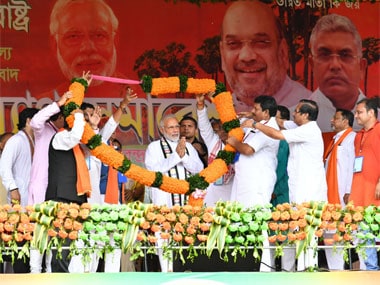 Prime Minister Narendra Modi at a rally in West Bengal's Midnapore. Image courtesy @narendramodi[/caption]It would be both instructive to examine Modi’s meeting in this context. Media reports peg the attendance at something between 100,000 and 500,000: that is, the police estimate is 100,000, while the BJP claims 500,000 people attended the rally. Neutral estimates are in the region of the BJP’s claim. Trinamool leaders say that the overwhelming majority of people at the rally were bussed in from neighbouring states, but that seems unlikely given the BJP’s unexpectedly good performance in that region – the districts of West Midnapore, Jhargram, Purulia and Bankura, to a lesser extent – in the panchayat elections. Let us just assume then that the attendance was impressive, by any standard.For most political observers it is almost axiomatic that crowds at public rallies and meetings do not necessarily reflect voting preferences. In the case of the Modi meeting, this understanding is probably even truer. Many of those attending the meeting probably just went to it to see Modi on the podium and hear him speak, because without any doubt the prime minister is both a charismatic leader and powerful orator. Many of these people will probably vote for the Trinamool next year.Whatever the attendance may have been, the meeting also served to place under the spotlight the bumbling of the Bengal BJP unit. First, there was the inability to exercise due diligence in organising the meeting, which indirectly led to the collapse of the marquee, injuring almost a hundred persons. The assumption that various agencies of the state were guilty of negligence does not absolve the BJP brass. Initially, state BJP president alleged a conspiracy, blaming the state government for the fiasco. On Thursday, however, he owned responsibility, citing the inexperience of the party in organising meetings of such magnitude. Media reports quoted BJP ‘insiders’ as having said this was a clear indication that the teams sent to investigate had found no fault with the administration.Then, of course, was the very public showdown between Union minister Babul Supriyo and state president Dilip Ghosh. The reasons for it need not detain us, nor is it necessary for us to adjudicate in the dispute. But the very fact that two of the most senior leaders in the state went toe to toe at the venue, even though it happened before the prime minister arrived, says a lot about the state of the leadership. Read that alongside the profiles of the top leaders of the Bengal BJP, most of them are political flyweights with very little statewide connect, and you don’t really see a recipe for regime change.The themes the prime minister chose to attack the ruling party, too, were, on the face of it, less than inspired. The characterisation of the current dispensation as a syndicate raj was legitimate, even if par for the course. But Modi’s constant references to the agricultural sector does not appear to be a fruitful line of attack. It would have been understandable had Modi highlighted the increase in the minimum support price for a number of kharif crops, but he chose also to harp on the promise that farm incomes would be doubled by 2022, while attacking the Trinamool’s record.
After four years, and amid the debris of unfulfilled promises, that wouldn’t have cut much ice with the farmers at the rally, especially because it is not inevitable that the BJP will be in power this time next year. In any case, since the Trinamool came to power in 2011, Bengal’s performance in the farm sector has been above the national average, even if somewhat erratic. A Trinamool statement pointed out, citing a parliamentary report, that in the first quarter of 2017 the number of farmers’ suicides in Bengal was zero compared to 635 in Maharashtra.Add to that a counter-intuitive fact. Though the Trinamool government has the image of being a poor performer when it comes to managing the economy, official statistics show that under Chief Minister Mamata Banerjee, Bengal has become one of the top performers in terms of per capita net state domestic product growth. Critics could legitimately say that this is because Bengal has been growing from a low baseline, but politically that nicety doesn’t mean much, especially if the people experience the fruits of growth, however small, on the ground. The indications are that this is happening. In other words, the prime minister may have been incompletely briefed.Modi predicted at the rally that the Trinamool government would collapse in a few months. He was obviously grandstanding. In fact, there is every indication that the Trinamool will sweep the 2019 Lok Sabha elections and the 2021 Assembly elections. In Bengal, the BJP has a long wait ahead of it.
First Published:Jul 20, 2018, 16:48:49 IST
Advertisement
Advertisement

Rahul Gandhi, Kharge lead protest near PM residence; Centre says Parliament discussion was offered
The developments come amid the continuing CJP-led agitation at Jantar Mantar, where protesters have vowed to continue their sit-in despite recent clashes with Delhi Police
2 min read
Parliament's Monsoon Session from July 20: Key bills, numbers game to dominate agenda
The Monsoon Session of Parliament will begin on July 20 and continue till August 13, with the government expected to push several key legislations, including constitutional amendment bills
2 min read
Major blow to Uddhav Thackeray as six Lok Sabha MPs join Shinde camp
In a major political setback for Shiv Sena (UBT) chief Uddhav Thackeray, six of the party's nine Lok Sabha MPs joined the Eknath Shinde-led Shiv Sena in Mumbai on Monday
2 min read
12 years and counting: NDA leaders felicitate PM Modi as he trumps Nehru's tenure record
Leaders of the National Democratic Alliance (NDA) on Wednesday felicitated Prime Minister Narendra Modi on completing 12 years in office and becoming India's longest-serving continuously elected Prime Minister
3 min read
‘Trust, progress and welfare’: PM Modi celebrates 12 years in office, highlights big policy moves
Prime Minister Narendra Modi on Tuesday marked 12 years in office. He described the period as one dedicated to "trust, development and public welfare" while highlighting key achievements of his government
3 min read
Advertisement
Advertisement