


Narendra Modi and RSS, Part III: Sangh, PM are on same page; never rely on static social base for support
As the 2019 elections draw near, Narendra Modi’s outreach to Scheduled Castes and Scheduled Tribes must be seen as a determined plan to expand the party’s support base beyond its traditional social constituency

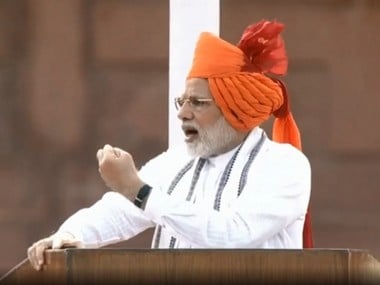
File image of Narendra Modi. Pic courtesy: Twitter@NarendraModi[/caption]Contrast the Shah Bano case with Prime Minister Narendra Modi’s decision to overturn the SC order that diluted the Scheduled Castes and Scheduled Tribes (Prevention of Atrocities) Act. There is an attempt to foment trouble on caste lines across the country. Yet, no political party is willing to be seen at the vanguard of the agitation against the apex court’s decision. On the other hand, the Sangh Parivar has been consistent in its endeavour to win over Dalits for years on end. And there is a discernible pattern in these efforts.On 6 December, 1993, a year after the demolition of the Babri mosque, Vishwa Hindu Parishad (VHP) supremo Ashok Singhal held a meeting with Hindu religious leaders of Ayodhya. The meeting assumed significance as for the first time, Dalit icon BR Ambedkar was included in the pantheon of the Sangh Parivar's "revered leaders". The rise of the Bahujan Samaj Party (BSP) and the Samajwadi Party (BSP) effective counters to Hindutva in Uttar Pradesh posed a grave challenge to the Sangh Parivar’s project. Hence the co-option of the assertive OBCs and Dalits was the best option. This was followed by RSS-VHP leaders lining up outside the residence of 'Dom Raja' (the fabled king of the funeral ghat in Varanasi belonging to the Scheduled Caste) to have a meal with him. The spectacle was not only symbolic but also a determined move to align Hindutva with the assertion of the scheduled castes.Modi’s thrust on winning over the SCs and STs is certainly not without design. Except for Uttar Pradesh, where the BSP is representative of the Dalit assertion, this social block is still in a state of political flux. In large parts of the country, its political strength is often channelised in no coherent manner. With the Congress withering away as an important political force, radicalisation of Dalits in certain pockets often challenges social peace and harmony. Modi’s decision to overturn the SC verdict on the SC/ST (POA) Act is a part of the agenda of “Hindu socialism” which may be radical in its content but not in style.
Those who regard Modi’s pro-Dalit stance as a charade would do well to remember that the BJP is the only party with national presence to have had a Dalit, Bangaru Laxman, as its chief (not counting the one-off exception of Sitaram Kesri as well as the case of regional parties or parties formed on the basis of Dalit identity). The project of elevating Laxman to the party’s top position came a cropper because of different reasons (he was seen accepting money in the Tehelka sting operation). But there is enough possibility of a Dalit leader emerging as a Hindutva icon in future.Given the fact that the RSS-BJP has been focusing substantially to co-opt Dalits to its fold, the possibility of emergence of a strong Dalit leadership steeped in the values of the Sangh Parivar and aligned within the Hindutva ideology cannot be discounted.Consider the fact that the BJP has the largest contingent of Scheduled Castes/Scheduled Tribes legislators in the country. In the Hindi heartland, the party has been winning the maximum number of seats reserved for Scheduled Castes and Scheduled Tribes. In states like MP, Chhattisgarh, Jharkhand and Gujarat where tribals dominate, the party’s strong contingent of lawmakers includes this section too.Those aware of Modi's style of functioning would know that as party general secretary and strategist during his stint in Delhi in the late 1990s, Modi had always insisted on focusing more on non-traditional constituencies in the states under his watch. For instance, he let non-Jat leadership grow in Haryana while he focused on tribals in the pre-bifurcated Madhya Pradesh. In Himachal Pradesh, he co-opted social sections falling outside the dominant Brahmin-Thakur leadership of the state. Over the years, his political experiments proved to be more successful than anticipated. In essence, Modi has never relied on a static social base for political support.As the 2019 elections draw near, Modi’s outreach to Scheduled Castes and Scheduled Tribes must be seen as a determined plan to expand the party’s support base beyond its traditional social constituency. Needless to say, this effort may have to weather a rough storm given the fact that a section of traditionalists within the Sangh Parivar is still beholden to dogmas and social prejudices. Such resistance would be very feeble in the face of a profound change expected to be unleashed by Dalit assertion within the Hindutva fold. If this happens, it would without doubt upend the traditional political leadership in the country and significantly conform to the Sangh Parivar’s idea of India.Read the first part here, and the second part here.

Rahul Gandhi, Kharge lead protest near PM residence; Centre says Parliament discussion was offered
Parliament's Monsoon Session from July 20: Key bills, numbers game to dominate agenda
Major blow to Uddhav Thackeray as six Lok Sabha MPs join Shinde camp
12 years and counting: NDA leaders felicitate PM Modi as he trumps Nehru's tenure record
‘Trust, progress and welfare’: PM Modi celebrates 12 years in office, highlights big policy moves