
Advertisement


Sections
Memo to Akali Dal: Let gurdwara tragedy be an American tragedy
Why is the Shiromani Akali Dal in India rushing in where Sikh leaders in America do not want to tread? The gurdwara tragedy is an American tragedy and Sikhs in America are quite able to respond to it.

The Shiromani Akali Dal in India rushes in where Sikh leaders in America do not want to tread.After the gurdwara attack in Oak Creek, Wisconsin, many television channels in the US tried to helpfully clarify to their viewers that it probably was a case of mistaken identity. The killer must have confused Sikhs and their beards and turbans with the Osama bin laden types. The Chinese had to prove they were not Japanese after Pearl Harbour. And the Sikhs had to prove they were not Arabs after 9/11. Sikh American leaders who had already gone through this post 9/11 were quick to react and not get trapped in this right-victim, wrong-victim dialectic.“No community ‘deserves’ this type of hostility,” wrote Amardeep Singh, an associate professor of English at Lehigh University in Pennsylvania, in the New York Times. “Would it be any less tragic if the victims in Wisconsin had been Muslims gathering for Friday prayers?” Osama bin Laden was a terrorist. But the turban and the beard are not the markers of a terrorist. Sometimes terrorists also look like bald, tattooed, white men as we found out in Wisconsin.But Harsimrat Kaur, MP for the Shiromani Akali Dal, seems to have far less qualms than her counterparts in the US. She ranted in the Lok Sabha yesterday that “just because there is some resemblance in attire, they are targeted.” “How much longer will it take for innocent and peace-loving Sikhs to give up their lives or live in terror before the Indian government wakes up to take some corrective steps to stop these senseless killings?” she demanded. Parkash Singh Badal, the Punjab CM, has said "There is a growing feeling in the minds of Punjabis in general and Sikhs in particular that the Union government must get more actively and vigorously involved in getting the US administration address the issue of safety in right earnest."[caption id="attachment_413929" align="alignleft" width="380"] After the gurdwara attack in Oak Creek, Wisconsin, many television channels in the US tried to helpfully clarify to their viewers that it probably was a case of mistaken identity. AP[/caption]What exactly do Badal and Kaur want the Indian government to do in a case that is clearly one of domestic terrorism in the US? Has the Oak Creek gurdwara asked for their help? Six days after the shooting the gurdwara has reopened for the public with a special service for peace.The local authorities there have pursued the case with vigour. They just arrested the shooter’s ex-girlfriend as well. President Obama ordered flags to fly at half mast until 10 August and called up Manmohan Singh. Even before the Wisconsin tragedy, Rep. Joseph Crowley from New York has been calling on the FBI to collect data on hate crimes against Sikhs. One could say that the Americans have shown more alacrity and responsiveness than authorities in India often do when such terrible things happen here.Sure, there is a larger debate to be had about the gun culture in the United States and the power of its gun lobby. But that’s a debate for Americans to have in America. New Delhi cannot impose that debate on Washington DC any more than Washington can tell Delhi how it needs to fix its own constitution.And yes, there is soul-searching to be done about how the mainstream American media treated the Batman shootings versus this one but again, that's hardly a debate the Indian government should get involved in.Ms Kaur seems so hell-bent on scoring domestic political points here she is ignoring the inconvenient fact that the Sikhs in America are actually quite well-organised, and have been since Sikh gas station owner Balbir Singh Sodhi was killed days after 9/11 in Arizona.As Amardeep Singh explains:
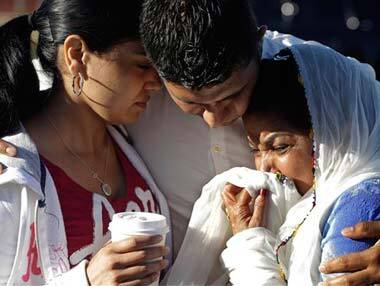 After the gurdwara attack in Oak Creek, Wisconsin, many television channels in the US tried to helpfully clarify to their viewers that it probably was a case of mistaken identity. AP[/caption]What exactly do Badal and Kaur want the Indian government to do in a case that is clearly one of domestic terrorism in the US? Has the Oak Creek gurdwara asked for their help? Six days after the shooting the gurdwara has reopened for the public with a special service for peace.The local authorities there have pursued the case with vigour. They just arrested the shooter’s ex-girlfriend as well. President Obama ordered flags to fly at half mast until 10 August and called up Manmohan Singh. Even before the Wisconsin tragedy, Rep. Joseph Crowley from New York has been calling on the FBI to collect data on hate crimes against Sikhs. One could say that the Americans have shown more alacrity and responsiveness than authorities in India often do when such terrible things happen here.Sure, there is a larger debate to be had about the gun culture in the United States and the power of its gun lobby. But that’s a debate for Americans to have in America. New Delhi cannot impose that debate on Washington DC any more than Washington can tell Delhi how it needs to fix its own constitution.And yes, there is soul-searching to be done about how the mainstream American media treated the Batman shootings versus this one but again, that's hardly a debate the Indian government should get involved in.Ms Kaur seems so hell-bent on scoring domestic political points here she is ignoring the inconvenient fact that the Sikhs in America are actually quite well-organised, and have been since Sikh gas station owner Balbir Singh Sodhi was killed days after 9/11 in Arizona.As Amardeep Singh explains:
To its credit, the Sikh community realized very quickly that it wouldn’t do to simply say, “Don’t hate me, I’m not a Muslim.” Sikhs got organized shortly after 9/11, forming advocacy organizations, chief among them the Sikh Coalition. These groups were emphatic that they opposed hate crimes directed against any group based on religious hostility. To spread awareness, Sikh groups also distributed educational materials and bought advertisements to try to reduce ignorance about the Sikh turban.The difference between 2001 and 2012 is clear. Filmmaker Valarie Kaur made the documentary Divided We Fall about the aftermath of 9/11 on Sikhs and Muslims in the United States. After the Wisconsin shooting she wrote in an email:
(O)n September 15, 2001, a Sikh man was gunned down in front of his gas station in Mesa, Arizona. Aside from a few quick clips on the local news, the coverage was sparse. But this time, something new is happening. Social media were flooded with messages of support and solidarity for Sikh Americans. They knew that the Sikh community gathered to pray on a Sunday morning, just like in millions of churches around the country. They knew that the terrible loss of life so recently after the shootings in Aurora shocks the conscience and violates our deepest values. And they know that this is not just a Sikh tragedy but an American tragedy.If 9/11’s terrible legacy has had any silver lining, it is this – it mobilized the Sikh community into action. The Sikh Coalition has carefully catalogued all instances of hate crimes and harassment and issued reports so that they would not be dismissed as isolated cases. The coalition says its has received thousands of requests for help since 9/11 for everything from school bullying to employment discrimination.And Sikhs realise quite clearly that the solution is neither to dump the turban and shave. Nor is it to just keep your head low and stay quiet, hoping that this too shall pass. In an essay she wrote for Hyphen Magazine and Firstpost, Meeta Kaur explains:
Sikhs have an outward identity that does not allow us to hide, so our only choice is to be vocal and act on a firm resolve as Americans who have a long-term stake in this country… I do not have the luxury of being scared or silent as I was during 9/11. I have to shift to a place of action so (my children) Benanti and Sidak know their fate is in their own hands, so they know they have voices they can use to stop discrimination.Those Sikhs know quite well how to stand up for themselves without Harsimrat Kaur or Manmohan Singh’s help all the way from India. The best thing well-wishers in India can do for their emigrants brothers and sisters is to allow them to respond to this tragedy as an American tragedy.
First Published:Aug 10, 2012, 15:26:38 IST
Advertisement
Advertisement

Rahul Gandhi, Kharge lead protest near PM residence; Centre says Parliament discussion was offered
The developments come amid the continuing CJP-led agitation at Jantar Mantar, where protesters have vowed to continue their sit-in despite recent clashes with Delhi Police
2 min read
Parliament's Monsoon Session from July 20: Key bills, numbers game to dominate agenda
The Monsoon Session of Parliament will begin on July 20 and continue till August 13, with the government expected to push several key legislations, including constitutional amendment bills
2 min read
Major blow to Uddhav Thackeray as six Lok Sabha MPs join Shinde camp
In a major political setback for Shiv Sena (UBT) chief Uddhav Thackeray, six of the party's nine Lok Sabha MPs joined the Eknath Shinde-led Shiv Sena in Mumbai on Monday
2 min read
12 years and counting: NDA leaders felicitate PM Modi as he trumps Nehru's tenure record
Leaders of the National Democratic Alliance (NDA) on Wednesday felicitated Prime Minister Narendra Modi on completing 12 years in office and becoming India's longest-serving continuously elected Prime Minister
3 min read
‘Trust, progress and welfare’: PM Modi celebrates 12 years in office, highlights big policy moves
Prime Minister Narendra Modi on Tuesday marked 12 years in office. He described the period as one dedicated to "trust, development and public welfare" while highlighting key achievements of his government
3 min read
Advertisement
Advertisement