


Long-standing bond between religion and politics won’t end with BJP’s demand for observers at mosques during polls
BJP has demanded special observers at mosques to prevent any attempt to influence voters. APP said the same observers should be appointed at RSS shakhas.

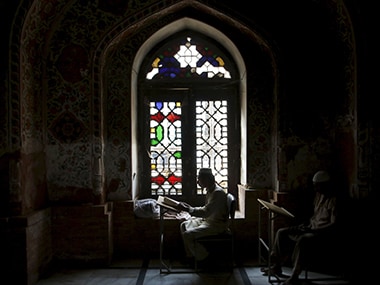
Representational image of a mosque. Reuters[/caption]Cut to 2014, and the friendship between religion and politics was still strong.On Sunday, the Delhi BJP had demanded that special observers be appointed to watch over mosques to prevent any attempt to influence voters along religious lines. In retaliation, the Aam Aadmi Party (AAP) said it will welcome all steps by the Election Commission to prevent any communal discord, with one condition that observers also be appointed at shakhas of the Rashtriya Swayamsevak Sangh (RSS).The letter — addressed by the legal department of the Delhi BJP — claimed Chief Minister Arvind Kejriwal and other AAP members often gave speeches that could polarise voters. Shyam Jaju, national vice-president and state prabhari of Delhi and Uttarakhand BJP, told Firstpost that Kejriwal challenging BJP's "purely constitutional" demands was another marker of his irresponsible leadership.In response, AAP's Amanatullah Khan told Firstpost that pushing the Lok Sabha election in Delhi to the seventh and last phase, making it fall during Ramzan, was a move aimed at dissuading Muslim votes. He also questioned why the RSS had gone back on its promise to Sardar Vallabhbhai Patel that it will remain a non-political organisation.Furthermore, a historian at Aligarh Muslim University, Ali Nadeem Rezavi explained the inevitability of politics in religious congregations and said the concept is not limited to Islam.Yet another dimension, according to historian Syed Irfan Habib, is that the voting pattern among Muslims and Dalits had changed over the years. He pointed out bifurcations in voting patterns; in Uttar Pradesh, for instance, the Muslim vote is broadly split between the Samajwadi Party and the Congress, and the Dalit vote is bifurcated, with some sub-castes, like the Valmikis and Ravidasis, voting for the BJP.
The inseparability of politics and religion is not limited to Muslims and Hindus either. In 2014, the Shiromani Akali Dal had raised the demand for an All India Gurdwara Act, a good six decades after a private bill was first moved on the subject. The bill proposes to bring all gurdwaras in India under the control of a unified body of Sikhs elected from across the country.In a book titled Sikh Separatism: The Politics of Faith, it is argued that "the proposed Act has elements designed to extend the Akali Dal's power base to Sikhs throughout the country, rather than to ensure the proper management of all Sikh religious institutions".In the North East, countering the "Church veto" in states like Nagaland and Meghalaya was a challenge for the ruling party. After the BJP's victory in the North East, its star campaigner in the region, Sunil Deodhar, had said he had seen a trend of candidates being introduced in churches in Meghalaya. Right after the results of the elections were declared, he had revealed that loyalties were so sharply divided that Presbyterian churchgoers were urged to vote for a candidate from their sub-caste even if they were contesting against a Catholic candidate.Last year, BJP spokesperson and advocate Ashwini Upadhyay had filed a petition under Article 32 to restrict the misuse of religion for electoral gains in line with the recommendation of the Election Commission. Under Section 123(3) of the Representation of People Act, an appeal on the grounds of religion, race, caste, etc, and promotion of feelings of enmity between various classes constitute corrupt practices, but the problem lies in the fact that the same can be questioned only by way of an election petition and cannot be a subject of inquiry before the Election Commission, even when the polls are underway. In fact, it is this lack of electoral reforms that has left the judiciary with no option but to intervene.In the world's largest electoral operation, the intervention of courts through such petitions has led to electoral reforms. For instance, one was on the provision for candidates to disclose their assets and criminal antecedents upon a petition filed by the Association for Democratic Reforms; another was on striking down Section 8(4) of the Representation of People's Act, 1951, which permitted even murder convicts to continue as MPs and MLAs.Upadhyay had pleaded the court to declare that the Election Commission has the power to take action on complaints related to the misuse of religion for electoral gains. He had also sought directions to the Centre to take appropriate steps to restrict the misuse of religion.The Supreme Court had dismissed the Public Interest Litigation in October 2018, but Upadhyay claims he had withdrawn the plea and moved the Election Commission, instead, to ensure free and fair elections in the spirit of articles 14, 19 and 324.In 2014, RSS joint general secretary Dattatreya Hosabale had referred to the Lok Sabha election that year as a "starting point of a long-term vision". The union of religion and politics demands addressing across parties and religions, not random measures like the appointment of special observers at particular institutions.

Rahul Gandhi, Kharge lead protest near PM residence; Centre says Parliament discussion was offered
Parliament's Monsoon Session from July 20: Key bills, numbers game to dominate agenda
Major blow to Uddhav Thackeray as six Lok Sabha MPs join Shinde camp
12 years and counting: NDA leaders felicitate PM Modi as he trumps Nehru's tenure record
‘Trust, progress and welfare’: PM Modi celebrates 12 years in office, highlights big policy moves