
Advertisement


Sections
From Assange to Kejriwal: Understanding media hostility
Both Kejriwal and Assange once had a symbiotic relationship with the media, but that has become borderline hostile today.

There was a time, not long ago, when Arvind Kejriwal was being billed as the ‘Julian Assange of India’. Perhaps this was born of the sense that Kejriwal’s record of launching high-decibel ‘exposes’ of alleged corruption, which were lapped up by the media, echoed Assange’s periodic WikiLeaks exposes of US cables that chronicled in merciless detail the diplomats’ observations on the ways of the world, and the shadowy side to American and foreign governments’ dealings.Today, however, for all their vastly different agendas, approaches and life circumstances, Assange and Kejriwal are united by other common strands: they have both becomes targets of political vendetta; and, somewhat paradoxically, they have both become victims of a creeping ‘expose fatigue’. By another curious coincidence, although both Kejriwal and Assange still retain enormous goodwill among large sections of the people, their relationship with the media, which once soared on the strength of symbiosis, have become strained, even borderline hostile.The hostility of the media is doubly curious because at one point the media fed off Assange’s scoops and Kejriwal’s recycled exposes, which worked to amplify the exposes and simultaneously profited from the relationship. The media also ostensibly shares Assange’s and Kejriwal’s commitment to transparency and freedom of information — and exposure of governmental wrongdoing; which is why their lack of sympathy for their causes is striking.Today, Kejriwal has reinvented himself as a politician has floated his own party — and operates openly. In that sense, he is considerably better off than Assange, who has for six months now remains holed up in the Ecuadorian embassy in London, where he has sought refuge to escape likely arrest (on rape charges in Sweden) and possible extradition to Sweden, and then on to the US (where he is wanted on rather more serious charges of espionage).WikiLeaks hasn’t released any sensational documents in recent times, so it’s been rather quiet on that front. But with Kejriwal, it’s come to a stage where his breathless accounts of crony capitalism and political corruption have run out of media steam. In recent days, Kejriwal has taken to brandishing a slip of paper and reading out what he says are the numbered Swiss bank accounts of the Ambani brothers, but the story hasn’t gained much traction in the media.[caption id="attachment_552259" align="alignleft" width="380"] There was a time, not long ago, when Arvind Kejriwal was being billed as the ‘Julian Assange of India’. AP[/caption]How does one explain the change in the media narrative in respect of both Assange and Kejriwal, from a point where they were hailed as courageous whistleblowers to, in some cases, borderline media contempt for both of them?Writing in The Guardian a while ago, columnist Glenn Greenwald flagged off several reasons to account for what he called the “bizarre, blinding media contempt” for Assange. More than a few of those could apply with the media’s relationship with Kejriwal as well.For instance, Greenwald reckons that one obvious reason why the media turned against Assange was the consideration of competition: “the resentment generated by watching someone outside their profession generate more critical scoops… than all other media outlets combined.”In Kejriwal’s case too, virtually every expose by Kejriwal has also exposed the media’s failure to follow up on material that they themselves had, in some cases, first made available. While the media is right to point out that Kejriwal is merely reheating old charges and serving them, the fact is that in virtually every case, they had failed to connect the dots and trace them to their political roots.Greenwald also cites other, subtler reason to account for why the media resents Assange.
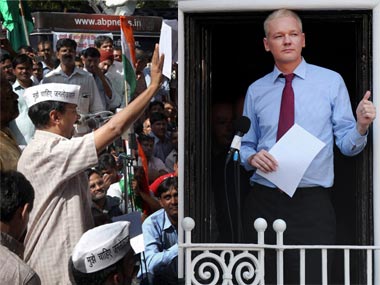 There was a time, not long ago, when Arvind Kejriwal was being billed as the ‘Julian Assange of India’. AP[/caption]How does one explain the change in the media narrative in respect of both Assange and Kejriwal, from a point where they were hailed as courageous whistleblowers to, in some cases, borderline media contempt for both of them?Writing in The Guardian a while ago, columnist Glenn Greenwald flagged off several reasons to account for what he called the “bizarre, blinding media contempt” for Assange. More than a few of those could apply with the media’s relationship with Kejriwal as well.For instance, Greenwald reckons that one obvious reason why the media turned against Assange was the consideration of competition: “the resentment generated by watching someone outside their profession generate more critical scoops… than all other media outlets combined.”In Kejriwal’s case too, virtually every expose by Kejriwal has also exposed the media’s failure to follow up on material that they themselves had, in some cases, first made available. While the media is right to point out that Kejriwal is merely reheating old charges and serving them, the fact is that in virtually every case, they had failed to connect the dots and trace them to their political roots.Greenwald also cites other, subtler reason to account for why the media resents Assange.
“Many journalists (and liberals) like to wear the costume of outsider-insurgent, but are, at their core, devoted institutionalists… and thus resent those (like Assange) who actually and deliberately place themselves outside of it. By putting his own liberty and security at risk to oppose the world's most powerful factions, Assange has clearly demonstrated what happens to real adversarial dissidents and insurgents – they're persecuted, demonized, and threatened, not befriended by and invited to parties within the halls of imperial power – and he thus causes many journalists to stand revealed as posers, servants to power, and courtiers.”Those are searing sentiments that could apply with equal ferocity to the media in Kejriwal’s case as well. The media, which ought, by its very nature, to keep its distance from power – and have an objective eye, and even play an adversarial role, as an outsider – has become too entrenched in the political system to be truly objective. And as was revealed most famously in the Niira Radia tapes, the media’s proximity to power has, in some cases, caused them to become “players” themselves, so much so that even when they stumbled on the faultlines of political corruption, their combative, adversarial instincts had become so deadened from being “on the inside” that they failed to connect the dots.Despite being a political insider today, Kejriwal’s idiom and politics makes him a rank outsider; in contrast to him, savvy media stars seem like consummate political players. Which is why although he thrived on media attention for a while, Kejriwal has repeatedly questioned the media’s affliction of short-term memory. And whenever he is asked why he doesn’t follow-up on his exposes, he flings the question right back at the media: “But that’s what your job was intended to be: to follow up.”It’s hard to see Assange change his life circumstances in any material way unless powerful governments that are out to get him ease up on their vendetta. For now, if he so much as steps outside the Ecuadorean embassy in London – much less go for that walk in the woods that he yearns for - he risks being arrested. In that sense, his contentious relationship with the media doesn’t look like it will get any better.With Kejriwal, though, one of two things could happen: the considerations of electoral politics could perhaps blunt his idealism over time, in which case, he too could become a “player” – and therefore non-threatening to the media. Alternatively, if his political movement fails, he could opt out and become the outsider once more, battering away at the citadels of power. In that case, the media which thrives in the hothouse of power politics, will continue to have an adversarial relationship with him.
Venky Vembu attained his first Fifteen Minutes of Fame in 1984, on the threshold of his career, when paparazzi pictures of him with Maneka Gandhi were splashed in the world media under the mischievous tag ‘International Affairs’. But that’s a story he’s saving up for his memoirs… Over 25 years, Venky worked in The Indian Express, Frontline newsmagazine, Outlook Money and DNA, before joining FirstPost ahead of its launch. Additionally, he has been published, at various times, in, among other publications, The Times of India, Hindustan Times, Outlook, and Outlook Traveller.
First Published:Dec 10, 2012, 18:26:52 IST
Advertisement
Advertisement

Rahul Gandhi, Kharge lead protest near PM residence; Centre says Parliament discussion was offered
The developments come amid the continuing CJP-led agitation at Jantar Mantar, where protesters have vowed to continue their sit-in despite recent clashes with Delhi Police
2 min read
Parliament's Monsoon Session from July 20: Key bills, numbers game to dominate agenda
The Monsoon Session of Parliament will begin on July 20 and continue till August 13, with the government expected to push several key legislations, including constitutional amendment bills
2 min read
Major blow to Uddhav Thackeray as six Lok Sabha MPs join Shinde camp
In a major political setback for Shiv Sena (UBT) chief Uddhav Thackeray, six of the party's nine Lok Sabha MPs joined the Eknath Shinde-led Shiv Sena in Mumbai on Monday
2 min read
12 years and counting: NDA leaders felicitate PM Modi as he trumps Nehru's tenure record
Leaders of the National Democratic Alliance (NDA) on Wednesday felicitated Prime Minister Narendra Modi on completing 12 years in office and becoming India's longest-serving continuously elected Prime Minister
3 min read
‘Trust, progress and welfare’: PM Modi celebrates 12 years in office, highlights big policy moves
Prime Minister Narendra Modi on Tuesday marked 12 years in office. He described the period as one dedicated to "trust, development and public welfare" while highlighting key achievements of his government
3 min read
Advertisement
Advertisement