
Advertisement


Sections
BJP clueless about South; Tamil Nadu doesn't see value in being compelled to learn Hindi, writes DMK's Manuraj S
Let it be said once again, for we live in the times of fake news and clichéd thinking, that Dravida Munnetra Kazhagam (DMK) does not oppose Hindi. Nor does it oppose Bengali, Urdu, Marathi, Malayalam or Sindhi. However, the imposition of any one language, through school education policy or otherwise, is not acceptable to the DMK. In other words, any such move to insidiously bring Hindi in through the backdoor will be thwarted.

Let it be said once again, for we live in the times of fake news and clichéd thinking, that Dravida Munnetra Kazhagam (DMK) does not oppose Hindi. Nor does it oppose Bengali, Urdu, Marathi, Malayalam or Sindhi. However, the imposition of any one language, through school education policy or otherwise, is not acceptable to the DMK. In other words, any such move to insidiously bring Hindi in through the backdoor will be thwarted.[caption id="attachment_6347281" align="alignleft" width="380"]![Representational image. Reuters]() Representational image. Reuters[/caption]The Bharatiya Janata Party (BJP), for its resounding political success across the West, North, and East of the country, continues to be clueless about the South. Here, it is often said that Hindi is not a language issue, as it is often portrayed to be. It is a political issue. The imposition of Hindi, directly or indirectly, on non-Hindi speaking states is viewed as an extension of the cultural majoritarianism policy of a Delhi-based government. Furthermore, it reflects the unrequited desire of mainland (read: Hindi-belt) political parties to make Hindi acceptable to Tamil speakers.India is a multicultural, multi-religious and multi-linguistic country. The fact that there is a great deal of diversity is and must be celebrated in India. The stirring up of age-old debates on the three-language policy is of concern to us because it comes at a time when the BJP has raked up a huge electoral victory in the Hindi heartland.
Representational image. Reuters[/caption]The Bharatiya Janata Party (BJP), for its resounding political success across the West, North, and East of the country, continues to be clueless about the South. Here, it is often said that Hindi is not a language issue, as it is often portrayed to be. It is a political issue. The imposition of Hindi, directly or indirectly, on non-Hindi speaking states is viewed as an extension of the cultural majoritarianism policy of a Delhi-based government. Furthermore, it reflects the unrequited desire of mainland (read: Hindi-belt) political parties to make Hindi acceptable to Tamil speakers.India is a multicultural, multi-religious and multi-linguistic country. The fact that there is a great deal of diversity is and must be celebrated in India. The stirring up of age-old debates on the three-language policy is of concern to us because it comes at a time when the BJP has raked up a huge electoral victory in the Hindi heartland.![pokhriyal tweet]() As the issue caused ripples on social media, it became obvious that the words of the Union Minister for Human Resource Development would not provide sufficient reassurance.So, it appears the Quick Response Team, within the BJP's Public Relations Department went looking for a Tamil minister. Unfortunately, with the BJP losing all its seats in Tamil Nadu and no representative from its ally All India Anna Dravida Munnetra Kazhagam (AIADMK) in the Union Cabinet, it was left to finance minister Nirmala Sitharaman and External Affairs Minister S Jaishankar to assuage the fears of Tamil speakers and opposers of Hindi imposition.
As the issue caused ripples on social media, it became obvious that the words of the Union Minister for Human Resource Development would not provide sufficient reassurance.So, it appears the Quick Response Team, within the BJP's Public Relations Department went looking for a Tamil minister. Unfortunately, with the BJP losing all its seats in Tamil Nadu and no representative from its ally All India Anna Dravida Munnetra Kazhagam (AIADMK) in the Union Cabinet, it was left to finance minister Nirmala Sitharaman and External Affairs Minister S Jaishankar to assuage the fears of Tamil speakers and opposers of Hindi imposition.![jaishankar tweet]() Commendable acts of ministerial overreach notwithstanding, the BJP has failed again to understand the sentiments of Tamils and the recent political history of Tamil Nadu.It is a settled fact that the anti-Hindi imposition protests leading up to 1965 provided the base for rise of Dravidian politics and heralded the end of the dominance of national parties in the state. Since 1968, Tamil Nadu has adopted a two-language policy — Tamil and English - and this has worked very well. Today, Tamil Nadu is an urbanised state with an expansive manufacturing base.The state has been role model in welfarism and social justice. The policies of the state have created sufficient opportunities for upward social and economic mobility. All of these advances have taken place without a three-language policy. Quite simply, Tamil Nadu does not see the value of being compelled to learn Hindi.Nevertheless, various governments and their coterie of nationalists have tried in the past to revive the three-language policy using various arguments. The most vocal arguments in favour of Hindi being lingua franca have always come from Hindi speakers. Surprise surprise! It would almost seem like the Hindi-speakers would like the non-Hindi speakers to learn Hindi to suit their own narratives of nationalism, which have now found refuge under the Narendra Modi government's Ek Bharat, Shresht Bharat sloganeering.However, each time such campaigns and efforts to casually bring about Hindi as a "national language" take shape, they always run into strong resistance from the DMK. For, the DMK believes, more than anything else, that Tamil is not just a language but an identity.In his book, 'Hindi Against India - Meaning of DMK', Mohan Ram in 1968 wrote that the "greatest threat to Indian unity is Hindi and what it represents. Hindi is not a language issue; it is a political issue. Hindi is the spearhead of the movement for the Hindi-speaking midland's domination of the rest of the country".Even in 2019, it would seem that the greatest threat to national unity is not from fringe groups but from an autocratic state that imposes its will on people without their consent.The author is a spokesperson of the DMK
Commendable acts of ministerial overreach notwithstanding, the BJP has failed again to understand the sentiments of Tamils and the recent political history of Tamil Nadu.It is a settled fact that the anti-Hindi imposition protests leading up to 1965 provided the base for rise of Dravidian politics and heralded the end of the dominance of national parties in the state. Since 1968, Tamil Nadu has adopted a two-language policy — Tamil and English - and this has worked very well. Today, Tamil Nadu is an urbanised state with an expansive manufacturing base.The state has been role model in welfarism and social justice. The policies of the state have created sufficient opportunities for upward social and economic mobility. All of these advances have taken place without a three-language policy. Quite simply, Tamil Nadu does not see the value of being compelled to learn Hindi.Nevertheless, various governments and their coterie of nationalists have tried in the past to revive the three-language policy using various arguments. The most vocal arguments in favour of Hindi being lingua franca have always come from Hindi speakers. Surprise surprise! It would almost seem like the Hindi-speakers would like the non-Hindi speakers to learn Hindi to suit their own narratives of nationalism, which have now found refuge under the Narendra Modi government's Ek Bharat, Shresht Bharat sloganeering.However, each time such campaigns and efforts to casually bring about Hindi as a "national language" take shape, they always run into strong resistance from the DMK. For, the DMK believes, more than anything else, that Tamil is not just a language but an identity.In his book, 'Hindi Against India - Meaning of DMK', Mohan Ram in 1968 wrote that the "greatest threat to Indian unity is Hindi and what it represents. Hindi is not a language issue; it is a political issue. Hindi is the spearhead of the movement for the Hindi-speaking midland's domination of the rest of the country".Even in 2019, it would seem that the greatest threat to national unity is not from fringe groups but from an autocratic state that imposes its will on people without their consent.The author is a spokesperson of the DMK
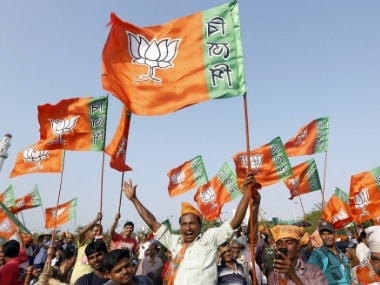 Representational image. Reuters[/caption]The Bharatiya Janata Party (BJP), for its resounding political success across the West, North, and East of the country, continues to be clueless about the South. Here, it is often said that Hindi is not a language issue, as it is often portrayed to be. It is a political issue. The imposition of Hindi, directly or indirectly, on non-Hindi speaking states is viewed as an extension of the cultural majoritarianism policy of a Delhi-based government. Furthermore, it reflects the unrequited desire of mainland (read: Hindi-belt) political parties to make Hindi acceptable to Tamil speakers.India is a multicultural, multi-religious and multi-linguistic country. The fact that there is a great deal of diversity is and must be celebrated in India. The stirring up of age-old debates on the three-language policy is of concern to us because it comes at a time when the BJP has raked up a huge electoral victory in the Hindi heartland.
It is of a bigger concern to us because of the Dr. K. Kasturirangan Committee which submitted the draft National Education Policy 2019 with the problematic recommendation to the new Union Minister for Human Resource Development, Dr Ramesh Pokhriyal Nishank — who had famously tweeted on 1 August 2017 that "Making Hindi the national language is absolutely essential."
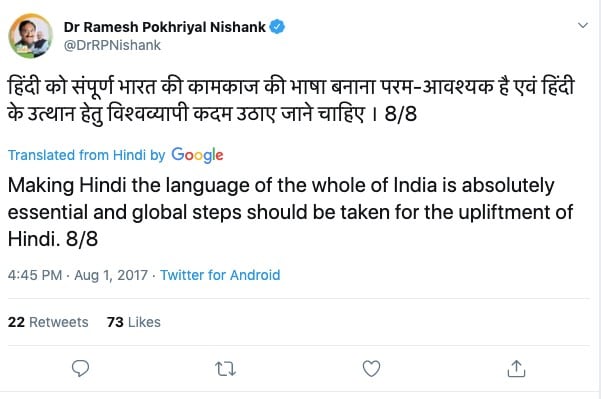 As the issue caused ripples on social media, it became obvious that the words of the Union Minister for Human Resource Development would not provide sufficient reassurance.So, it appears the Quick Response Team, within the BJP's Public Relations Department went looking for a Tamil minister. Unfortunately, with the BJP losing all its seats in Tamil Nadu and no representative from its ally All India Anna Dravida Munnetra Kazhagam (AIADMK) in the Union Cabinet, it was left to finance minister Nirmala Sitharaman and External Affairs Minister S Jaishankar to assuage the fears of Tamil speakers and opposers of Hindi imposition.
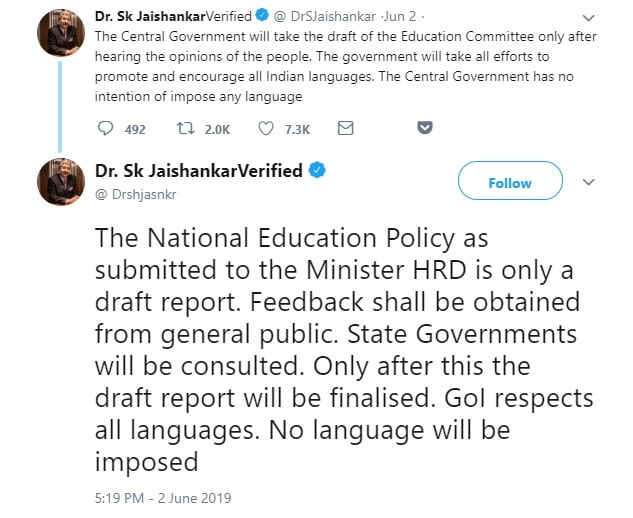 Commendable acts of ministerial overreach notwithstanding, the BJP has failed again to understand the sentiments of Tamils and the recent political history of Tamil Nadu.It is a settled fact that the anti-Hindi imposition protests leading up to 1965 provided the base for rise of Dravidian politics and heralded the end of the dominance of national parties in the state. Since 1968, Tamil Nadu has adopted a two-language policy — Tamil and English - and this has worked very well. Today, Tamil Nadu is an urbanised state with an expansive manufacturing base.The state has been role model in welfarism and social justice. The policies of the state have created sufficient opportunities for upward social and economic mobility. All of these advances have taken place without a three-language policy. Quite simply, Tamil Nadu does not see the value of being compelled to learn Hindi.Nevertheless, various governments and their coterie of nationalists have tried in the past to revive the three-language policy using various arguments. The most vocal arguments in favour of Hindi being lingua franca have always come from Hindi speakers. Surprise surprise! It would almost seem like the Hindi-speakers would like the non-Hindi speakers to learn Hindi to suit their own narratives of nationalism, which have now found refuge under the Narendra Modi government's Ek Bharat, Shresht Bharat sloganeering.However, each time such campaigns and efforts to casually bring about Hindi as a "national language" take shape, they always run into strong resistance from the DMK. For, the DMK believes, more than anything else, that Tamil is not just a language but an identity.In his book, 'Hindi Against India - Meaning of DMK', Mohan Ram in 1968 wrote that the "greatest threat to Indian unity is Hindi and what it represents. Hindi is not a language issue; it is a political issue. Hindi is the spearhead of the movement for the Hindi-speaking midland's domination of the rest of the country".Even in 2019, it would seem that the greatest threat to national unity is not from fringe groups but from an autocratic state that imposes its will on people without their consent.The author is a spokesperson of the DMK
First Published:Jun 04, 2019, 13:03:02 IST
Advertisement
Advertisement

Rahul Gandhi, Kharge lead protest near PM residence; Centre says Parliament discussion was offered
The developments come amid the continuing CJP-led agitation at Jantar Mantar, where protesters have vowed to continue their sit-in despite recent clashes with Delhi Police
2 min read
Parliament's Monsoon Session from July 20: Key bills, numbers game to dominate agenda
The Monsoon Session of Parliament will begin on July 20 and continue till August 13, with the government expected to push several key legislations, including constitutional amendment bills
2 min read
Major blow to Uddhav Thackeray as six Lok Sabha MPs join Shinde camp
In a major political setback for Shiv Sena (UBT) chief Uddhav Thackeray, six of the party's nine Lok Sabha MPs joined the Eknath Shinde-led Shiv Sena in Mumbai on Monday
2 min read
12 years and counting: NDA leaders felicitate PM Modi as he trumps Nehru's tenure record
Leaders of the National Democratic Alliance (NDA) on Wednesday felicitated Prime Minister Narendra Modi on completing 12 years in office and becoming India's longest-serving continuously elected Prime Minister
3 min read
‘Trust, progress and welfare’: PM Modi celebrates 12 years in office, highlights big policy moves
Prime Minister Narendra Modi on Tuesday marked 12 years in office. He described the period as one dedicated to "trust, development and public welfare" while highlighting key achievements of his government
3 min read
Advertisement
Advertisement