


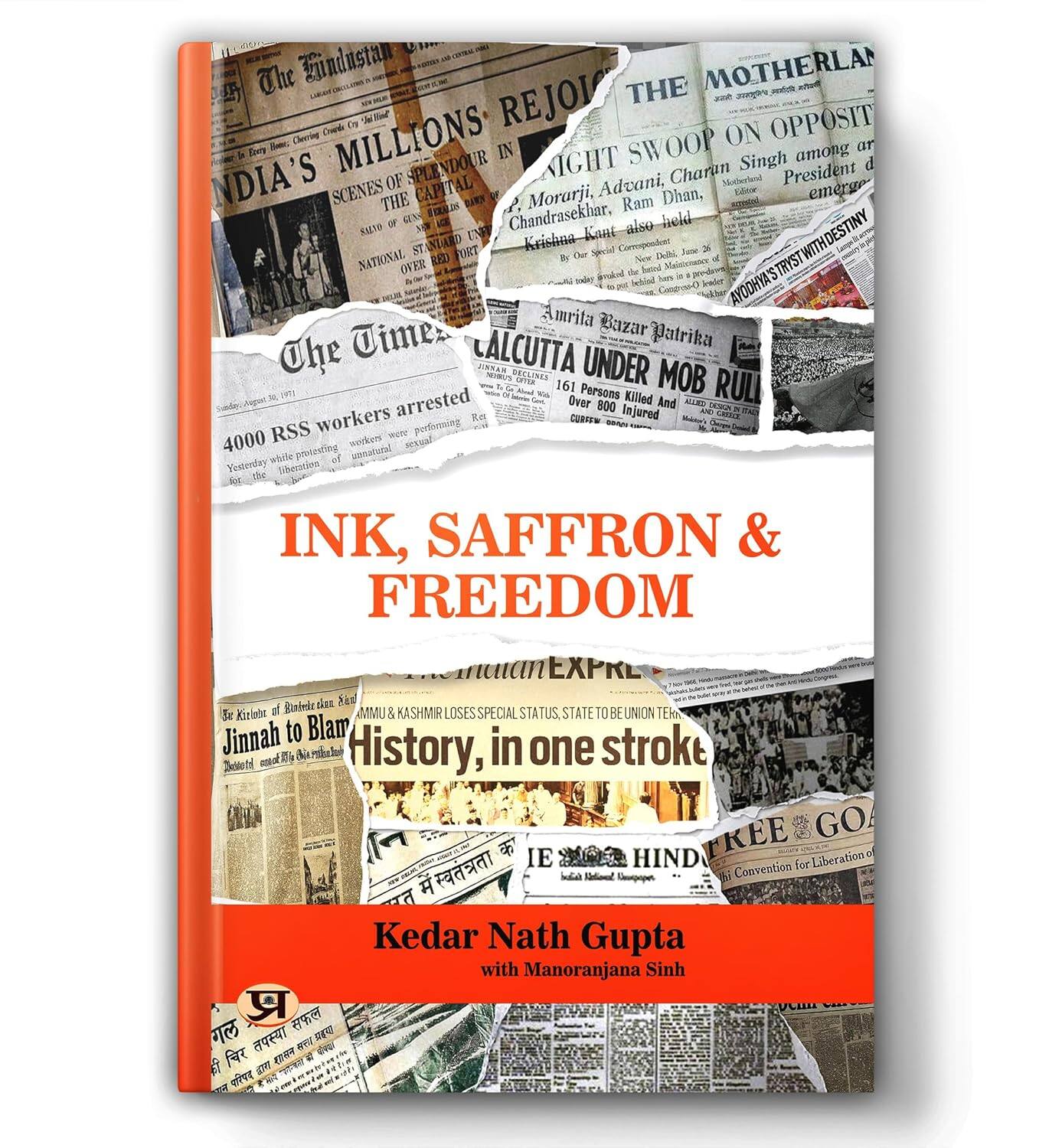
‘Ink, Saffron and Freedom’: Memoir of a journalist and a nation
Kedar Nath Gupta’s book is less a memoir in the intimate, inward-looking sense and more a primary chronicle — a reporter’s ledger of a nation being made, unmade and remade

I begin with a caveat. This ‘not-so-critical’ review of Ink, Saffron and Freedom is also a tribute to Kedar Nath Gupta, or KNG as he was fondly called by his colleagues at The Economic Times in the early 1980s. He was a wonderful mentor to many trainee journalists — rookie reporters and sub-editors like me (from 1982-84). This was an era when newspapers were printed on the lithographic press, and the chief sub often had to go to the shop floor to carry out the last-minute substitutions of an ‘a’ for an ‘e’ or an ‘i’!
KNG had joined ET after the closure of Motherland, and he had played an activist role in the Emergency years as well. This is a review of the candid biography of this young-at-heart veteran of nine decades and four.
Witness to Partition
On the morning of Partition and across the tumultuous decades that followed, KNG did not merely observe history: he reported it. Ink, Saffron and Freedom is less a memoir in the intimate, inward-looking sense and more a primary chronicle: a reporter’s ledger of a nation being made, unmade and remade.
 More from Opinion
KNG’s account matters because it brings readers ‘from textbook abstractions to street-level immediacy’: the smell of smoke after riots, the cadence of newsroom anxiety, the private conversation with the political mandarins of the times. As a witness to Partition, his recollections convert statistics into human scale. It is one thing to report the number of deaths, quite another to provide texture to trauma. What textbooks compress into bullet points — migrations, massacres, map-lines — here unfold as scenes lived by someone who kept his notebook open while history happened.
This is what I would call the reporter’s edge, as it used to be — when we were told to draw a clear line between facts and opinion pieces. Thus, the reportage from different ends of the political spectrum would be more or less similar — the differences came out sharply in the editorials. The editorial stance was stated upfront. There were no advertorials, and paid news was unheard of. Professional PR agencies were not encouraged on the editorial floor, and advertisement managers came pleading to the News Editor to somehow ‘accommodate’ the advertisement in a more prominent setting. But we, in the editorial desk, ‘controlled’ the space.
That era, unfortunately, is long gone, never to return. This book is also a survey of that vanished era of journalism. Gupta’s career spans what he and his contemporaries considered “fearless” reporting: an ethos of mission, public-mindedness and front-page accountability that stood in marked contrast to the later decades of mediated pressures, political patronage and corporate appetite. His reportage — and his reminiscences of rubbing shoulders with influential ideologues and officials — offers intimate portraits of figures who are part of the political canon. Those interactions do more than humanise icons; they show how press and polity shaped one another in formative years, for good and ill.
Equally central to Ink, Saffron and Freedom is the ‘Dilliwala’ sensibility. This is a book steeped in the city’s moods: a Delhi of mohallas, of temple bells and kachori stalls, of fairs in Garhmukteshwar, rickshaws, tongas and single-screen movie halls. Gupta writes as a Dilliwala by instinct — attentive to the city’s layers, wistful about vanished bazaars, conscious of how the capital’s physical growth mirrored the expansion and complications of the Indian state. The Delhi of yesteryears exists no more. The fifties and sixties were decades when the Punjabis drove the political economy of the capital. From the nineties, Delhi became the chief magnet for migrants from across the country, and now it is called Bihar’s second largest city (Rohit Saran: 100 Ways of Seeing India).
KNG is upfront about his ideology — and let me mention that in the eighties, when most of Bahadur Shah Zafar Marg was what is now pejoratively called ‘Left liberal’, KNG wore his RSS colours on his sleeve. A lifelong Swayamsevak, his commitment to the idea of ‘Akhand Bharat’ and the cultural priorities that attend it informed his moral bearings. However, as a professional, he maintained the fine balance between public duty and private belief across changing political climates. Facts were facts, and there was no compromise on this front.
Three larger points emerge. First, this is a near-century sweep: the book bridges colonialism, Partition, the Nehruvian project, and the fissiparous politics of the fifties and sixties — these were indeed ‘India’s dangerous decades’. Second, it balances nostalgia with critique; Gupta’s wit and anecdotal flourishes make dense history readable without flattening its contradictions. Third, above all, it is a study in resilience: professional fidelity and ideological persistence amid radical systemic change.
Let me now focus on his work at Motherland — for all the other publications he worked for — Indian Express, Times of India and Economic Times continue to be in the public space. Ironic as it may seem, the owners — Bharat Prakashan — had purchased the printing press from the owners of Dawn, the mouthpiece of M.A. Jinnah’s Muslim League. It was then the largest printing press in New Delhi. The most controversial story commissioned by him was about Rustom Nagarwala’s embezzlement of Rs 60 lakh from the Parliament Street branch of SBI — a very big sum in the seventies — by claiming to speak on behalf of then Prime Minister Indira Gandhi. Motherland averred that Nagarwala was an agent of RAW — an allegation which has neither been proved nor denied. Likewise, it was very harsh on the Maruti project of Sanjay Gandhi. No wonder Motherland had to close shop during the Emergency.
Questions remain for the discerning reader. How does a committed ideological stance shape the ethics of reporting when the state’s contours shift? To what extent do personal networks and institutional loyalties tilt the scales of historical record? Gupta does not pretend to answer every such query, but his memoir supplies primary material that scholars, journalists and citizens will find indispensable.
In the epilogue, ‘Let us not worship misguided altruism’, he calls upon the successful members of the Indian diaspora to get their priorities right, and support education and social initiatives in India, rather than the Ivy Leagues — which may not value their contribution the way their schools, colleges and universities in India would. Why can’t the IT mandarins support the government primary schools in their ancestral villages? He is also concerned about the failure of Indian consulting firms to pose a challenge to the big daddies of consulting — McKinsey, BCG, E&Y, KPMG and Deloitte. He points to the downside of these dependencies — they are quite expensive to engage with, and if things go wrong, they are not really accountable.
Ink, Saffron and Freedom closes with six mantras for life which include, inter alia: embracing your roots, service to society, quest for knowledge, upholding of Dharma, nurturing family bonds and living a purposeful life. KNG did not just propose these aphorisms: he lived them.
(Sanjeev Chopra is a historian, columnist and festival director. Views expressed in the above piece are personal and solely those of the author. They do not necessarily reflect Firstpost’s views.)

Could India have done more to prevent the Iran war?
The Russia-Ukraine war: Why peace remains so elusive
Head-on | Why President Trump is targeting India
When Manila and Tokyo draw a line, Beijing draws a red line
Bangladesh gets a new envoy to reset its India ties