


Indus Waters Treaty: A year of ending one-sided concessions
A year on, the Indus Waters Treaty remains in abeyance — and rightly so. Few examples exist of an upper riparian conceding as much as 80 per cent of its waters

There are hundreds of trans-boundary river basins all over the world. In 99.9 per cent of cases, the upper riparian nations share the bounty of fresh waters with their lower riparian neighbours only after first substantially fulfilling their own needs. Providing their own citizens with drinking water, irrigation facilities for their farmers and enough water for their industries. After meeting these domestic obligations, they give/share water to/with other co-riparians, more often than not rather reluctantly.
If anyone has any doubts about the dictum of one's own interests first, as explained in the first paragraph, they can study just two examples of Turkey and China, two of Pakistan’s best friends. Or additionally, how the US treats Mexico in the allocation of waters of the mighty Colorado River.
 More from Opinion
What needs to be reiterated here is that for all nations, beginning with A for America to Z for Zambia, their own national interests come first and foremost. These outweigh any other considerations, moral compunctions, diplomatic niceties or anything else just as vague. Incidentally, Zambia is a landlocked country bordered by eight other nations and is named after the mighty Zambezi River. The Zambezi (meaning Great River) reflects the country's abundant water resources.
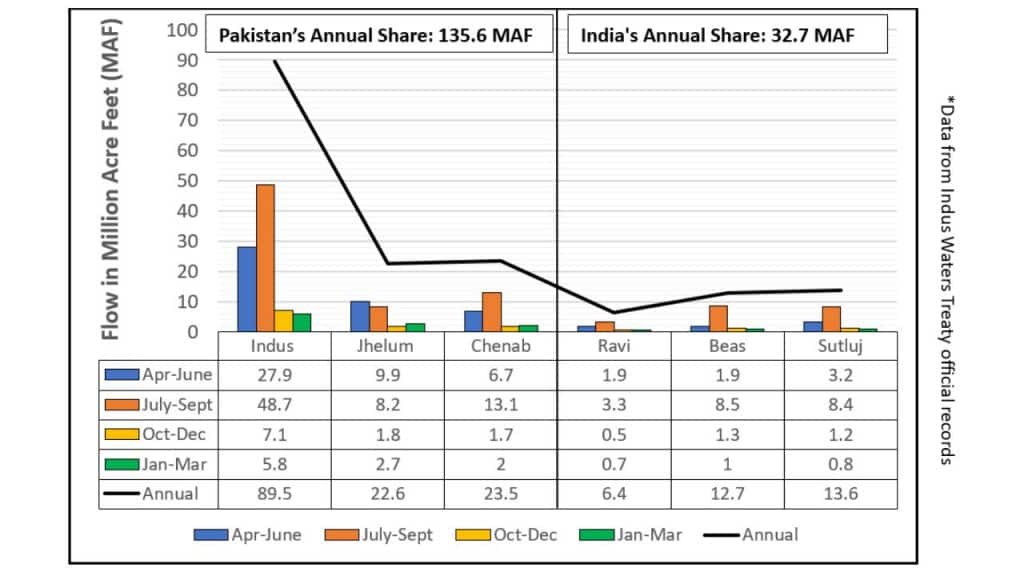
Not India. Not India under Prime Minister Pandit Jawaharlal Nehru from August 1947 to May 1964, when his journey on terra firma was completed. He divided the Indus River system, comprising six rivers, including the mighty Indus, with lower riparian Pakistan in an 80:20 ratio. In this grossly unequal and inequitable division, finalised under the Indus Waters Treaty (IWT) signed on September 19, 1960, Pakistan got 135.6 million acre feet (MAF) and India only 32.6 MAF.
Annual River Flows, 80:20 Division
Incidentally, the six rivers of the Indus system, with their annual flows given in brackets, are 1. Indus (89.5 MAF) 2. Jhelum (22.6 MAF) 3. Chenab (23.5 MAF) 4. Ravi (6.4 MAF) 5. Beas (12.7 MAF) and 6. Sutlej (13.6 MAF). The first three are called the Western Rivers and the last three are called the Eastern Rivers under the IWT. The figures of annual flows, calculated at over 168 MAF per annum, were based on hydrological data collected between 1920 and 1925, a century ago.
Globally, no similar example of misplaced and misdirected generosity is available anywhere, with upper riparian agreeing to a measly 20 per cent only. Not only this water harakiri, but before September 1960, it had never happened in the history of mankind that the upper riparian was also left paying the bills for the benefit of the lower riparian!
India paid for replacement canals and dams that Pakistan built: Mangla in Mirpur on Jhelum and Tarbela on Indus. This money was no joke either, as it would amount to approximately $4 billion, or over Rs 37,360 crore in today’s value (calculated at $1 = Rs 93.4 as in April 2026). India agreed to these steep terms reluctantly, hoping this generosity would be reciprocated and placate Pakistan.
Purchasing Peace With Pakistan: Nehru
On November 30, 1960, a couple of months after the treaty signing, Pandit Jawaharlal Nehru told the Indian Parliament during a debate that the MPs were fighting over a pail of water. He said: … by payment, you get something in exchange. … And we purchased peace, and it is good for both countries.
Nehru’s justification for giving way too much to Pakistan was buying peace! By his own admission in the temple of democracy, Parliament. Pandit Nehru had obviously hoped to placate Pakistan with this gesture. Some days after signing the treaty in Karachi, President Ayub Khan said, 'By accepting the procedure for joint inspection of the river courses, India has, by implication, conceded the principle of joint control extending to the upper regions of Chenab and Jhelum, and joint control comprehends joint possession.'
More than a decade after signing the treaty, India planned its first dam on the Chenab, a western river, for producing hydroelectricity. Incidentally, under the Treaty, India has unlimited rights on these rivers for doing so. However, Pakistan objected to its design elements, arguing sediment flushing would harm its interests. In April 1978, just when the project was coming up 48 years ago, Salal’s sluice gates meant for efficient management of sediments were plugged with concrete. Of course, on Pakistan’s insistence.
Enhanced Reservoir Capacity of Salal
This concretisation, resulting from the Atal Behari Vajpayee-Aga Shahi parleys, harmed the reservoir of the Salal power house. The total pondage at this dam reservoir, spanning around 22 km in the Reasi district, was initially calculated to be around 284 million cubic metres (MCM). By last year, that is, 2025, this had gone down substantially due to sediments settling in the reservoir, and it was calculated at 9.91 MCM only, a steep reduction of around 274 MCM.
Two very significant dates fall in the week we are in: April 22, the first anniversary of the Pahalgam terrorist attack last year. The next day, April 23, when India decided to stand up and respond strongly to Pakistan. One of the first things it did was to put the IWT 1960 in abeyance, something that seems to be there for keeps. With this single step, the IWT went into a coma.
Salal, hit hard due to Pakistan’s objections, has gained during the last one year. With the IWT on a pause, Salal has flushed out sediments more than once, something unimaginable at one time. It has also been dredging aggressively to clean up all the accumulated muck, thereby enhancing the reservoir's holding capacity. It is on path to recovery with reservoir capacity likely to be enhanced substantially, if not fully. Moving towards the status quo ante as it prevailed before April 1978 appears to be on the cards.
The stories of the Ratle, Sawalakote, Dul Hasti, Pakal Dul, Kirthai, Bursar and Miyar hydropower projects, too, after the IWT pause, are better today. Each story is worth being read separately, as the central government has committed thousands of crores of rupees to them.
Within a decade, by 2036, we are potentially looking at a scenario where the power production in Jammu & Kashmir is likely to touch 11,000 MW. At least three times more as compared to today. Instead of being a net importer of power, J&K may then start exporting over 6,000 MW to the Northern Grid. An era of economic transformation may have already dawned, but it may be some years before the fruits ripen.
(Sant Kumar Sharma is a senior journalist. The views expressed in this article are those of the author. They do not necessarily reflect Firstpost’s views.)

Could India have done more to prevent the Iran war?
The Russia-Ukraine war: Why peace remains so elusive
Head-on | Why President Trump is targeting India
When Manila and Tokyo draw a line, Beijing draws a red line
Bangladesh gets a new envoy to reset its India ties