


India’s energy sovereignty requires diversification and resilient planning
India’s path to resilient energy security lies in converting crisis‑driven improvisation into a coherent strategy: deep strategic and commercial stocks, diversified suppliers and routes, a fast‑greening and electrifying consumption base, and a geopolitically agile approach to sanctioned and sanctioning states alike

India’s energy security has been repeatedly stress‑tested by the Russia-Ukraine war and now the conflict in Iran, exposing how vulnerable an 88-89 per cent oil‑import‑dependent economy is to geopolitical shocks. A reimagined strategy must deliberately use these crises to hardwire resilience into India’s energy system through diversification, buffers, domestic capacity and smarter regulation.
India’s crude demand has surged even as domestic production stagnates, pushing oil import dependence from about 83-85 per cent in FY19-FY22 to 88.3 per cent in FY25 and 88.6 per cent in April-January FY26. Over the same period, crude imports rose to about 206 million tonnes in the first ten months of FY26, while domestic production slipped to 23.5 million tonnes, leaving self‑sufficiency in petroleum products at barely 11-12 per cent.
 More from Opinion
The Russia-Ukraine war fundamentally altered sourcing patterns. Russia’s share in India’s crude imports increased from under one per cent in 2018-19 to roughly 35-40 per cent by 2024-25 as India bought deeply discounted Urals, with Russian volumes jumping from about 4 million tonnes in 2021-22 to over 87 million tonnes in 2024–25. In May 2023, Russia supplied about 42 per cent of India’s crude, around 1.96 million barrels per day, making it India’s single largest supplier at discounts of 9-14 per cent versus Iraqi grades.
By contrast, Iran went from providing roughly 10 per cent of India’s oil needs before sanctions to essentially zero after 2019, when New Delhi stopped imports as US waivers ended. India‑Iran trade has since contracted by about 87 per cent, with oil imports collapsing by 99 per cent from their 2008 levels. Any large‑scale war involving Iran threatens the broader Gulf chokepoints through which a majority of India’s Middle Eastern oil flows, amplifying freight, insurance and price risks even if volumes remain available.
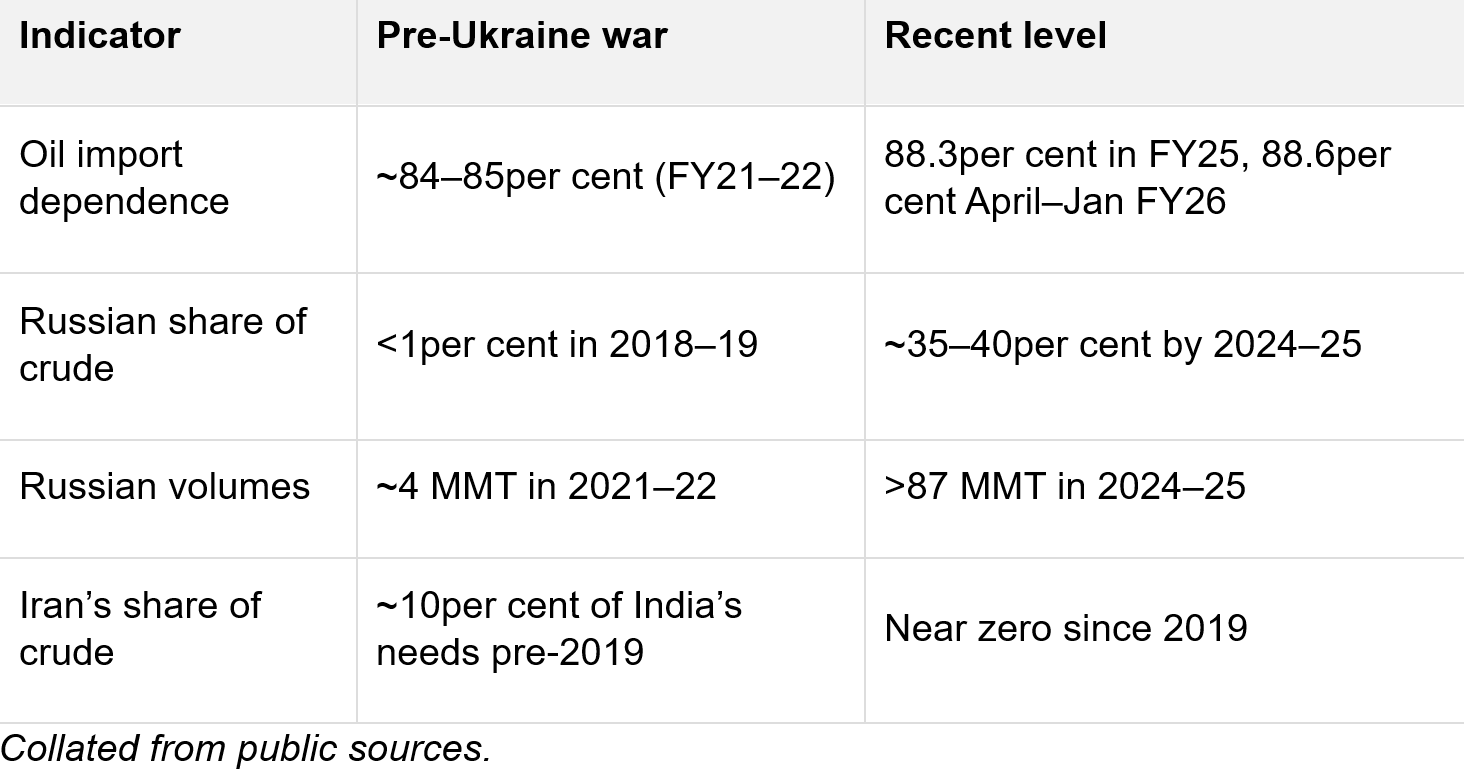
These shifts show India exploiting arbitrage but at the cost of concentration risk and exposure to secondary sanctions and maritime disruption.
First, India needs much deeper buffer capacity. Strategic petroleum reserves (SPRs) currently hold around 5.33 million tonnes at three sites—Visakhapatnam, Mangaluru and Padur—with plans approved to expand to 11.83 million tonnes through additional facilities at Chandikhol and an expanded Padur. Even after expansion, these reserves would cover only a few weeks of net imports at current consumption, which exceeds 200 million tonnes of petroleum products annually.
Policy should therefore set a statutory target (for example, 60-90 days of net crude and product imports) by combining SPRs with mandated commercial stocks. It could also fast‑track the Chandikhol and Padur projects under PPP and identify at least two additional cavern sites to move beyond 11.83 MMT and use financial hedging and diversified freight contracts to smooth price spikes and insure against closure of the Strait of Hormuz or Red Sea routes.
Second, risk management has to go beyond volumes to logistics. A war in Iran or escalation in the Gulf would primarily be a shipping and chokepoint crisis. India should incentivise greater use of west‑coast refineries for Atlantic, African and Latin American crude and create a dedicated long‑term charter of tankers under the Indian flag to reduce exposure to sanctions‑driven shipping disruptions.
The Russia pivot proved that India can rapidly reorient its sourcing, but resilience demands deliberate diversification. Russia’s share rising above 35 per cent by value and volume has compensated for reduced shares from Iraq, Saudi Arabia and the UAE without reducing their absolute quantities, because total imports grew from 196 MMT to 244 MMT between 2021-22 and 2024-25. The policy goal should be a ‘no‑supplier‑above‑25 per cent’ norm, enforced through purchase guidelines for PSUs, while maintaining flexibility to exploit temporary discounts.
Simultaneously, the energy mix must shift. India missed its 175 GW renewable target for 2022 but has rapidly expanded solar and wind and now aims for 500 GW of non‑fossil capacity by 2030, including hydro and nuclear. Recent reporting suggests India has crossed 50 per cent non‑fossil in installed power capacity, reducing the relative role of coal and gas in electricity generation.
Smart domestic policy can leverage this trajectory by front‑loading grid‑scale storage (batteries, pumped hydro) as a national infrastructure priority so that higher renewable penetration displaces imported gas and oil in power and industrial use, targeting electrification of freight corridors and urban buses, which are heavy consumers of diesel—linking rail electrification, EV incentives and renewable‑backed charging, and using time‑of‑day tariffs and demand‑response to maximise utilisation of variable solar and wind output.
Even with aggressive renewables, India will remain a major oil and gas importer for decades, but the degree of dependence is not predetermined. Domestic crude output has been flat to declining, with recent data showing a fall from 24 MMT to 23.5 MMT in the first ten months year‑on‑year, even as consumption rises.
To reverse this, policy should rationalise exploration and production contracts to reduce regulatory friction and litigation risk, making the promised $500 billion in energy sector opportunities—spanning exploration, refining and LNG—credible to investors, and prioritise gasification of industry and households via LNG imports and pipeline expansion, since gas‑based systems allow quicker substitution by hydrogen, biogas and synthetic fuels later.
Finally, resilience in a world of sanctions and wars requires attention to refining and fuel flexibility. Indian refiners like Jamnagar have already become major processors of Russian crude, with Russian imports into that complex alone rising 64 per cent in early 2025 compared to the previous year. Policy can push refiners to upgrade for maximum feedstock flexibility (being able to switch between Urals, Middle Eastern and Atlantic crudes) and to produce export‑quality fuels that can be swapped in regional markets during crises.
Energy security is also foreign policy by other means. India’s earlier dependence on Iran (about 10 per cent of oil needs) provided route diversification and access to the Persian Gulf’s eastern flank, which was sacrificed under US sanctions. The current war in Iran underscores the cost of having limited direct economic stakes in a key regional actor while remaining deeply exposed to Gulf shipping risks.
A reimagined approach would:
- Maintain discounted Russian supplies within the G7 price‑cap framework to reduce secondary‑sanctions risk, while gradually lowering Russia’s share toward a more balanced basket.
- Quietly rebuild limited, sanctions‑compliant economic engagement with Iran (for example, in petrochemicals, Chabahar‑linked logistics and, eventually, conditional oil offtake if diplomatic space opens).
- Invest in cross‑border power trade and gas/LNG cooperation with neighbours (Bangladesh, Sri Lanka, possibly Myanmar) to share reserves, smooth demand and anchor India as the regional energy ‘bank’.
In effect, India’s path to resilient energy security lies in converting crisis‑driven improvisation into a coherent strategy: deep strategic and commercial stocks, diversified suppliers and routes, a fast‑greening and electrifying consumption base, and a geopolitically agile approach to sanctioned and sanctioning states alike.
(Hindol Sengupta is a professor of international relations and director of the India Institute at the OP Jindal Global University. Views expressed in the above piece are personal and solely those of the author. They do not necessarily reflect Firstpost’s views.)

Could India have done more to prevent the Iran war?
The Russia-Ukraine war: Why peace remains so elusive
Head-on | Why President Trump is targeting India
When Manila and Tokyo draw a line, Beijing draws a red line
Bangladesh gets a new envoy to reset its India ties