


Great Nicobar project is no ‘ecological disaster’; it’s a strategic necessity for India
The project balances strategic and economic necessity with ecological and tribal safeguards, highlighting its importance for maritime security, trade efficiency, and regional geopolitical positioning

The editorial of an English daily, The Hindu, carried an article titled “The Making of an Ecological Disaster in the Nicobar”. The title is alarming. Nothing could be farther from the truth. There are factual errors in the article, and much of the information is dated.
To add to it, a political figure has recently cast shadows on the project by calling it an ecological disaster.
Let us first look at the geography. The Container Transhipment Terminal Project is being built in Galathea Bay (Great Nicobar), which is at the southernmost tip of India, Indira Point. The point itself is half submerged in the sea post-tsunami. So is the piece of land leading to the lighthouse at Indira Point. It may be recalled that the entire tectonic plate had tilted as a result of the earthquake which preceded the tsunami in 2004.
 More from Opinion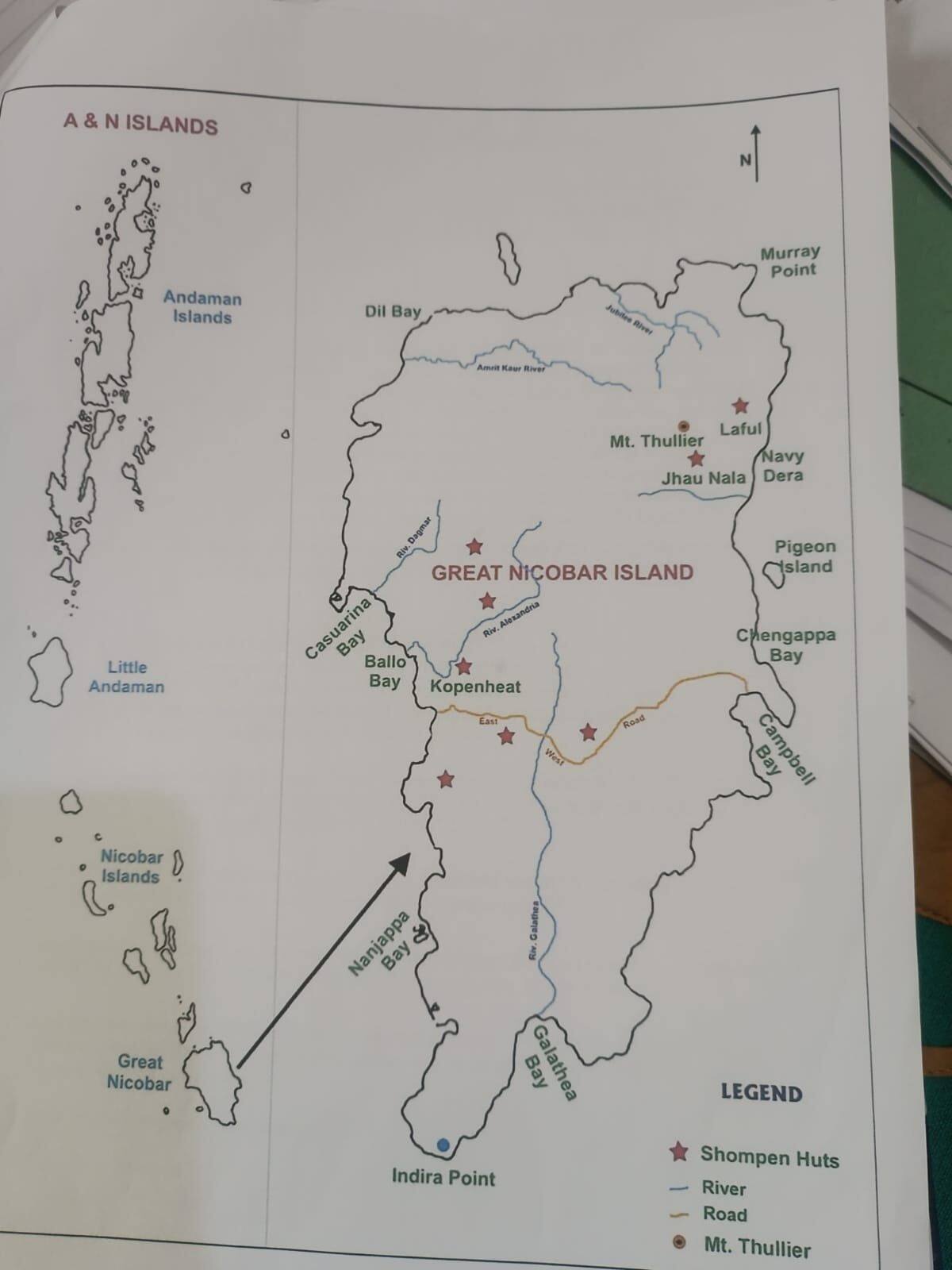
Significance of the Project
As is evident, this island sits at the mouth of the Malacca Strait, which connects the Indian Ocean to the Pacific (South China Sea). One of the busiest sea lanes, through which the world’s most energy is transported in the form of crude oil and gas. This being a narrow passage, ships have to slow down and thereby become vulnerable to piracy, theft, unauthorised boarding, etc. As regards our adversary, some 40 per cent of their oil and gas is transported through this strait.
The energy sources are transported from the Gulf, the Gulf of Aden, the African coast and South America. The sense of vulnerability by the adversary is such that one of their heads of state has called it the “Malacca Dilemma” for his country. In spite of their efforts to carry oil through pipelines laid from the discharge port to refineries in the said country, a significant quantity would have to be through the Malacca Strait.
Some studies have indicated that at least 53 per cent of energy will flow through these straits till approximately the year 2053. Given the geopolitical turmoil that the world is witnessing, great power competition is here to stay till a new world order emerges, and that could be in decades. When this contest will turn into conflict is anyone’s guess. Right now, shadow boxing is going on.
Given that we have long unsettled borders with our northern neighbour, our strategic advantage remains overseas, of which the Malacca Strait transit route becomes important. It is pertinent to mention that our adversary(ies) already have power presence in all the choke points which are used for transit in and out of the Indian Ocean. It is for this reason that the Navy keeps 24x7 surveillance over the entire Indian Ocean, particularly at choke points. Better preparation will deter any misadventure.
Second, significant revenue is being earned by foreign shipping companies by way of the transfer of containers from Singapore's transhipment port to Indian destinations. This revenue does not get into the Indian system despite containers and users being in India. It is estimated that nearly $230 million revenue is lost every year by way of transhipment costs to foreign companies in the absence of a container offloading terminal on the Indian side.
The International Container Transhipment Project (ICTP) also includes the development of inland infrastructure which will support the visiting ships for handling large volumes of cargo.
Therefore, we have strategic and economic reasons to be at Galathea Bay. India’s growth as a major power is being watched by the world. It is natural that obstructions would be created to slow this down with the fear of West/East losing their absolute supremacy. Some of their toolkits are playing out in our country and the neighbourhood.
Apprehension of Ecology and Tribals
As far as compliance with extant regulations is concerned, the Forest Rights Act (FRA) (2006) provided by the Ministry of Environment, Forest and Climate seems to have been complied with as per local inputs. Interest of Shompen Particularly Vulnerable Tribal Groups (PVTGs) and Jarawa PVTGs, represented through Andaman Adim Janjati Vikas Samiti, was an important part of the subdivisional and district-level committees, of which tribal officers are an integral part. To ensure fair representation, the chief of the tribal council for Little and Great Nicobar Island (for the Nicobari tribal community) and the tribal welfare officer for the Shompen tribes were in the sub-divisional-level committees.
A proposal for diversion of landfalls was put up in the appropriate committee to consider the holistic development of Great Nicobar Island. This also included the tribal welfare officer of Campbell Bay and the chairman of the council. Only after their consent the project would have moved forward. It is understood that no rights of Scheduled Tribes, Traditional Forest Dwellers, Primitive Tribal Groups and Pre-Agricultural Groups have been violated or infringed. This land fall will create much agricultural land for the local residents.
Shompen Displacement
This seems to emanate from lack of understanding of the geography of this island. The tribes live in the Mount Thullier, Laful, and Jhau Nala areas. The distance between their habitat and Galathea Bay is approx 30 kms in a zigzag fashion across mountains. The Thullier Mount being far away, there is no possibility of uprooting them when the project gets going. Also, Shompens are a shy tribe who do not wish any contact with other populations. Probably one or two tribal officers have contacted them.
As far as the Nicobaris are concerned, they are permanent residents and have moved between their original habitats in Car Nicobar, Nancowrie and the Little Andaman Islands. They have a tribal council and live quite dispersed in northern and western parts closer to a few rivulets. After the war with China in 1962, some claims were made for this island by Indonesia, probably instigated by China. The government then began a resettlement programme in which 69 ex-servicemen families were settled in April 1969. Subsequently, larger numbers were settled in various parts of this island. There had been illegal migration from erstwhile East Pakistan prior to the 1971 war. Their main occupation is agriculture.
There is a naval air station in Campbell Bay, INS Baaz. The extension work will ensure operation of aircraft of the C-130 Hercules, which can lift troops in a crisis situation. This airfield makes a significant contribution to surveillance over the entire area. Considering that it is not beyond imagination for this front to become a hotbed of illegal ingress with offensive intentions, better preparedness is prudent.
There is mention of 32 to 58 lakh trees that may be cut; this is far beyond any reasonable local estimate of 10-15 lakh. It should be noted that Galathea National Park covers nearly 166 square kilometres, which covers 7 revenue villages and falls under the jurisdiction of 3 Gram Panchayats.
Also, the port of Sabang in Indonesia is located just about 170 kms (90 nautical miles) away, which is jointly being developed by India and Indonesia under the strategic and economic partnership.
Conclusion
Any development project worldwide is a tightrope walk between benefits and environmental impact. The prevention and likely mitigation are driven by the laws of the land. They must be rigidly followed, which seems to have been followed by all accounts. In the case of ICTP, it is a tough one, walking between the strategic/economic benefits of the country and ecosystem/tribal protection. Here, Nicobaris are largely in the mainstream. It is important to note that the total population of Shompen has been reducing over a period. This is attributed to reducing the number of females and within-tribe marriages. In Great Nicobar Island, the known number of the Shompen tribe was 229, and that of the Nicobaris (Little Nicobar and Great Nicobar) was 892. As far as families go, there are 58 Shompen and 235 Nicobaris families.
Preservation of the tribes has been a top priority of the Andaman and Nicobar administration by all accounts. With all canons being followed, we need to move ahead and mitigate ill impacts along the way. Any red herring is uncalled for.
(The writer is ex-Chief of Integrated Defence Staff and Commander-in-Chief of the Western Naval Command. The views expressed in the above piece are personal and solely those of the author. They do not necessarily reflect Firstpost’s views.)

Could India have done more to prevent the Iran war?
The Russia-Ukraine war: Why peace remains so elusive
Head-on | Why President Trump is targeting India
When Manila and Tokyo draw a line, Beijing draws a red line
Bangladesh gets a new envoy to reset its India ties