


Energy shock may outlive Iran war
The structural scars — rerouted supply chains, elevated insurance costs, disrupted LNG investment, and sovereign debt distress — will persist for years, even if the war ends soon

Oil prices have surged more than 55 per cent since the start of the Iran war, with Brent crude jumping from around $72/bbl on February 27 to nearly $120 at its peak. March marked one of the largest monthly oil price jumps on record. On April 25, at $105.88/bbl, it remains uncomfortably elevated — and the damage is not uniform.
The Calm Before the Storm
There is a bitter irony in the timing. In the six months preceding US-Israel strikes on Iran on February 28, 2026, global energy markets had settled into a deceptive calm. Brent crude traded in a narrow band of $66-$74 per barrel — below the $80 threshold that most economists identify as the beginning of fiscal stress for oil-importing nations. Asian LNG spot prices (JKM) hovered between $10 and $13 per MMBtu; European TTF gas ranged from $9.80 to $12/MMBtu; and the United States, emboldened by its shale surplus, was exporting record LNG volumes.
 More from Opinion
Markets were not entirely sanguine. JP Morgan, in a February 27 note, observed that Brent was trading “around $10/bbl above fair value” on war anticipation. Goldman Sachs had forecast Brent at $76 for 2025, falling to $71 in 2026. The IMF, in January, projected oil at approximately $62/bbl for the year.
None of these institutions anticipated that shortly thereafter, the world would be staring at $120 oil.
The War's Impact on Crude and Gas Prices
On February 28, 2026, US and Israeli aircraft struck Iranian nuclear and military sites. By morning, the Strait of Hormuz — the world’s most critical energy chokepoint, carrying roughly 20 per cent of global oil and 15 per cent of LNG — was functionally closed. Sooner, Qatar’s Ras Laffan LNG terminal, the world’s largest, responsible for 5.8 million tonnes of monthly supply, was forced to halt production. The damage that the war caused was the following:
Oil Shock: Brent crude jumped from $72/bbl to $120/bbl — a 55 per cent+ surge in under three weeks. The IEA confirmed global crude oil inventories fell by 85 million barrels in March alone. Peak supply losses exceeded 12 million barrels per day — 11.5 per cent of global demand. Shipments through Hormuz, which normally carry 20 per cent of global consumption, were reduced to 3.8 million bpd. The IEA explicitly stated this 2026 shock was the worst disruption in history — significantly larger than the 4.5 million bpd disruption during the 1973-74 embargo and the 5.6 million bpd loss during the 1978-79 Iranian Revolution.
Gas Catastrophe: For gas, the consequences were worse. The Qatar shutdown removed 14 per cent of global LNG supply at a stroke. Asian JKM spot prices surged from $13/MMBtu to $22/MMBtu+ in March, with intraday spikes above $25/MMBtu. European TTF hit $17.90/MMBtu. US LNG producers buying gas at $3/MMBtu domestically were selling into Asia and Europe at $20/MMBtu — a spread generating windfall profits for US exporters while devastating buyers in South Asia and Africa. On April 25, Brent crude remained uncomfortably high at $105.88/bbl, with JKM easing to $16.39/MMBtu on April 23 — still elevated and far above pre-war norms.
The crisis was best articulated by Pierre-Olivier Gourinchas, IMF Economic Counsellor, on April 14, 2026, while releasing the IMF World Economic Outlook report, Global Economy in the Shadow of War. He said: “What is happening in the Gulf is potentially much, much larger than the tariff shock…”
Rockets and Feathers
Few phenomena in economics are as frustrating as the asymmetric speed at which energy prices move. The phenomenon has a canonical name — coined by economist RW Bacon in 1991 — “Rockets and Feathers".
Energy prices shoot up like a rocket. They drift down like a feather.
The Federal Reserve Bank of St Louis has documented this pattern repeatedly across decades of gasoline data. UC Berkeley’s Severin Borenstein (with Cameron and Gilbert, QJE 1997) established that retail prices exhibit “markedly different responses to wholesale cost increases versus decreases". A 2025 ScienceDirect study confirmed that gasoline prices adjust quickly to rising crude oil prices but far more slowly when prices decline.
Five structural forces entrench the asymmetry:
• Inventory replacement cost logic: Refiners price output at the replacement cost of the next barrel — not existing inventory. Prices rise before the physical shock hits; when prices fall, expensive inventory is drawn down slowly.
• OPEC’s managed floor: Commodity Context’s founder Rory Johnston (CNBC, April 20) noted that even a Hormuz reopening would only trigger a temporary $10-$20 drop, with Brent anchored in the $80=$90 range by infrastructure damage and OPEC’s fiscal breakeven of ~$75-$80/bbl.
• Supply chain inertia: Qatar’s Ras Laffan terminal is unlikely to return to full operations before August 2026. Rerouted shipping adds permanent cost layers.
• Financial market positioning: War risk premiums unwind slowly. Institutional investors maintain elevated commodity allocations as an inflation hedge.
• Corporate pricing power: Downstream price increases are transmitted immediately, while decreases arrive with lags of weeks to months as companies protect margins.
What If the War Ends Tomorrow
The historical record is instructive and sobering. After the First Gulf War (1991), prices fell 30 per cent within three months — but only because Saudi Arabia had compensated by raising output. The 2022 Ukraine shock is the more instructive analogue: Brent exceeded $120 in March and June 2022 but never returned to pre-war levels. It traded around $80-$85 through 2023 (EIA annual average: 2024 — $80.56/bbl; 2025 — $74.22/bbl) against a pre-war 2021 average of $70. European gas prices (TTF) did not fully normalise by late 2025 — the price floor remains permanently higher.
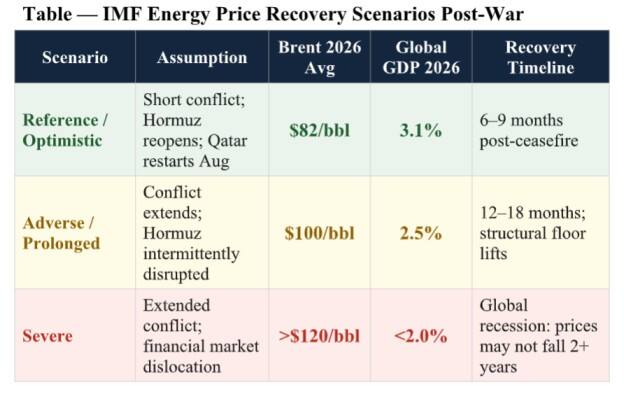
For the current crisis, the IMF’s April 2026 World Economic Outlook models three scenarios, with even the optimistic case leaving oil $10 above pre-war levels through end-2026.
Who Pays the Bill
Persistent high energy prices are, at their core, a regressive tax. They fall most heavily on those least positioned to pay. The IMF’s April 2026 WEO stated categorically: “Conflict impacts will be highly uneven, particularly affecting countries in the conflict region, commodity-importing low-income nations, and emerging market economies through energy, food, and financial shocks.”
The sectors under siege are:
Airlines and Aviation: Jet fuel accounts for 25-35 per cent of airline operating costs. At $100+ Brent, it can exceed 40 per cent of revenues. Lufthansa Group has cut over 20,000 short-haul European flights through October. At least thirty airlines have suspended or eliminated Gulf destinations. The conflict has triggered a severe aviation crisis — surging fares (up to 25 per cent on some European routes), route cancellations, airspace restrictions, and a reported six-week fuel supply crunch in Europe.
Fertilisers, Agriculture and Petrochemicals: Natural gas is both the primary feedstock for nitrogen fertilisers and a major ammonia input. At $20/MMBtu JKM, fertiliser production in South Asia becomes economically unviable without a subsidy — India’s 2026-27 fertiliser subsidy bill has been substantially enhanced to manage the crisis. The cascade — higher fertiliser costs → higher food prices → food insecurity — hits the poorest hardest. In petrochemicals, Asian producers have curtailed operating rates by approximately 6 mb/d (IEA, April 2026).
Gas-Based Power Generation: India’s gas-fired power plants were already running at suboptimal plant load factors before the crisis (IEEFA, October 2024). At $20/MMBtu JKM, gas power is economically catastrophic. Pakistan faces 8-16 hours of daily load-shedding; Bangladesh’s garment sector — employing over four million workers — faces industrial energy cuts that threaten the country’s export engine.
The Collateral Damage: Many countries will suffer collateral damage. A representative list is as follows:
- Pakistan sources 99 per cent of its LNG from Qatar — the Ras Laffan shutdown directly threatens its energy supply.
- Sri Lanka, still recovering from its 2022 sovereign default, has minimal buffers.
- Egypt faces a $69 billion external financing requirement for 2026-27 that becomes structurally harder with each dollar increase in Brent — the IMF has already cut Egypt’s growth forecast by 0.5 percentage points.
- For Sub-Saharan Africa’s oil importers — Ghana, Kenya, Tanzania, Ethiopia, Uganda — a sustained $30/bbl rise in crude adds 2-3 per cent of GDP to import bills, weakens currencies, and accelerates imported inflation.
As The Washington Post observed, central banks are caught in “the most painful macroeconomic dilemma since the Volcker shock (1979-1982)".
The Permanent Cost of Conflict
The Iran war has exposed the fragility of a global economy built on concentrated energy choke points. The Strait of Hormuz — a ribbon of water twenty-one nautical miles wide at its narrowest — carries the energy lifeblood of a third of the world’s population. We always knew this. We never truly prepared for it.
An April 9 article in Foreign Policy by Rabah Arezki (Harvard Kennedy School), argues the crisis is accelerating a fundamental restructuring of global LNG trade flows — away from the Middle East toward US and Australian supply — that will reshape energy geopolitics for a generation. Foreign Affairs (April, Jason Bordoff) notes this marks the definitive end of the 2015-2024 era of abundant supply that allowed the world to defer its hardest energy decisions.
Bangladesh, Pakistan, Sri Lanka, and Ghana did not start the war. They have no strategic reserves, no domestic surplus, no fiscal buffers. Yet they bear a disproportionate share of the pain. The war will end. Prices will come down — but like feathers, not rockets, tortuously slowly. The structural scars — rerouted supply chains, elevated insurance costs, disrupted LNG investment, sovereign debt distress across more than two dozen developing economies — will persist for years.
The next chokepoint crisis is not a question of if, but when we will finally choose to build the energy resilience that prevents a twenty-one-nautical-mile strait from holding the global economy hostage. As the IMF economic counsellor noted, "The global economy is in the shadow of war. It is not knocked out, but it is not sprinting either. It is limping, and the most vulnerable are carrying the heaviest load.” Make no mistake: the world is headed toward an unmitigated disaster.
Implication for India
India’s exposure to the current energy crisis is structural, acute, and politically sensitive. As the world’s third-largest oil importer — meeting approximately 85% of its crude needs from abroad — and with LNG import dependency deeply embedded in fertiliser, power, and city gas distribution, India sits at the intersection of every risk vector described in this article.
The Immediate Fiscal Blow
The collateral damage of even a $10/bbl rise in Brent crude is severe for India. Three key impacts are discussed here:
- GDP growth slows by approximately 0.3 per cent to 0.5 per cent.
- The current account deficit (CAD) widens by roughly 0.4 percentage points of GDP.
- The import bill increases by approximately $13-18 billion annually.
- Inflation can rise by 0.3 to 0.5 percentage points (30-50 bps), with the potential to reach 60 bps, according to some estimates.
With Brent at $105.88/bbl — $35 above the 2025 annual average of $74.22/bbl — the incremental import bill for FY2026-27 is estimated at ₹3.5-4.0 lakh crore. Consensus estimates suggest India’s current account deficit could widen to 2.0-2.5 per cent of GDP, and the rupee is under sustained downward pressure (₹1 = 94.29 per USD on April 24).
Fertiliser
India’s fertiliser subsidy architecture is directly linked to natural gas prices. At $20/MMBtu JKM, the fertiliser subsidy bill is on course to breach ₹2 lakh crore. This is a fiscally regressive shock: the subsidy must be paid to protect kharif and rabi crop cycles; failure would mean higher food prices that disproportionately burden the rural poor and urban wage earners.
The Geopolitical Tightrope
India faces an uncomfortable geopolitical arithmetic. It sources 50-55 per cent of its crude imports from the Gulf and LNG from Qatar — the very theatre of the conflict. Its strategic partnership with the United States must be balanced against long-standing economic and diplomatic ties with Iran. The war forces India into difficult choices — each with significant trade-offs.
The Strategic Imperative
India’s response cannot be confined to short-term crisis management. The war strengthens the long-term strategic case: accelerate renewables, build strategic petroleum reserves toward the IEA benchmark of 90 days, diversify LNG supply away from Qatar, and invest in domestic gas production. The National Infrastructure Pipeline and PM Gati Shakti must treat energy security as a foundational layer, not an afterthought.
India did not start this war. But it will pay for it — in higher import bills, a weaker currency, costlier fertilisers, stranded gas assets, and compressed fiscal space — not only for months but potentially for years. The question is whether this crisis finally catalyses the structural energy self-reliance that India has long promised and too often deferred.
(The author is a multi-disciplinary thought leader with Action Bias and an India-based impact consultant. He is President of Advisory Services at BARSYL. Views expressed are personal and do not necessarily reflect Firstpost’s position.)

Could India have done more to prevent the Iran war?
The Russia-Ukraine war: Why peace remains so elusive
Head-on | Why President Trump is targeting India
When Manila and Tokyo draw a line, Beijing draws a red line
Bangladesh gets a new envoy to reset its India ties